Scene
Students, administrators discuss the creation and execution of campus-wide ‘cubbies’
As many have said before, this semester is certainly shaping up to be one unlike any other. Campus spaces are no exception to this, as libraries and other study spaces are closed for the time being. But Washington University members were hard at work to replace these spaces while adhering to appropriate public health guidelines, developing and implementing over 1,000 “cubbies” for student use.
The cubbies, which are individual desks with felt dividers for privacy and noise control, were initially announced as “Zoom-study-dine pods” in the late July fall plan from the University. Will Carter, a sophomore who has frequented the cubbies in the past few weeks, confessed, “They aren’t quite what I envisioned when they called them ‘pods.’” He is not alone in this sentiment, and James Kolker, University architect and associate vice chancellor of facilities planning, explained the name change.
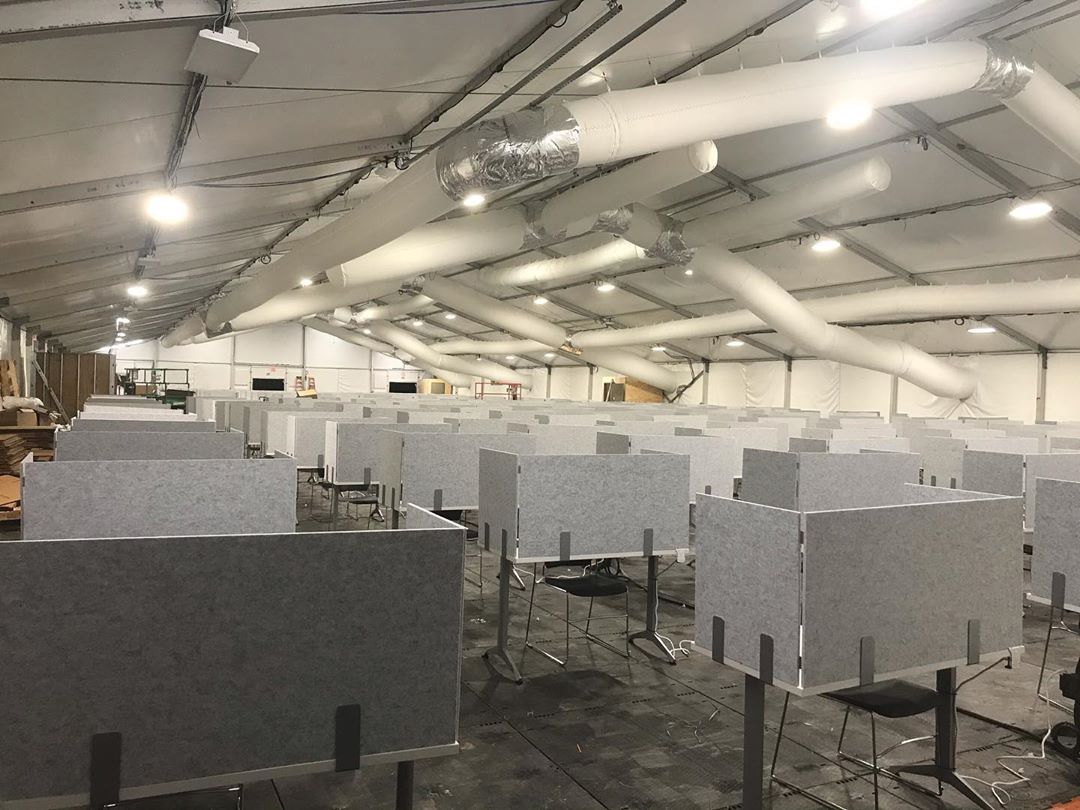 Photo courtesy of Barstool WashU
 “I would say ‘Zoom-study-dine pods’ was a working title that described what they were…and that was what was published in the plans,” Kolker said. “Then, there was this parallel talk nationally about ‘pods,’ you know, pods of people living together and pods of communities, so there was some confusion with what a ‘pod’ was, and the imagery that ‘pods’ conjures up was not exactly what they are. In the town halls that were in August, Beverly Wendland, the provost, would call them ‘zoom-study pods’ and then say ‘I think they should be called cubbies!’ She said it in every town hall, and all of the sudden they became cubbies.”
Despite the disconnect between the expectations from the initial announcement and the reality of the spaces, most students have found the cubbies to be effective study spots, albeit a little too quiet to participate in a Zoom class. “I like that they are kind of private so I don’t have to walk all the way back to my place for online class,” said sophomore Jenna Rogge, “but they are also dead silent and it’s super awkward if you have to ask a question or participate in class.”
Cubbies can be reserved on the University’s “Reserve-A-Space” website for a few hours at a time. Some students, such as Carter, have found this to be a bit redundant, stating, “I thought they were a comfortable place to get your work done, but I don’t really see why there’s a need to make a reservation, because when I went there were probably at least 10 empty seats surrounding me.”
This system has several specific purposes, according to Brian Newman, the project manager for this endeavor. In reference to the online reservation system, he said, “It was debated for some time, and in the end, there were really two deciding factors. One was we liked the idea of avoiding any space use conflict. We like the idea that someone could reserve the cubby and know it’s there and not have someone sitting in the spot where they’re planning on spending a couple of hours. The other thing that was appealing to us was the potential to aid in any contact tracing that may be needed.”
These spaces are located throughout campus in former classrooms, large gathering spaces like Holmes Lounge and Graham Chapel and in the newly constructed outdoor tents. According to Kolker, “We were specifically looking at things other than classrooms and housing and dining, everything else that’s part of the holistic student experience…What are the pieces that make up the complete student experience on campus, beyond going to school, studying, eating and sleeping? So, in those conversations it became evident that it was really important to provide other spaces…and it also became apparent that it was very likely the libraries wouldn’t be open for student use. I believe if you look at all the libraries on campus, there are almost 2,000 seats, and basically, that’s a big part of the student experience. Where are students going to fit and do things?”
Students have still mourned the loss of the spaces they used to frequent. “The first time, it was in the DUC fun room, which was weird to see filled with study cubbies,” said Abby Matt, a junior. She did say it was a good place to study, stating, “the quality wasn’t ‘Olin level-focus,’ but it was okay. I miss Olin.”
Planning for how to handle campus study spaces in the future is still in preliminary stages. “I think those conversations are starting,” Kolker said, “but it’s all in response to the changing public health situation, so we don’t want to get ahead of ourselves, but I think we have the flexibility to use them as they are, fill them all up if we need to, reduce the density if we need to, maybe use them in different ways in the spring if we see the cubby use is not peaking…We’re doing the best we can to be as flexible as we can, and we’re fortunate to have so many spaces on campus.”
Students have still been grateful for these efforts and are mostly happy to use these spaces for the time being. As senior Zoe Holtzman noted, “I don’t know how much better they could do. They’re trying, and I appreciate that.”
Stay in Touch!
Get the latest and top news from StudentLife delivered to your inbox