News
‘Should Everyone Be Religious?’: NYT columnist discusses the existence of God and significance of religion
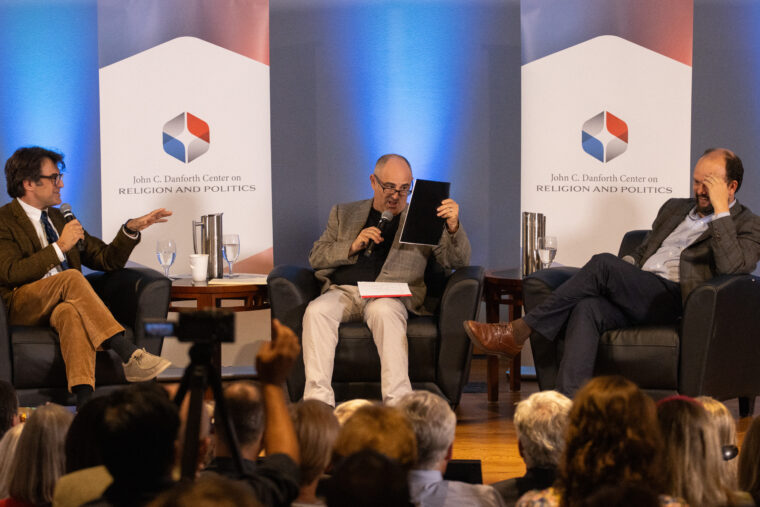
Philip Zuckerman discusses the significance of God and religion. (Hannah Dorval | Contributing Photographer)
The John C. Danforth Center on Religion and Politics hosted a discussion between New York Times opinion columnist Ross Douthat and Philip Zuckerman, atheist author and professor of sociology and secular studies at Pitzer College, to discuss whether or not God exists, Oct. 16.
Douthat published his book “Believe: Why Everyone Should Be Religious,” earlier this year, which was the focus of the discussion. Zuckerman, who was the respondent to Douthat, founded Pitzer College’s secular studies department, telling Student Life in an interview that academia as a whole has devoted an unequal amount of effort towards religion. They debated the existence of God and the role of religion in daily life.
First-year Noah Hunt attended the event and wished that Douthat and Zuckerman had delved into different arguments concerning God’s existence, beyond the benevolence or lack thereof of such a figure.
“To be quite honest, I thought they both, to some extent, focused on the wrong things,” Hunt said. “I don’t know that the problem of evil, which was focused on, in my opinion, disproportionately in the debate, is [as] damning to the idea of religion as [it] was put forth during the debate.”
One major point the speakers discussed was the idea of miracles and spiritual healing. Zuckerman responded to a story of miracle neck healing that Douthat shared, saying miracles don’t serve as evidence that God is real because of the prevalence of things like infant mortality.
“So God cured Wanda’s neck and that’s evidence of God, then what are 15,000 dead babies evidence of?” he said.
Douthat disagreed, saying that God might not be benevolent, and that Zuckerman’s point demonstrates the idea of a non-benevolent God, also saying he misunderstood the point of miracles in the first place. Douthat said that the Hunger Games are an example of a designed game by a non-benevolent figure.
“If you woke up tomorrow and found yourself inside the Hunger Games, you would say, somebody created this game, and it’s bad, right? But you would believe that someone created the Hunger Games. You wouldn’t say, oh, no one could have possibly created this. Everyone’s trying to kill me!”
First-year Chris Serrao appreciated how Douthat argued on behalf of religion as a whole rather than a specific denomination.
“I like that [Douthat] framed [his arguments] from religious pluralism, generally not from Christianity or Catholicism,” Serrao said. “I’m Catholic myself. I think it’s good to have those differentiations.”
Douthat attributed this focus on pluralism to his experience working for the New York Times as a conservative Catholic.
Douthat described his experiences writing as a “champion of religious truth” for a secular society and readership.
“You quickly realize that actually you’re speaking for religion in a period where religion is in swift cultural retreat,” he said.
Douthat said that while committing to the theological premises of dominant religions is more rare in the current day, he still sees it as a valuable addition to society.
Zuckerman agreed with Douthat that religion can be useful.
“There’s a lot of advantages to being part of a religious community,” Zuckerman said in an interview with Student Life. “It’s about identity, it’s about heritage, it’s about culture, it’s about morals, and I think secular students are often adrift when it comes to that.”
Director of the Center on Religion and Politics Abram Van Engen was happy with the way the discussion went. He felt that students and other attendees were drawn to both speakers and their beliefs.
“We should have more great, lively debates on campus…It had the feel of these Oxford Union style debates, where the two people speaking clearly had a lot of respect for each other and very much disagreed with one another,” Van Engen said. “That is modeling the kind of debate and disagreement I’d love to see more of.”
Stay in Touch!
Get the latest and top news from StudentLife delivered to your inbox