News
‘A Conversation with Ta-Nehisi Coates’ discusses modern-day global oppression
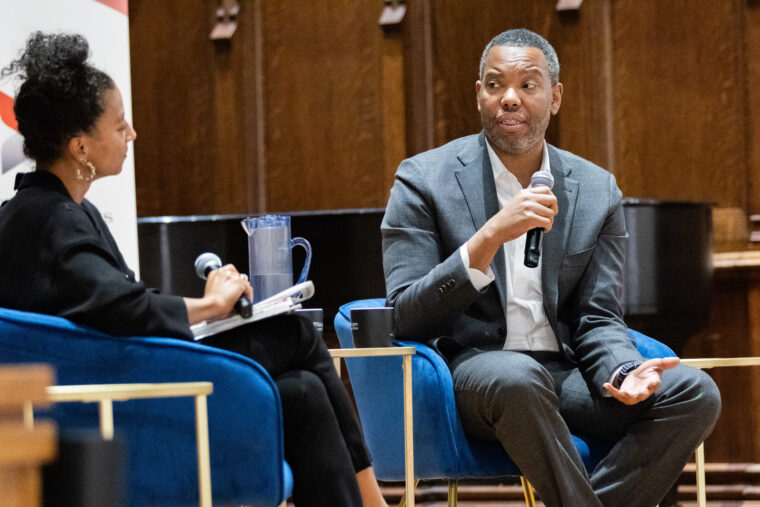
Coates talks with Hinton at Wednesday’s event. (Millie Wolff | Contributing Photographer)
Renowned journalist and author Ta-Nehisi Coates spoke on holding society accountable for continuing the fight against oppressive systems worldwide. The sold-out event was hosted by the John C. Danforth Center on Religion and Politics on Wednesday, Oct. 22, in Graham Chapel.
Coates and Yale Professor of history, Black Studies, and law, Elizabeth Hinton, discussed a wide range of topics from the occupation of the Palestinian territories to the works of James Baldwin. Coates commented on many facets of today’s political and cultural landscape, also laying out his new book “The Message,” a work on perception, facing reality and oppression globally.
Coates began the discussion by recalling his previous visit to WashU in 2014, during which he spoke with organizers of the Ferguson protests. The protests were sparked by the shooting of 18-year-old Michael Brown by police officer Darren Wilson in Ferguson, a suburb of St. Louis, that year.
Coates said that as a journalist, his role is to carry on the fight for justice and for future generations.
“We choose to fight with our words; we choose to fight with our books. I want you to understand that we are fighting,” Coates said.
Coates returned to themes of bravery in belief and confronting the past to look toward the future. There were frequent shouts and claps from the audience throughout Coates’ impassioned monologues.
He expressed frustrations with people’s aversion to resisting oppressive systems.
“There are people who don’t really know anything about resisting anything themselves,” Coates said.
Hinton, who has spoken with Coates in similar settings before, writes about race relations in the United States. She also conducts research on political violence and brutality.
She asked Coates questions about all three locations featured in “The Message” (South Carolina, the Palestinian territories, and Senegal). Coates described in depth his experiences visiting the Senegalese island of Gorée, where enslaved Africans were forced onto transatlantic slave ships from the 15th to 19th centuries. Coates also spoke about his visit to the West Bank and Israel in May 2023.
Hinton said she was struck by the way Coates talked about cycles of violence in Jewish history in the last century.
“He was talking about … grappling with violence and grappling with what it means when people who have suffered a horrible genocide are now … perpetuating violence, causing a genocide,” Hinton said in an interview with Student Life after the talk.
During the conversation, both Hinton and Coates discussed being motivated by anger in their writings.
“We can turn anger into something that can help us solve the source of the problem,” Hinton said.
WashU Assistant Professor of African & African American Studies, Themba Mbatha, said that the talk reminded him of how powerful Coates’ global perspective is because of the context it gives to his usual U.S.-focused discussion of race.
“What I was reminded of is just how globalist he is and how he thinks about these questions, which [is] very easy to forget, because he’s always placed within an American-centric conversation,” Mbatha said. “He draws from different traditions [and] different histories to form his political voice.”
Former Congressperson for Missouri’s First Congressional District, Cori Bush, attended the conversation and said that she is inspired by Coates’ career and mission. She spoke specifically about feeling supported by his work while receiving backlash after her proposed ceasefire deal for Gaza in October 2023.
“[Hearing Coates is] just something to help feed my own soul,” Bush said. “Because I deal with so many attacks and all the criticism, and so being able to hear someone else as they’re walking through their journey too, and how they’re processing it and how they stand strong, is helpful.”
Coates said that his involvement in conversations around the Palestinian territories stemmed from what he sees as historical connections and similarities between Black America, Palestinian communities, and Jewish communities.
“I’ve been in Palestine, and these people live in constant violence,” Coates said. “I don’t mean that metaphorically.”
Coates went on to explain that he felt that his own experiences with oppression in the United States mirrored those of the Palestinians he spoke with during his travels.
“America has a megaphone … because of what Black people are in this country, which is the bottom of the socioeconomic [pyramid],” Coates said.
Bush echoed this sentiment of wanting to speak out against oppression across a wide variety of causes and contexts.
“For me to [propose a ceasefire deal] as a Black woman — I’m not Palestinian, and people were like, ‘You Black,’ ‘Why do you care?’ ‘Why are you sticking your neck out?’” Bush said. “It was like, ‘Because I understand oppression, and I understand suffering under discrimination and segregation, and so why wouldn’t I?’”
Coates also discussed the importance of communities that have faced oppression standing up for groups outside their own based upon their own experiences of oppression.
“We feel like … somehow our oppression has made us more moral. It has not. It has damaged us. But there’s wisdom we can draw from that damage,” Coates said.

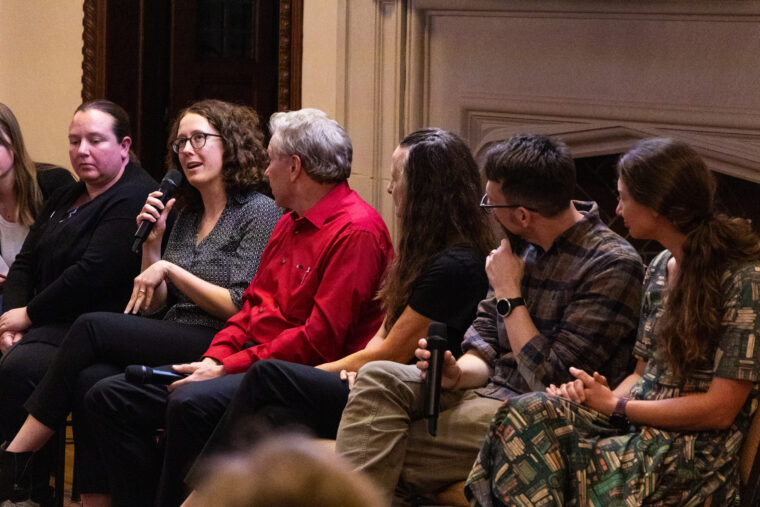
Attendees watch Coates’ talk keenly. (Millie Wolff | Contributing Photographer)
A few attendees shared with Student Life their reasons for attending.
“I needed to feel some hope,” Aviva Page, a St. Louis local, said. “He was very courageous in standing up for what’s right when people are scared to stand up for what’s right and factual.”
WashU Brown School alumna, Jane Lee, said she appreciated Coates’ perspective on generational trauma and suffering.
“What resonated with me was his part about [how] suffering and oppression doesn’t make a population or person more moral [or] better in any way,” Lee said.
Bush said she felt a sense of connection to the other audience members.
“Those who show up to hear from him … it’s the team,” Bush said. “It’s our team. It’s people [who] believe or have the same values that I do.”
Stay in Touch!
Get the latest and top news from StudentLife delivered to your inbox