News
Danforth Center hosts Elizabeth Hinton to speak on mass incarceration and Black rebellion

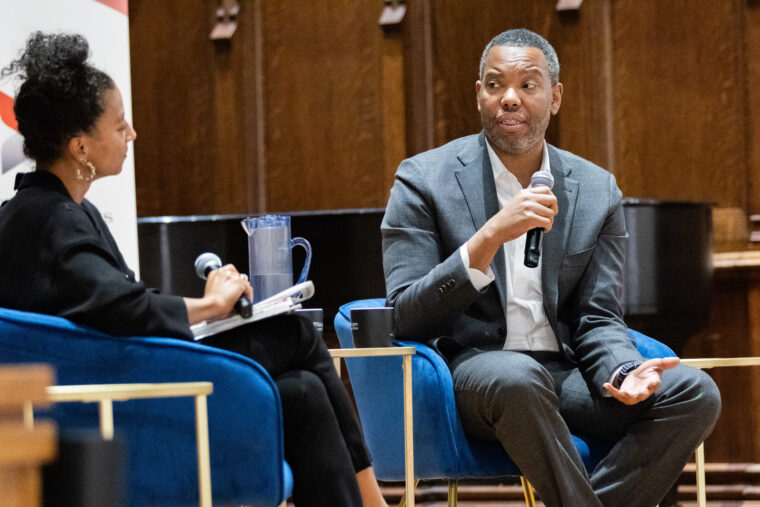
Hinton and Flowe discuss her work on policing and mass incarceration in an event hosted by the Danforth Center on Religion and Politics. (Photo Courtesy of the Danforth Center)
The John C. Danforth Center on Religion and Politics hosted Elizabeth Hinton, Professor of History, Black Studies, and Law at Yale University, to discuss mass incarceration and Black rebellion. The event, held on Oct. 22, featured a short talk by Hinton followed by a conversation moderated by Douglas Flowe, Associate Professor of History at WashU.
Tazeen Ali, an Assistant Professor of Religion and Politics at the Danforth Center, organized the event, which preceded a conversation between Elizabeth Hinton and Ta-Nehisi Coates later that evening.
“[Hinton] is a leading voice in the study of mass incarceration and state violence, and her work has shaped both scholarly and public understandings of these issues,” Ali said.
Hinton opened her remarks by framing her childhood experiences as the entryway to her current work on mass criminalization and incarceration following the War on Drugs.
“I was born in the mid-80s at the height of the War on Drugs … the kind of rhetoric and discourse of the day around locking people up, around gang violence, the fear mongering in the media very, very much shaped my childhood,” she said.
Hinton explained that the media narrative ran contrary to her own experiences, sparking questions about mass criminalization and incarceration.
“The politics of the War on Drugs were playing out in my family. I had family members who were addicted to drugs, family members that were in and out of prisons … I always felt this sense that there was this disconnect between the rhetoric and the context through which my family members were susceptible to drug addiction or incarceration,” she said.
Hinton’s first book, “From the War on Poverty to the War on Crime: The Making of Mass Incarceration in America,” traces mass incarceration to the Reagan administration’s War on Drugs and the Johnson administration’s War on Poverty. Hinton cited legislation such as the Violent Crime Control and Law Enforcement Act of 1994, which made multibillion-dollar investments into policing and prisons. Passed with bipartisan support, she characterizes such legislation as “preemptive” and based upon assumptions made by federal policy makers rather than responses to legitimate crime.
Hinton explained, “[policymakers] targeted the group that they determined was responsible for the nation’s crime … young Black men between the ages of 15 and 25.”
Hinton described crime control policies as a “self-fulfilling process” wherein preemptive policing targeting Black men motivates Black rebellion that is met with further policing.
Flowe and Hinton further described ongoing arrests, detention, and deportations by Immigration and Customs Enforcement (ICE) under the Trump administration as demonstrative of preemptive policing.
“Now, if you’re a migrant, you’re a potential criminal, even though we know that crime rates are very low among migrants. It’s the myth-making that continues,” Hinton said.
Hinton published her second book, “America on Fire: The Untold History of Police Violence and Black Rebellion Since the 1960s,” in 2021. Countering the media’s portrayal of confrontation between Black residents and police as senseless “riot,” Hinton draws on archival material of over 2000 uprisings to recharacterize the events as politically charged “Black rebellion” responding to institutional violence.
“We need to discontinue the practice of seeing these incidents of collective violence of riots as they’ve been called, in part because that language labels them criminal … then the only response is more police and more incarceration, which is, of course, the very thing that the people who participated in these events were rebelling against,” she said.
Hinton frames Black rebellions as “logical extension[s] of the freedom struggle” that are often met with police violence. She noted that 96% of the protests during the summer of 2020 were entirely nonviolent, yet police often responded with force, including tear gas and arrests.
“Protest for racial justice, whether it’s violent or nonviolent, has always been labelled a criminal act … if you appear to be challenging the white supremacist status quo, that is a criminal act,” Hinton said.
Hinton also spoke about American law enforcement’s role in training “colonial governments” in tactics of suppression, citing the use of tear gas against protestors as a tool that originated in Selma and is now witnessed transnationally.
“Chemical weapons used against protesters throughout the 20th century, of course, are … very much adopted by the Israeli government and used against Palestinians,” she said.
Hinton also described the essential role of the 2020 protests in bringing systemic racism into the public eye.
“There was a real reckoning with the history of racial exploitation in this country … That was very, very scary to people who do not want to see this country as a multiracial democracy,” Hinton said.
Citing Michelle Alexander’s book, “The New Jim Crow,” Flowe added that the state responds to moments of racial progress with attempts to “correct” it by recreating “racial caste systems.” Flowe believes the Trump administration’s deployment of police violence is one such attempt.
“[Trump] makes this pronouncement about, if you’re a police officer, do whatever you want,” Flowe said.
Flowe also asked Hinton about her work as co-founder of the recently created Institute on Policing, Incarceration, and Public Safety. Hinton stated that the initiative aims to do community-based work to not just theorize, but realize, a more just and equitable society.
“If we understand these policies as a set of decisions, that means that they can also be undone. As a scholar of mass criminalization, I think it was my ethical duty to not only work with directly impacted people … but also being at an extremely well-resourced university like Yale that itself was built from slavery, it’s my responsibility to help try to redistribute resources back to communities,” Hinton said.
Stay in Touch!
Get the latest and top news from StudentLife delivered to your inbox