News
New York Times columnist discusses the state of free speech and the First Amendment at WashU

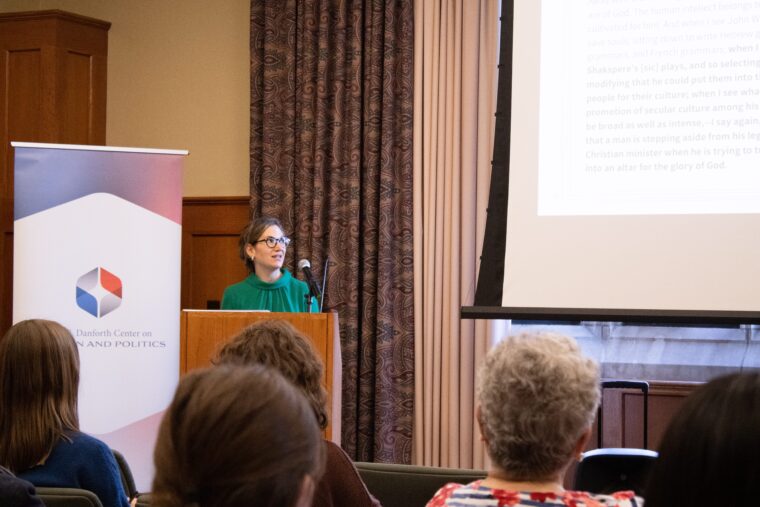
New York Times columnist David French discusses free speech and “institutional neutrality” at an event for law students. (Elizabeth Stump | Managing News Editor)
WashU hosted a fireside chat with New York Times columnist David French in which he discussed the current state of free speech and the First Amendment both in the United States and on college campuses, Sept. 12.
The discussion was sponsored by the WashU Law School and introduced to audience members by WashU Law professor Karen Tokarz. French is a former litigator, president of the Foundation for Individual Rights and Expression (FIRE), and writer at National Review. He has written frequently on free speech, political polarization, and religion in America. French was joined by WashU professor of Law and Religion, John Inazu at the event.
The assasination of Charlie Kirk which had taken place two days prior to the event was the first subject of discussion. French, a frequent advocate of free speech who has written three separate columns on the aftermath of the shooting, took a firm stance on the killing and said that he was “sick to [his] stomach” over the assassination.
“In a very real way, that assassin’s bullet wasn’t just aimed at the human being Charlie Kirk, a man created in the image of God whose life is precious beyond words,” French said. “It was also aimed at the public square — it was aimed at our ability to have the necessary conversations in a deeply divided country.”
The conversation then shifted to the state of religious freedom in the United States. French emphasized the strength of current legal protections in the United States and noted that the Supreme Court has consistently upheld religious freedom in the recent past.
“There’s not been a single significant religious liberty loss at the Supreme Court in 15 years,” French said.
French said that he disagrees with Americans who perceive religious liberty rights to be under threat and “one election from extinction.”
“We live in a world where so many of our liberties are legally more secure than they’ve been in a very long time,” French said.
French also criticized the state of free speech on college campuses, like WashU’s, and expressed support for colleges using First Amendment doctrine to guide their policy rather than attempt to create their own ambiguous guidelines.
“If [a private university] is going to depart from First Amendment doctrine, you shouldn’t do so in vague words,” French said. “It’s that ambiguity that is wrecking universities, because into that ambiguity leaks all kinds of bias…and it’s one of the reasons why public regard for universities is pretty low.”
When asked about his view on WashU and other universities implementing statements of institutional neutrality, French was generally supportive of the practice, arguing that official stances can alienate community members who hold differing views.
“The pressure to weigh in creates a situation where a lot of times, campuses are being called to weigh in on things where A, their opinion is completely irrelevant, and B, it’s well outside their areas and arenas of expertise, and it creates a constant pressure for more,” French said.
The first question during the audience Q&A came from WashU Chancellor Andrew Martin’s communications director Beth Bowden. This drew laughter from attendees because French had just criticized college administrations. Bowden asked how campuses might reshape the way students think about free speech.
In response, French emphasized the need to reduce hostility in public discourse and strengthen civic education to promote the idea that free speech and justice should be understood as complementary rather than conflicting values.
Another attendee asked about how the modern media landscape has shaped free speech and the political atmosphere. French responded by pointing out that consumers increasingly rely on media and online sources, as opposed to in-person interaction, to learn about opposing views.
“The people who are following politics most closely are [the] most wrong about their political opponents, and they’re most wrong in a very particular way. They believe their opponents are more extreme than they really are,” French said. “If you’re a partisan person on the right or the left, you have a hunger for news or information that validates your priors.”
Leaving the event, many attendees said they appreciated the tone of the conversation and French’s focus on unity.
“It’s also very politically relevant, given the events of this week, so it was good to kind of hear discourse around it in this style, as opposed to kind of what we see online,” senior Caroline Cowin said.
In concluding the event, French ended with a message to many of the law students in the room.
“Congratulations on joining the last functioning branch of government,” French said. “Somebody’s got to model the values of a pluralistic democracy, conceived in liberty and dedicated to the proposition [that] all men are created equal. It’s your turn now.”
Stay in Touch!
Get the latest and top news from StudentLife delivered to your inbox