News
‘We are representing all of you’: WashU government relations head discusses federal lobbying efforts

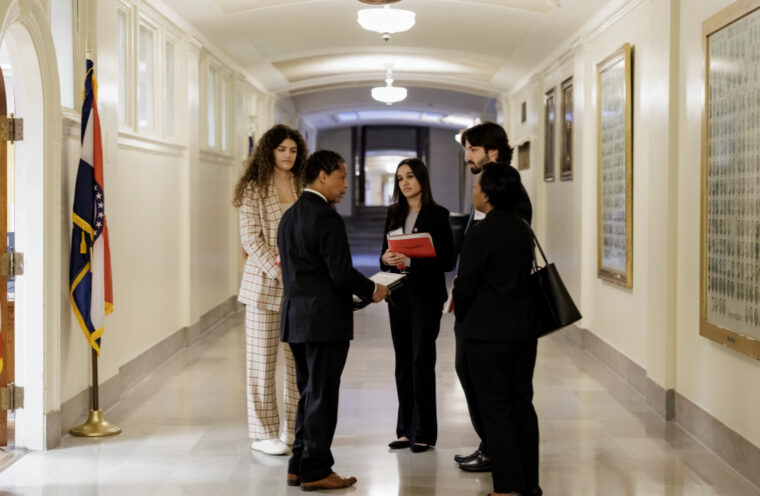
Vice Chancellor of Government and Community Relations J.D. Burton answers questions about WashU’s federal lobbying efforts. (Hannah Dorval | Staff Photographer)
J.D. Burton, WashU’s vice chancellor of Government and Community Relations, held a fireside chat with students in which he discussed WashU’s federal lobbying efforts after one year of the Trump administration, Jan. 27.
Burton leads a nine-person team that conducts local, state, and federal lobbying for the University and the medical school. The conversation was moderated by the undergraduate student representatives to the board of trustees, seniors Bella Gomez and Da’juantay Wynter, and graduate student representatives Michael Kudom-Agyemang and Alyssa Labonte.
Burton said that efforts at the federal level have taken up most of his team’s time because WashU is a private university that is not attached to the state of Missouri and does not receive direct funding for tuition and other programs, but does rely on federal research funding. WashU now has two dedicated lobbyists working in Washington, D.C.
“We have a huge amount of connection to the federal government,” Burton said. “We know that there’s a lot of folks who are counting on us being successful to help them be successful.”
WashU’s lobbying efforts have intensified significantly over the last few years. WashU spent $720,000 on federal lobbying in 2025; in 2022, the University spent just $50,000.
Burton singled out issues around medical and scientific fields at WashU as some of the thorniest issues. He said that research funding is “at risk in a lot of different ways.” He also mentioned transgender and reproductive care as contentious topics when speaking to officials.
“The Ivies of the world are going to suck all the oxygen out of these discussions, always,” Burton said. “We have done a good job of making sure that we are creating a reputation in D.C. as an institution that is credible, that is forward thinking, that is not going to necessarily get pushed around.”
Burton said that lobbying provisions of the One Big Beautiful Bill Act (OBBBA) took up “a lot of effort” last year. The legislation included significant changes to federal education policy, including alterations to the Pell Grant program and increases in the endowment tax on institutions like WashU.
Amid a political environment where public perception of higher education is at a record low, Burton said that many public officials shared the public’s skepticism of universities in conversations. However, he believes that WashU’s status as a large research institution gives it more credibility.
Burton emphasized the importance of building long-term relationships with policymakers and establishing WashU as a credible institution. He also reaffirmed WashU’s policy of institutional neutrality while encouraging students to engage politically amid protests last semester.
“I’m fortunate that I don’t have to control WashU’s view or … decide whether we take a political stance or not. That’s all of you,” Burton said. “Every single one of us on this campus has every right to speak about whatever topic that they want to in their own personal capacity.”
Affordability has become a hot-button issue in national politics, and Burton said that members of Congress frequently bring up how WashU and other institutions are working to reduce the cost of college. Burton said that a lot of conversations in Congress have revolved around the “return on investment” of college.
Burton pointed out members of the Missouri Congressional Delegation, including Senator Eric Schmitt and Representatives Wesley Bell, Jason Smith, and Ann Wagner, as having helped WashU in policymaking. He also said that Senator Susan Collins, the chair of the Senate Appropriations Committee, visited the WashU Medical Campus last week to explore WashU’s biomedical research work.
“I think where we are right now is that we’ve done a really fantastic job with our congressional delegation,” Burton said. “I think that there’s still a long way to go in members who just have no connection to WashU.”
In an interview with Student Life, Burton said that WashU has been working with partner institutions in other Republican states, like Vanderbilt University, Rice University, and Emory University, in federal efforts, as well as the Association of American Universities (AAU).
Burton said that his team is looking to continue to expand WashU’s reputation in Washington, D.C.
“We’ve done a great job, I think, though, in sort of reversing negative impressions and expectations that people may have had of WashU in the D.C. space,” Burton said.
Burton said that the University was looking to address some of the larger problems around higher education, but rejected the idea that change could only come from the federal government.
“It can’t be top down only,” Burton said. “You have to have higher education leaders who are … willing to say there are issues we have to address.”
Gomez said that she and Wynter organized the fireside chat due to the relevance of national political events to WashU and students’ interest in how WashU is responding.
“We wanted to create a public forum and an opportunity for dialogue, for students to be able to ask questions from our biggest advocate himself, and just be able to kind of connect students to the team of people that’s speaking on their behalf,” Gomez said.
While the event was meant to establish greater transparency, some student attendees, like sophomore Dash Leigh, expressed frustration at WashU’s neutral stance on major national issues.
“WashU doesn’t take a political stance unless the things are actively, directly impacting the University,” Leigh said. “But that’s kind of like a non-statement, because every political issue affects people personally.”
Burton encouraged attendees to join WashU Advocates and Bears Caucus, two programs that allow students to engage directly with government officials and share their experiences, and emphasized his role as an advocate for the interests of the WashU community.
“We are representing all of you. We are your lobbyists, and so our job is not to talk about the great things that I’m doing, or the team’s doing,” Burton said. “Our job is to echo and repeat and share what you’re doing and the stories that you’re creating, and get your good stories out there so that people can understand.”
Stay in Touch!
Get the latest and top news from StudentLife delivered to your inbox