News
From Clayton to Congress: Students join WashU’s lobbying efforts
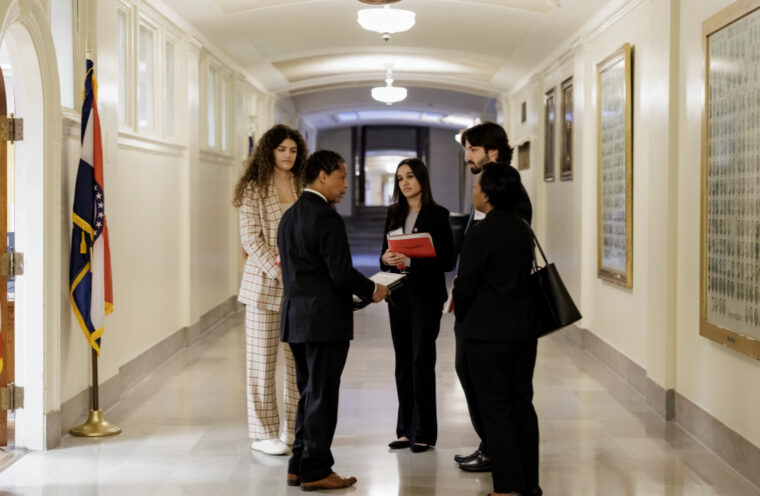
Members of Bears Caucus meet with government officials in the Missouri state capitol.
In recent years, WashU’s commitment to lobbying has grown in order to navigate federal and state policy changes. The University employs professional lobbyists at the federal, state, and local levels, and since last spring, has included student volunteers in the effort through Bears Caucus, a student lobbying group created by WashU’s Office of Government & Community Relations.
Thirty WashU undergraduate and graduate students are lobbying in coordination with full-time staff through the Bears Caucus program.
“I’ve always found in my career in higher education that students are some of the best advocates,” said J.D. Burton, vice chancellor of Government & Community Relations.
In the first three quarters of 2025, WashU has spent an estimated $720,000 on lobbying efforts at the federal level — an increase from fiscal year (FY) 2024, in which the University reported spending $720,000 across all four quarters and a 288% increase from the amount spent during all of 2023. The number of federal lobbyists on the University’s payroll has increased from eight to 17 over the same two-year period. And while there are no public numbers for WashU’s state or local lobbying expenditures, 15 state-level lobbyists were registered with the Missouri Ethics Commission as currently active.
Burton spoke to Student Life about his role leading lobbying efforts at all levels for WashU.
“We feel it’s really important for us as an institution that is a recipient of taxpayer dollars to be forward and be engaged and be visible to demonstrate value. … It certainly is something that has led to our success and drives what we do every day,” Burton said.
The Office of Government & Community Relations chooses which issues to prioritize by consulting with deans, administrators, and Chancellor Andrew D. Martin.
Burton said that, at the city and state levels, WashU’s lobbyists are involved with issues such as public health, land use and zoning, public safety, and financial aid, specifically Bright Flight and the Access Missouri Financial Assistance Program.
Burton explained that the University’s return on investment from lobbying efforts is difficult to calculate, but he said that the federal endowment tax rate that was initially proposed was three to four times greater than the final number. Burton cited the abandonment of a proposed state-level university endowment tax as another example of lobbying efforts that paid off.
“On the state side, we’ve been able to make the case for legislators why increases in endowment taxes, or other taxation at the state level, are not good for the state, and that has successfully saved us tens, if not hundreds of millions of dollars over the last couple of years,” Burton said.
As an extension of its mission, in January of 2025, the office launched WashU Advocates, a program that encourages students, faculty, alumni, and community members to get involved with the University’s government initiatives. The organization’s website offers information for contacting state and federal officials, as well as a general “advocacy toolkit.”
Tonya Rice, assistant vice chancellor for advocacy and engagement, said that through her role, she focuses on engaging the WashU community to “champion” University priorities.
Rice established the Bears Caucus to promote direct interaction between lawmakers and students. Rice said student-forward lobbying is more common at public institutions like the University of Minnesota, where Burton was formerly the chief government relations officer.
“We were … at the very beginning, championing this kind of model in a way that wasn’t seen before [at] private universities,” Rice said.
One student advocate is junior Chantal Ogbeifun, who joined the group as a result of her experiences as a rural student.
“I think the initial pull that got me in was [that] Tonya [Rice] had asked, ‘Why?’ Like, if there was one thing that I could advocate for on the University side, what would that be? And my initial response was just access to higher education for rural students, because I’m from Republic, Missouri, super rural, not a lot of resources and access to education,” Ogbeifun said.
Ogbeifun clarified that, at this stage, Bears Caucus students are not promoting a specific agenda but rather building relationships with policymakers.
Referring to meetings with representatives, she said, “It was really humanizing on both sides.”
Along with other members of Bears Caucus, Ogbeifun traveled to Jefferson City, Missouri, and around St. Louis to meet with state lawmakers and the St. Louis Board of Aldermen, respectively. Bears Caucus has also met with Congressman Wesley Bell over Zoom.
Rice added that she is planning a Bears Caucus research showcase in Washington, D.C. for next year.
Ph.D. student Isaac Eastmond joined Bears Caucus because he was concerned about the impact of federal budget cuts on research at the medical school.
Eastmond stressed that Bears Caucus is a nonpartisan program, which he said was important for counteracting misinformation amidst a highly polarized information environment.
“Universities are supposed to be this place where high-quality debate takes place, where you can exchange ideas freely, and where we can evaluate ideas based on truth. And so I think having programs like this, creating environments where productive conversations can take place, is really important. And I think the in-person aspect of Bears Caucus has been kind of critical to that,” Eastmond said.
Ogbeifun agreed that in-person interactions were impactful. Ogbeifun said discussions during the Jefferson City Advocacy Day helped dispel some lawmakers’ perceptions that WashU “tries to put itself in a separate category” from other Missouri schools.
“The most interesting thing that I learned from it was there [were] a few representatives that kind of had a bad taste of WashU in their mouths, like they thought that WashU was some distant school,” she said. “Feedback that I heard was that it was nice for them to put faces to students at WashU and know that we are interested in Missouri as well and not just coming to St. Louis to get an education and then leaving.”
Outside of face-to-face discussions, Bears Caucus continues to contact their representatives, and the group planned a “Digital Advocacy Day,” which included an opinion submission in Student Life about cuts to research funding.
Burton said the University’s commitment to lobbying, especially at the state level, is unusual for a private university.
“We have taken a very heavily engaged approach to lobbying for a private institution. We have been much more present at the state level. Even though we don’t receive a lot of state resources, we’ve been much more engaged on the advocacy side,” Burton said.
Stay in Touch!
Get the latest and top news from StudentLife delivered to your inbox