News
Dean’s Distinguished Lecturer Professor Diana Z. O’Brien discusses state of women’s political representation
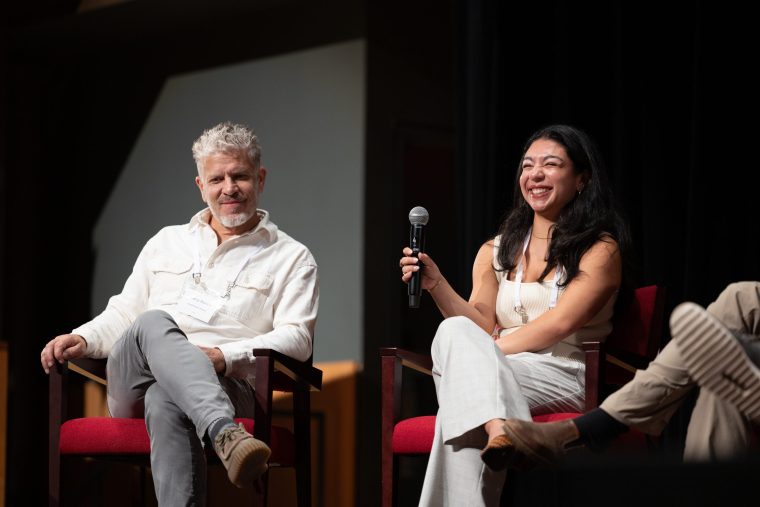
Amid a contentious election cycle with its second-ever female presidential nominee, Professor in Political Science Diana Z. O’Brien gave a talk regarding the factors that affect women’s political representation, Oct. 2.
O’Brien’s discussion of the representation of women in politics drew around 60 attendees — primarily faculty and graduate students — with 150 more tuning in via a Zoom livestream. She addressed both the consequences of the underrepresentation of women in politics and strategies to get more women elected into office.
“[I came to this event to] learn more about women’s representation in politics and why it is imperative to continue to allow women to have a piece in democracy. [With this, I aim to] foster change within any community,” sophomore Precious Barry said.
O’Brien used a supply-and-demand analogy to explain the causes of women’s underrepresentation in politics. She posed a question to the audience: Is there a supply of well-qualified women willing and able to pursue political office, and is there a demand within voters willing to put women in office?
O’Brien cited a study that concluded that, out of samples of Black, Hispanic, and white men and women, men in all of those categories are more likely to consider running for political office, more likely to think that they are more qualified to run and more likely to think that they are more qualified for president than their female counterparts.
“When we think about how we learn about politics in school, how we talk about politics, politics are often portrayed as an environment where great men do great things,” O’Brien said. “Women are absent from this narrative, and political culture is coded male in a way that fosters male political ambition.”
Continuing with the supply-and-demand analogy, O’Brien stressed the importance of ballot access — the procedures regulating one’s right to candidacy — and political representation.
“Ballot access matters a lot. Once you’re on the ballot, you are running under a party label. Even if voters are explicitly biased against women, they might still pass their vote for you because they want to support the party,” O’Brien said.
After hearing O’Brien speak, sophomore Kaylia Humphrey said that she thinks education and voter engagement are crucial for students.
“I think it’s really important for myself as well as other people to continually educate themselves, especially in the political climate that we are in now,” Humphrey said. “I want to emphasize the importance that one voter or one collective group of people does have.”
Furthering this conversation about the necessity of voting, O’Brien explained what governmental bodies may lack when women are excluded from the political sphere.
“In the U.S., women introduce more legislation, they are better at working alongside other policymakers, they bring federal money back to their districts, and they respond more and more helpfully to their constituents,” O’Brien said. “Women also bring unique perspectives to critical laws.”
O’Brien explained the legislative impact of women in government.
“Parties that elect more women are more likely to be issue entrepreneurs. They also offer more diverse policy agendas to the electorate,” O’Brien said. “Women bring women’s issues to the agendas.”
O’Brien proposed gender quotas as a solution to the underrepresentation of women in office.
Gender quotas operate by setting a minimum number of women required on ballots or reserving seats in legislatures to foster the inclusion of women. From her own study, O’Brien concluded that elected women are equally qualified — if not more-qualified — compared to their non-quota counterparts, and that elected women perform at equal or higher levels.
One common doubt about quotas is that they degrade democratic legitimacy. To address this fear, O’Brien has been studying how respondents in 12 different countries with vastly different political atmospheres and gender biases feel about the efficacy and judgment of a city council with a gender quota.
While O’Brien recognizes the unlikelihood of the U.S. enacting a quota system for the Senate, she said that it is necessary for women to be encouraged to run for office, as encouragement will lead to women expressing equal levels of ambition compared to men.
O’Brien’s four steps to closing the gender gap include encouraging women to run for office, encouraging political parties to recruit women candidates, providing women with the training and (financial) support that they need, and dismantling barriers to women’s access to power.
Barry said she appreciated the University hosting events like these with the upcoming election.
“[It is important] to have events like this to make sure the community is coming out and people are educated about what’s going on in politics,” Barry said. “Not just what we see on social media or the news, but actually seeing what is going on in our democracy and seeing what laws and legislations candidates are trying to adopt.”
Stay in Touch!
Get the latest and top news from StudentLife delivered to your inbox