News
Expert on Ukraine speaks about “An Unwinnable War”
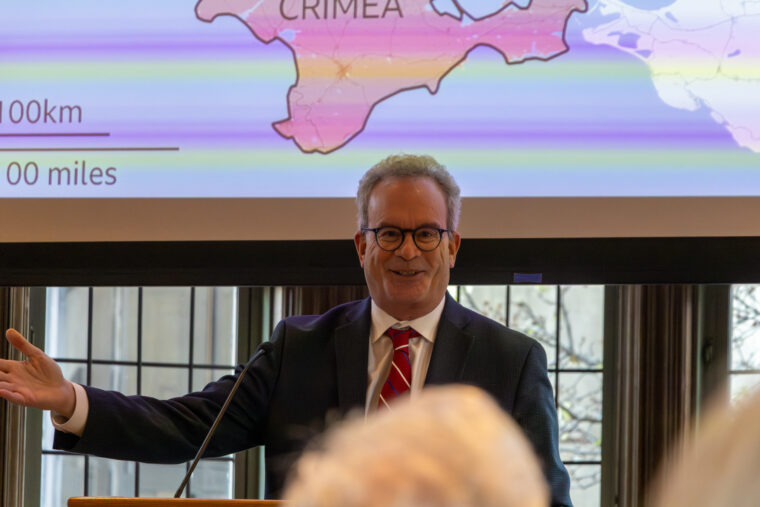
Political scientist Samuel Charap from the RAND Corporation spoke at Washington University about the Russia-Ukraine war and related foreign policy, in an event hosted by the Department of History on Wednesday, Feb 21.
Charap began his presentation by outlining what the future of the ongoing war looks like. He emphasized five main points: possible Russian use of nuclear weapons, possible escalation to a Russia-NATO conflict, territorial control, duration of the conflict, and forms of war termination.
Charap discussed potential benefits to the United States and the rest of the world, should Ukraine retake lost territory.
“Fewer Ukrainians would be living under Russian occupation, [and] Ukraine could become more economically viable and less dependent on external assistance.” Charap said.
Although this outcome would benefit the West and Ukraine, Charap believes that a decisive Ukrainian victory is unlikely.
Charap indicated several ways the war could end without a decisive victory for either side.
Charap said, “The narrative that you often hear about this war is that it will end when Ukraine pushes out the Russian invaders from its sovereign territory…the problem with that narrative, of course, [is] why would the Russian military stop fighting if that were to take place?”
Charap emphasized that territorial reconquest is not a form of war termination. He cast doubt on the possibility that Ukraine could take back the territory it had lost, and furthermore said even if it does, that doesn’t mean the end of hostility and conflict.
“The ability of either Russia or Ukraine to impose an effort to achieve an absolute victory seems quite limited, even if it seems that Russia was trying to do that.”
Charap went on to emphasize the costs and benefits of a long war for the United States and the West as a whole. According to Charap, the most significant benefit was that Russia’s geopolitical position would be weakened the longer the war continued.
Charap explained that the largest risk of prolonged conflict is possible escalation into a Russia-NATO war.
“There would be an elevated risk of Russian nuclear use and a war with Russia. Avoiding these two forms of escalation is paramount to US priority,” Charap said.
“The United States should take steps to make an end to the conflict over the medium term more likely”
Because absolute, unilateral victory seems unlikely at this stage, Charap discussed how diplomacy should be used to end the war.
“The first thing that could be done is a socialization process. In other words, talking about talking.”
Charap ended the Q&A section of his talk by emphasizing the need for Ukraine’s continued funding by the West.
“The challenge is that in the short term, without US assistance, Ukrainians are going to be in deep trouble when it comes to artillery and air defense munitions, because they no longer are using systems that they had before the war.”
Stay in Touch!
Get the latest and top news from StudentLife delivered to your inbox