News
Keeping eyes on Ukraine: American University professor gives lecture on state of Ukraine-Russia war
Max Silberg | Staff Photographer
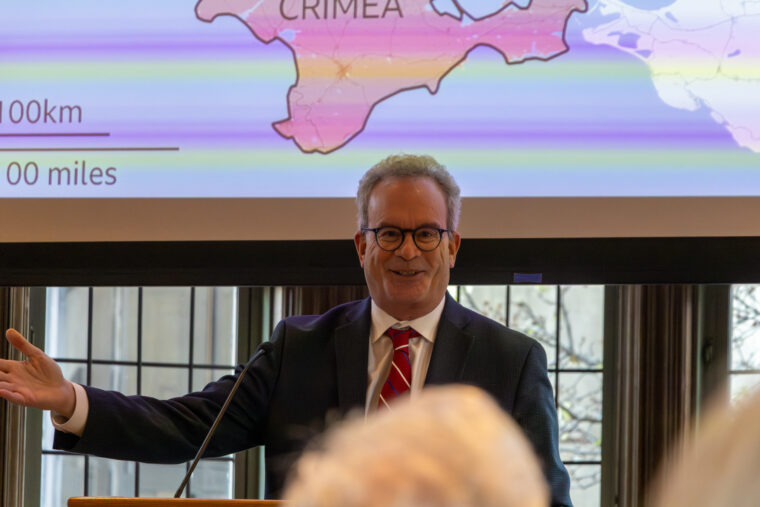
Professor of International Relations at American University James Goldgeier spoke on Vladimir Putin’s role in the ongoing Russia-Ukraine war and its consequences for Ukrainians, reminding audience members not to forget the war amidst a wave of recent conflicts.
Goldgeier’s lecture was part of the WashU history department’s Crisis & Conflict in Historical Perspective (CCHP) Series, which is run by history professor Krister Knapp. Attendees, including undergraduates, WashU faculty, and community members, filled up Umrath Lounge.
Goldgeier was introduced by senior Jenae Bothe, one of Knapp’s students.
Goldgeier opened with a discussion on Russian President Vladimir Putin. Goldgeier said that Putin’s anger was partially responsible for the war, and that it extended to Lenin, Gorbachev, the U.S., the 2003 Iraq War, and more. In addition to Putin seeing a military invasion as the only option, Goldgeier listed Putin’s self-importance and confidence as reasons for invading Ukraine.
“We don’t know how big his appetite is,” he said.
Goldgeier then turned toward Ukraine and its role in the conflict, both militarily and socially. He emphasized the need for Ukraine to retain its claims to the territory Russia is attempting to annex, because of the difference between how the Baltic and other East European countries were treated after the dissolution of the Soviet Union.
The Baltics were never formally recognized as part of the Soviet Union, according to Goldgeier, and were accepted into NATO because of that. If the currently contested areas of Ukraine were to be recognized as Russian territory, future perceptions of those regions would be vastly different from how they are viewed now.
“Ukraine would never, and should never, legally recognize that territory as part of Russia, nor should [the U.S.],” Goldgeier said.
Goldgeier also heralded the skill of the Ukrainian military and the bravery of the Ukrainian public.
“[The Russians] have bombed civilians, they’ve kidnapped Ukrainian children,” Goldgeier said. “The resilience of Ukraine is one of the most extraordinary aspects of this [war].”
Above Goldgeier’s head hung a map indicating the conflict zone outlined in salmon pink, spanning four provinces where the war is currently being waged — Kherson, Zaporizhzhia, Donetsk, and Luhansk.
Goldgeier said that the conflict zone would likely remain on the map for a long time.
“My bottom line on the Russia-Ukraine War: It’s likely to go on for some time without major changes. But of course, any war involves uncertainty,” Goldgeier said.
In the Q&A portion of the discussion, Goldgeier returned to Putin — a theme throughout the lecture.
“The key to ending the war is getting Putin to believe that it’s time to end the war,” Goldgeier said. “Only if the costs are high enough to him economically or militarily will he have any incentive to come to a deal.”
Goldgeier also spoke about the 2026 Iran War and China-Taiwan relations. The American University professor explained that, like in the Russia-Ukraine War, those military conflicts are defining the identities of the parties involved.
“The war in Ukraine is existential to Ukraine. The war in Iran is existential to Iran,” Goldgeier said.
Some came intrigued by Goldgeier’s perspective as a visiting professor. Ben Yarkin, a junior studying Chinese, came to Goldgeier’s lecture after attending another CCHP event.
“Since [the first event], I’ve always been looking at my emails for the things that get pushed to the bottom of the inbox,” Yarkin said. “I don’t know that much about Russia [and] Ukraine at all, so I wanted to learn more because I think it’s really important.”
Others like Andrew Sobel, Professor Emeritus of Global Studies, have been coming to Knapp’s lectures for years, even into his retirement.
“I’ve been supportive of Krister for a long time,” Sobel said.
Yarkin said he appreciated Goldgeier’s multidimensional perspective. In the Q&A section, Yarkin asked about the similarities between Russia and China, and whether the Russia-Ukraine war has any bearing on the tense relations between China and Taiwan.
“I’m a Chinese major and interested in what’s going on in China, and I think [the Russia-Ukraine War] has a really big impact on what happens [with China and Taiwan],” Yarkin said.
Goldgeier noted that while he was not an expert on China-Taiwan relations, he agreed with Yarkin’s drawing parallels between the two supranational relationships.
Goldgeier referenced the UN and how its intended function from the mid-1900s should serve as a model for current political and military conflicts.
Stay in Touch!
Get the latest and top news from StudentLife delivered to your inbox