News
New working group seeks to facilitate student-neighborhood partnerships
During her junior year at Washington University, Sophie Scott noticed an opportunity for growth. She was involved with a class in the Sam Fox School of Design and Visual Arts, “Segregation by Design,” that connected a cohort of students to St. Louis neighborhood groups. One of the groups was looking for someone to create a new website for them, and Scott thought of the University’s many technology and web design-based clubs. She wondered if students could use their coding skills to help out St. Louis neighborhoods.
Now a senior, Scott has worked with Student Union Executive Vice President junior Anne He to start a working group dedicated to creating a lasting system for those connections between University student groups and St. Louis community organizations that could use their skills or services. The working group’s initiative, which Scott and He are calling the STL Engagement Project, is still in an early phase, but the pair hopes that it will become an important aspect of the student group experience over the next few years.
Scott and He, who knew each other from time together in SU in the past, started collaborating over the summer when they realized that much of the activism surrounding students’ renewed focus on racial injustice was taking place online.
“A lot of it was Instagram activism, and while that’s great for raising awareness to different issues—it did do that over the summer—it really got [us] thinking about how we can capitalize on the movement that was happening in the summer and make sure it was sustainable and also leaves a real impact on specifically the St. Louis area,” He said.
With the idea of a program that would match student groups to neighborhood organizations in mind, Scott and He met with more than a dozen University and community stakeholders over the summer. Through those stakeholders, they got connected to an organization in the West End neighborhood, an area just northeast of the Danforth Campus. They then piloted their idea in the neighborhood, using skills they had learned at the University to organize a community raffle and design graphics that encouraged West End residents to fill out the census.
Three other members of the working group have since joined in those efforts. “The aim of this working group is to not only perform a project ourselves, but to connect with the West End neighborhood, see what they need and be able to do a project for them,” He said.
At the core of the working group’s initiative is the idea that their work in St. Louis neighborhoods should be collaborative. The goal is to see how students can meet the needs of communities around campus, from providing business consulting advice to technological, organizational or artistic support. “We have so much to learn from the work that residents of these neighborhoods are already doing,” Scott said.
Scott and He noted how too often in the past, students would become involved in St. Louis communities only to abandon projects upon graduation or once they become too busy, leaving neighborhoods in the lurch.
“The biggest piece of advice the stakeholders were giving us was to really be intentional about how you’re going to build this into an infrastructure, because otherwise it’s not going to be sustainable and may even potentially end up harming the community,” He said. “‘Parachute in’ was the term that a lot of stakeholders gave us, like how oftentimes Wash. U. students will parachute into the neighborhoods and then four years later will parachute right back out. It leaves the neighborhoods and the community thinking ‘Where did they go?’”
He emphasized that the planning process would be slow and calculated, as the working group wants to ensure that they have time to think critically about various aspects of the partnerships from training to logistics. Once the members of the working group have done more work, they plan to involve other student groups in the program. The working group is currently in the process of looking through the list of student groups and finding how each one might be able to contribute something to various neighborhood groups across the city.
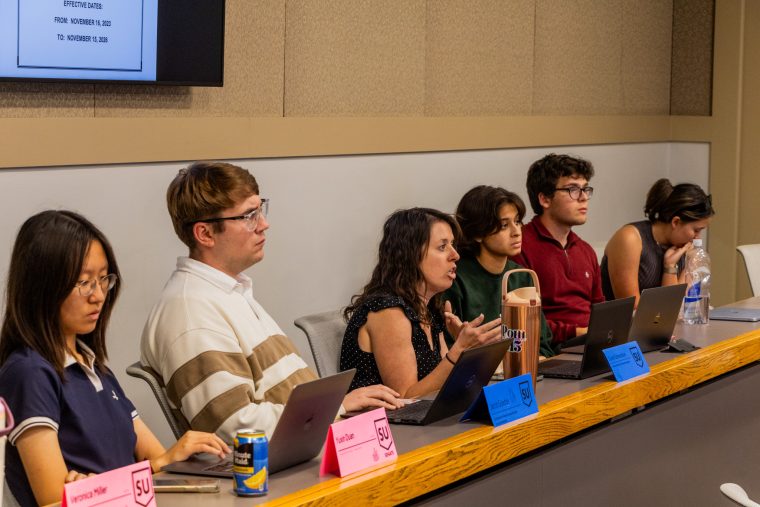
Scott, a former SU Senate speaker, and He, who previously served as a senator, chose to house the initiative in SU since that was the campus structure with which they were most familiar. Their goal is to have SU leverage its power over student groups to encourage more involvement beyond campus, with the thought that the organization can introduce “engagement touchpoints” in addition to the “financial touchpoints” that today represent most of the interactions between SU and student groups, He said.
However, they have worked to involve voices outside of SU and are not committed to keeping the project within SU’s framework going forward. Both Scott and He suggested that they are approaching the working group with a sense of flexibility and are open to the idea of shifting the project’s structure.
Part of the working group’s plan is to make it easier for students who come to the University without an explicit desire to engage in community service to become involved in St. Louis.
“Right now, if students want to engage with St. Louis, it takes a lot of intentionality,” junior Diva Harsoor, a member of the working group, said. “It’s just not a thing that seems to be in the culture of every club here. There’s just not that pathway, since most clubs just meet on campus and do things related to college or the campus community. They might have some connection with St. Louis, but it’s not really a big part of their operation.”
There is a long way to go. Scott and He see the initiative as a long-term plan and recognize that the fruits of their labor will likely not be fully realized until after they graduate. “I think both of us know that the long-term goal of this won’t be implemented until one or two years out,” He said.
That extended timeline does not get in the way of their optimism, though. Harsoor expects a positive reaction from student groups. “I think it’s something that is going to resonate with a lot of folks, especially because I think that a lot of people have a new social consciousness, or if they had a social consciousness before it’s been directed in new ways,” she said. “There will be a lot of excitement around this opportunity to genuinely be involved in St. Louis.”
Stay in Touch!
Get the latest and top news from StudentLife delivered to your inbox