Forum
Opinion Submission: Holding Space: Affinity suites need accessibility
Reid Kellermann | Contributing Illustrator
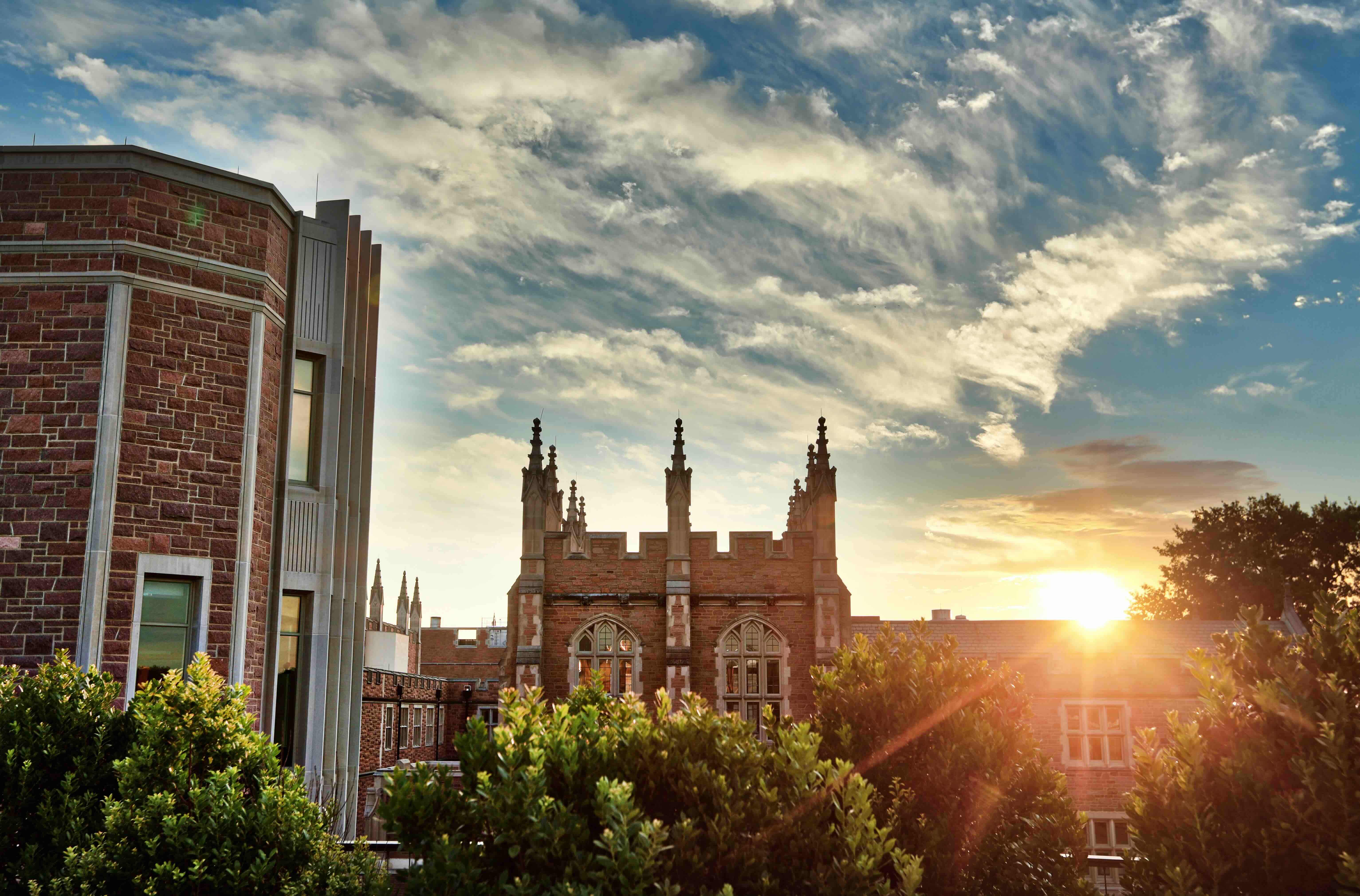
The Ann Whitney Olin Women’s Building, one of the many beautiful brownstones of Danforth Campus, stands at three gorgeous stories tall and is home to the Center for Diversity & Inclusion North Offices, which includes the Office for International Student Engagement (OISE); some of the dance and drama studios; the sorority suites; and the affinity group suites.
On paper, this seems like an incredible space, right? There’s just one massive problem, one that is shared by a select few old buildings on campus: It does not comply with the Americans with Disabilities Act (ADA).
There are stairs leading up to the main entrance, which lack the button-controlled doors found on nearly every entrance and exit at WashU. The accessible entrance, located at the back of the building, leads to the basement. The only way to the ground floor is via a key-operated chair lift, which requires a student to call facility services and wait for the assistance of another person. This lift only allows for entrance to the main floor. The ADA states that buildings with more than one floor must be vertically accessible. For the Women’s Building to meet that requirement, each floor would need a chair lift, escalator, or elevator to allow for access to all floors.
Students with mobility aids are therefore unable to reach floors beyond the basement and main level, and they can only reach the main level with the assistance of another person. All of the actual community spaces are on floors two and three. Those with chronic pain, fatigue, or asthma may have the mobility to reach the suites, but not without exertion that can cause a flare-up or asthma attack, leading to days out of class spent recovering. These people cannot access the benefits of the communities located in the Women’s Building, like meetings or events.
When not every community member can access a space, the space cannot serve as an authentic or beneficial resource for the community. The purpose of the affinity and sorority suites is to create an environment where students can feel supported by others with whom they share an identity. When even one person is excluded from that space, it prevents the sense of safety and community from reaching everyone who may need it.
Because of the lack of accessibility, few organizations actually use their suites for purposes of gathering and community, as they were intended. Some affinity groups and sororities use their suites as open community spaces; others, like the Asian Multicultural Collective, use theirs to practice various cultural activities.
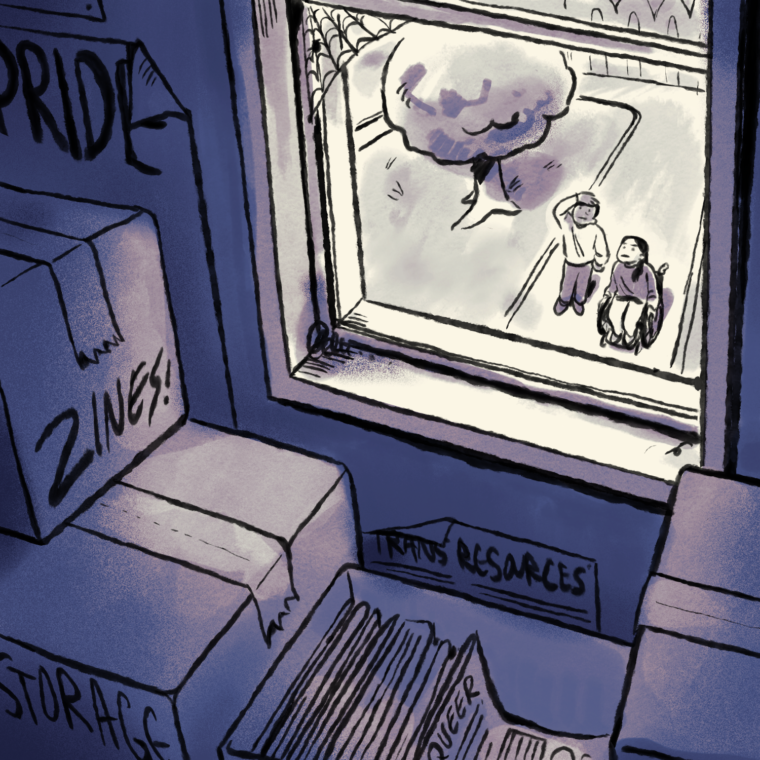
After 2024, many of the suites decided to stop using their spaces to meet so that they could better serve all of their community members. Pride Alliance, the group that I am a part of — along with the other LGBTQ+ groups that share the Pride Suite — abandoned our space on the third floor to meet elsewhere on campus. Most groups use their suites solely for storage, including my own.
Pride Alliance, the umbrella LGBTQ+ group on campus and one of five student-run organizations serving the queer community, has its suite on the third floor of the Women’s Building. We, alongside Transcending Gender (who serves the genderqueer community), Ace&Aro (who serves our asexual and aromantic spectrum students), MedQ (the pre-med LGBTQ+ group), and oSTEM (the STEM field pre-professional LGBTQ+ group), are run by queer students, for queer students. Pride Alliance likely started in the early 2000s and has had the suite since around that time.
As vice president (and a man with too much time on his hands and a bone-deep urge to sort things), I took it upon myself to create an updated inventory of the items in the suite. From flyers and tri-fold poster boards advertising long-disbanded student groups and their events, to the small collection of 26 zines made and distributed by Pride Alliance throughout the years, I discovered a long-forgotten trove of decor and supplies for programming.
Throughout this process, I couldn’t help but mourn the loss of what must have been a vibrant community space. When I arrived at WashU in fall 2024, the Pride Suite had been glorified storage for about a year already. Instead of having a dedicated space for programming, we reserve spaces in the Danforth University Center. This adds another layer of organizational complexity associated with planning events. Activities and programming meant to build community and togetherness end up feeling detached and ephemeral, our presence temporary in whatever room we use.
I never got the chance to experience the suite when it was alive and full of queer WashU students. So, I phoned a friend.
Senior Aspen Groves has been an active leader and trailblazer of the queer community on campus since her first year. Given her experiences as both a general and an executive member of various organizations, I reached out to her to learn about the old community dynamics in the Pride Suite. Groves told me that some of her first queer experiences on campus were during Transcending Gender meetings in the suite. She reflected on how it felt to have a space dedicated to LGBTQ+ students on campus.
“It felt good to have the space. It was a safe space during meetings and outside of them. During a time where the Missouri government was becoming very openly anti-trans, the Pride Suite was a space for trans people all across campus to come together and remember that we had a community and that we had people to lean on,” she said.
Even with her positive experiences, Groves expressed pride in our community for choosing to move out of an inaccessible space.
“Myself and several of my friends have had issues accessing the suite while it was still in use. The suite is inaccessible to anyone with mobility issues, conditions like chronic fatigue, or even something like asthma … We realized that the suite wasn’t accessible to everyone in our community … I obviously want a physical space for queer and trans students at WashU, but I’m very proud of the queer community at WashU for putting its people first and moving to more accessible locations,” she said.
The saddest part about the loss of this suite is that it’s entirely fixable. There have been rumors of an elevator getting installed in the Women’s Building for years now, but no sign of any planned construction. The construction budget has been ambiguous, as WashU cancelled the active work to improve Mudd Field and the building of Riney Hall in the spring of 2025, but it also just announced the construction of the new Alumni House and the South 40 housing expansion for underclassmen.
It seems that the Women’s Building is at the bottom of WashU’s priorities for improvements. I believe this is likely because the building only has the capacity for studio dance classes. The University makes less money from improving accessibility in the Women’s Building than it would from a building that would provide more space for lecture or lab classes.
WashU needs to create a concrete, actionable plan to improve accessibility for the affinity suites. Students and staff in the near future deserve these spaces. We all deserve these spaces, and that means equal access. This isn’t only an issue of accessibility: If the University is not meeting the needs of the students with disabilities in the affinity groups, it is not committing to its institutional goal “to build an inclusive, equitable, respectful, ethically-principled environment for living, teaching, learning and working for the present and future generations.” WashU needs to do better for all of its affinity students and sorority groups.
Stay in Touch!
Get the latest and top news from StudentLife delivered to your inbox