Forum
How to overcome your gym anxiety
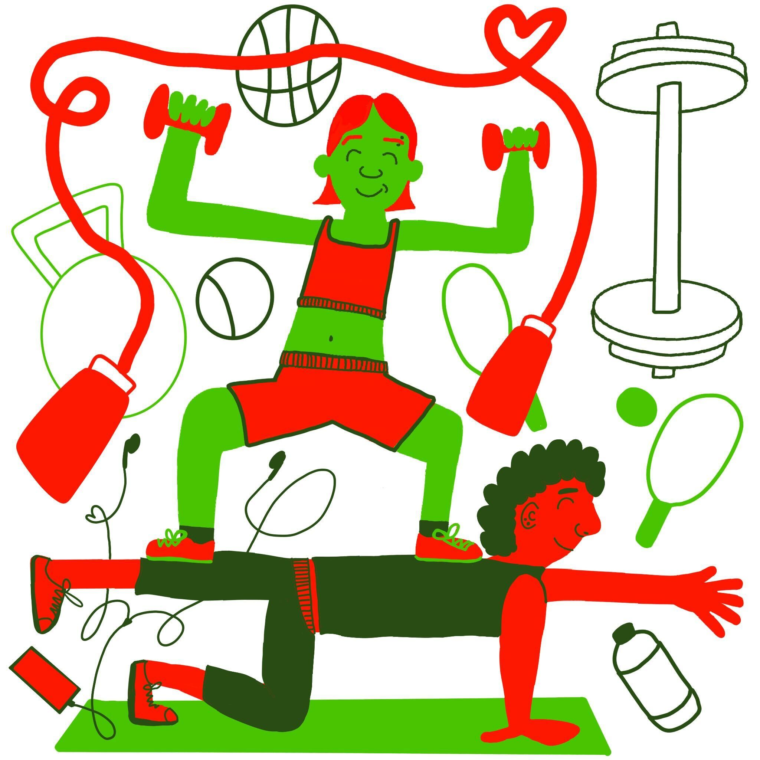
Janae Crespo | Contributing Illustrator
Looking back at my various conversations with peers at WashU, there is a constant that connects women and feminine-presenting first-year students: gym anxiety. These feelings are not exclusive to WashU or to the female experience, nor are these anxieties rooted in individual motivation. Instead, this “out-of-place” feeling is systemically manufactured and not just in your head.
On college campuses, women and female-presenting folk tend to be vastly outnumbered in the weight section, are less likely to lift, and experience more body image anxiety. As a result, women often make sense of the discomfort they feel by interpreting the gym as a masculinized, surveilled space. By challenging these assumptions, actively dismantling systemic biases (often unconscious), and fostering a community of respect and compassion, the gym can become a more inclusive space that welcomes all individuals — regardless of identity, ability, or background.
Like any other type of anxiety, gym anxiety is entirely personal. You could be new to the gym or returning, unfamiliar with the equipment, trying new things, worried that everyone is judging you, or petrified of gym culture — gym anxiety comes in all forms. More likely than not, fellow gymgoers have felt these same emotions of inadequacy and insecurity — myself included. Rather than treating discomfort as a personal failing, I had to validate these emotions.
Simply put, avoidance is not the answer, and although you cannot change the culture alone, you can change how much power it has over you.
For credibility’s sake, I have been lifting since my first year of high school. Living in a couple of different places growing up, I have overcome many gym landscapes. From military fitness centers to Planet Fitnesses, I have seen gym anxiety affect many people. I spent most of my sophomore year in a vicious ruminating cycle, overcome by a self-conscious haze. Admittedly, I have had plates fall from a low bar mid-thrust, sweat drip from every crevice of my body, and injured myself mentally and physically, leading to a complicated relationship with my body that I was able to control. Nonetheless, I have compiled a list of reassuring affirmations that I wish I had heard as a first-year student:
- Start short and small. Getting more confident in the gym starts with small changes to your routine: I recommend picking a less busy time (this can be anywhere from 6-9 a.m., 11 a.m.-1 p.m., or 7-11 p.m., in my experience), bringing a friend, fueling yourself with a pre-workout meal, familiarizing yourself with the layout, setting personal boundaries for social interaction (i.e., while lifting, try to avoid glances and conversation), using a distracting tool to focus on something besides the people around you (i.e., music or a podcast), or claiming a corner for stretching either on the elevated track, Studio 1904, the strength training area, or a crevice of your choosing. If you’re unfamiliar with Sumers Recreation Center, you can explore its amenities and note what you prefer.
- You can’t run till you walk. Beginning a routine is the hardest part of getting comfortable in the gym, yet it’s integral for consistency and to reduce further intimidation. I suggest that you walk on the elevated track at Sumers, smack around in the boxing alcove, stretch in the three-court gym, dissociate with the lights off in Studio 1904, fall asleep in the sauna offered in the downstairs locker room, or follow an exercise video on YouTube. Results in the gym don’t show up overnight — give yourself grace as you experiment.
- Find joy in moving your body — the gym does not have to feel like a chore. You can make the gym fun with a comfortable and cool outfit or uplifting music. Research and create a simple plan before your visit, pick up a small weight, acquaint yourself with specific motions, and try something new every time, making note of what feels correct or incorrect.
- You cannot hate yourself into loving yourself. Start by taking the pressure off of comparison and remind yourself that shifty eyes do not mean animosity. Struggling to find the love in yourself? Practice complimenting someone new, and, more than likely, they will reciprocate the love.
- The cardio plaza is comfortable, but the strength training area needs some love too. Lifting weights in a male-centered gym can be daunting, yet the machines are optimal for essential strength training and reducing the risk of injury. Having access to these machines may not be the same as feeling included, but you can foster inclusion by asserting yourself within the space. Ask trainers or use Google, YouTube, or Fitbod for help when necessary.
- Most importantly, the gym is all about you, your goals, and your wellness. The same egocentrism, or “main character syndrome,” that makes you worry about how you look is making them worry about themselves, not you; you are far more than a passing glimpse in someone else’s set, and your value has nothing to do with how you work out in Sumers.
Celebrate Body Acceptance Week at WashU Rec with me by fostering a shift toward self-love rather than insecurity, whether through moving your body at Sumers or otherwise.
Stay in Touch!
Get the latest and top news from StudentLife delivered to your inbox