Forum
Not all of your ‘Missed Connections’ are truly missed
Mateo Kahoun | Staff Illustrator
Maybe, through writing this article, I’ll meet the love of my life.
That manic, love-seeking mentality, ridiculous as it sounds, seems to be a governing principle of single life. Coffee shops aren’t coffee shops anymore — they’re meet-cute potential. The library isn’t the library — it’s a place to “aura farm.” People aren’t people — they’re romantic possibilities.
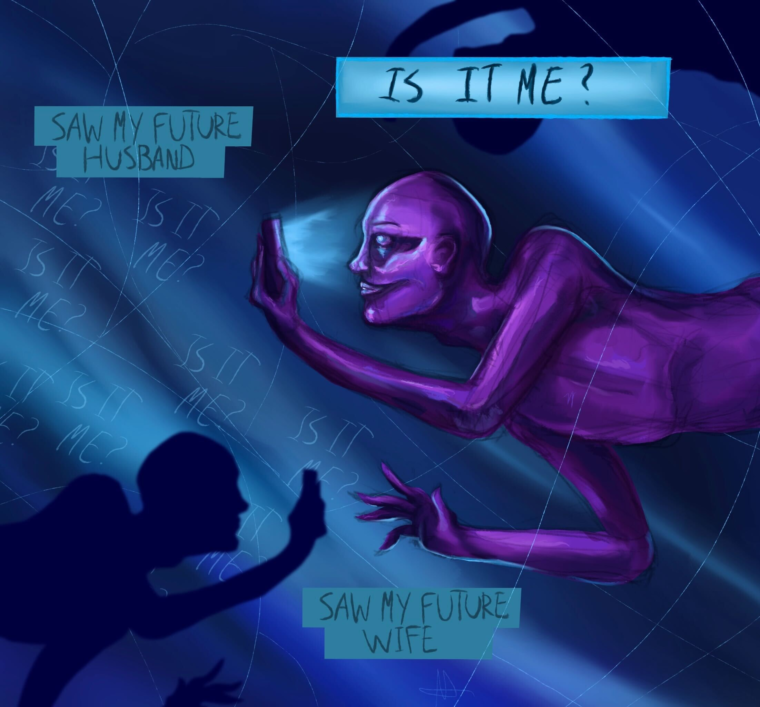
The Instagram account WashU Missed Connections seems to share this mentality. Currently boasting over 4,000 followers, roughly half the size of WashU’s undergraduate population, WashU Missed Connections is a cute, tongue-in-cheek way to get in touch with people who have caught your eye. The account posts entries it receives through direct messages (DMs). If someone recognizes themselves as the person being described, then the account’s admin can put them in touch with their secret admirer. Descriptions tend to fall into two categories: posts about someone whom the author already knows, or creepily specific info-dumps about someone they’ve never met.
Though this account seems to be an innocuous way of showing interest, I view it as a way to distance yourself from the person with whom you claim to want to connect. Missed connections rarely stem from a real barrier to an in-person conversation with your crush. Rather, they stem from the idea that a digital rejection, or lack of acknowledgment, will hurt less than getting rejected face-to-face. Under the convenient veil of anonymity, Missed Connections is a manifestation of rejection anxiety and the lazy digitization of modern love.
WashU Missed Connections carries on a centuries-old legacy of placing advertisements in newspapers in hopes of reconnecting with someone you saw but could not formally meet. This practice dates back to at least the early 19th century. Each time period and geographical location presents its own unique parameters for courtship.
College life presents its own unique landscape for “missed connections.” As a smaller community, it is more likely for a university’s Missed Connections account to succeed in getting people in touch. At the same time, it is easier to suss out information about a person through context clues or social media before you submit a Missed Connection DM about them, making it less of a risky endeavor.
WashU Missed Connections entries vary from “To the redhead guy in my lab who had the Wikipedia page for the year 2014 pulled up, you are actually so smart I wish I could spend more time with you :)” to “To the 6’6 skeletal slenderman built ass man leaving Heemstra’s orgo — PLEASE take me out.”
Clearly, there is a range.
One Missed Connection entry reads: “To the Scottish girl with bright red hair and a green dress next to me in college writing… PLEASE BE LESBIAN PLEASE BE LESBIAN PLEASE BE LESBIAN…” Super funny, super cute. But wait, did the author say that they sit next to this person in College Writing? Meaning the author knows her name, could probably find her Instagram, and could easily talk to her. It also means that if the person in question sees this post, she will be able to narrow it down to one or two people who posted it.
Nothing about this connection is actually missed. The stated purpose of the account is to reconnect people who “just BEAR-ly missed” the love of their life, according to its bio. But if the person who posted already has a means of contacting the person they wrote about, then the function of this account stops being to reconnect people. Missed Connections has become a way of outsourcing your confession to a sterile, impersonal, digitalized space.
This dynamic is a theme of the account; a large portion of posts describe situations where the author has a reliable means of contacting the subject or already has a deep relationship with their crush.
The specificity of some of these posts gives them an off-putting undertone. They can even border on predatory. If I were to find out that someone who has a prominent role in my life, or even worse, is completely on the sidelines, was fantasizing about me — and that they feel less comfortable saying it to my face than they do airing out their feelings in front of 4,000 WashU students online — that would be unsettling.
At the same time, WashU Missed Connections does have the potential to bring students together, especially when we use it as a space to recognize small acts of kindness. For example: “To whoever slipped a ‘have a good day’ note on the desk of me and my friend … it brightened my otherwise sh•tty day and I hope that kindness is paid forward to you always.”
There are also posts with romantic undertones that strike me as a good-faith way of bringing people into contact with each other on campus: “To the guy who complimented my glasses and asked where I got it from on the shopper shuttle, I’m so sorry that I couldn’t keep the conversation going … please give me one more chance.”
The admin of WashU Missed Connections genuinely wants the account to be a means of connecting people. When I asked them over DM if they have successfully gotten missed connections in touch with each other, they said there have been “plenty of times” where they have played matchmaker as a result of a post.
They also addressed the potential parasociality and/or predatory undertones of the account: “I think it depends on your outlook. If you send a message expecting a 100% chance of your crush contacting you, I think that’s more a reflection of an unhealthy outlook than a problem with the account … I run this account with the intent that people can have an alternative to [approaching people out of the blue] if they want and that every so often it’ll end up helping people move their connections to real life.”
While the account admin has good intentions, WashU Missed Connections still exacerbates a campus culture that values digital networking over genuine, in-person networking. How many times have we heard the joke about a WashU student using LinkedIn to slide into your DMs?
Missed Connections shows how seemingly innocuous digital spheres, under the guise of bringing us closer together, can actually push us further apart. We shouldn’t get rid of Missed Connections, but we need to reassess how we use this platform. Digital spaces are not a stand-in for real-life connections.
Stay in Touch!
Get the latest and top news from StudentLife delivered to your inbox