Forum
Bring back dancing
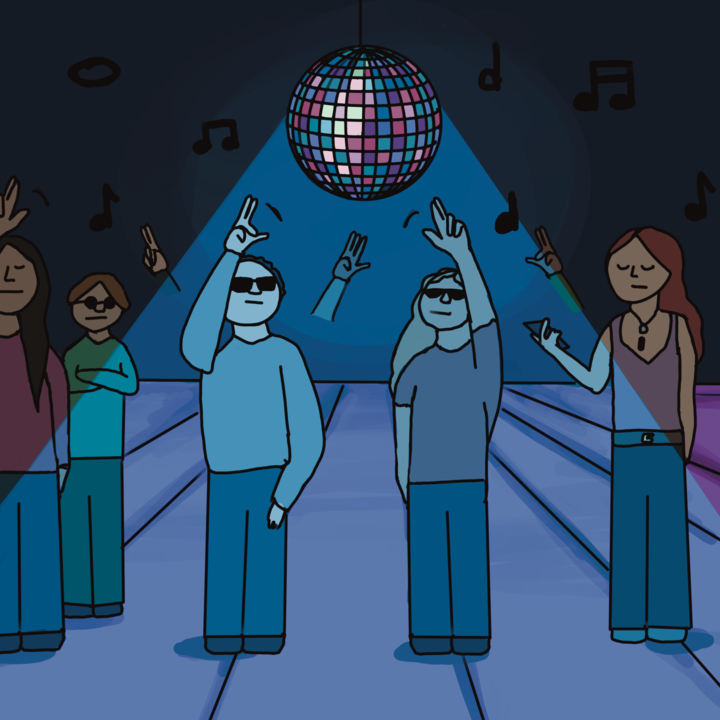
Tillie Szwartz | Contributing Illustrator
Choosing a random roommate as a first-year meant I (Levi Cutler) didn’t know what I was going to get. My roommate didn’t either. By the third night of school, our whole suite — four kids who had never met each other — were busting down to Francis Santana’s “Compadre Pedro Juan.”
This is what dance once was: serendipity colliding with moments of free expression — exactly what happened with me and my suitemates — creating a sense of community.
Unfortunately, these serendipitous moments of dance have become far too seldom. The norm at social gatherings looks something closer to low-effort frat flicks, almost imperceptible head nods, mindless drunken swaying, and other such detached dance moves (if you can even call them that). This is more than a change in the aesthetics of nightlife. It’s emblematic of a cultural shift towards indifference.
If we are going down the qualities unique to social dance, they are expression and spontaneity, particularly the moments where those two elements intersect. In today’s culture of collective nonchalance, detachment itself has become an enviable characteristic, in part due to social media’s romanticization of apathy in Gen Z. The culture of surveillance and public shaming has led our generation’s predominant emotion to be embarrassment. Yet, after nonchalance became the defining attitude, spontaneity in dance was diminished, and with it, the freedom of expression, the freedom to dance. As The Blessed Madonna said when featured on Fred Again’s 2021 hit track, “We’ve lost dancing.”
What once was a universal form of connection has been replaced by an ideology of indifference. When did “not caring” stop meaning reckless inhibition and start meaning total disengagement? Dancing used to be synonymous with freedom. It was an inclusive act with cultural roots tied to engaging with the community. Dancing was for everybody.
However, dance in 2025 explicitly does not include everybody. Online dance now exists, in many ways, as the antithesis to what social physical dance is. Within the context of dance, we contend with social media’s expectation of nonchalance by eliminating all defining character traits of social dance. We favor the safety of detachment rather than the exhilaration of uninhibited dance to protect our egos and reputations.
The detachment of online dance causes it to be isolating practice, overly routine-based, and driven by online engagement metrics. Traditional social dance is done with people (a community), sparked by moments of spontaneity and encouragement rather than judgment. To better understand the harm that the online world has done to dancing, we can look at the following three features.
First, online dances are generally done solo, making it inherently isolating. Stuck behind the screen, the only community one could feel is via the half-hearted comments of their followers. In traditional social dance, tangible community is the breeding ground for moments of expression and acceptance. For example, in line dancing, which originated in Nashville, the visual of the dance itself relies on a cohesive and consecutive group of people arranged in a lined format, clanking their boots in unison. Dances like Merengue require a partner, and square dancing uses a group of four and a caller dictating moves. The necessity of physical community is baked into each of these dances.
Second, online dance is almost entirely devoid of spontaneity. Conversely, social dance happens when moments of free expression collide with moments of spontaneity. For example, in traditional break dancing from the 1970s in the Bronx, dancers took turns improvising moves, competing, or telling stories through dance. Spontaneity was built into the idea of dance as both competition and self-expression, with the goal of impressing the audience around them. True dancing is expressive in nature, while the routinization of online dance has made it monotonous and mundane.
Third, social media is an inherently quantitative space. These apps’ focus on quantitative symbols of support, such as likes and comments, feeds into humans’ internal desire to compare ourselves to others, even when we are all doing the same dance. This homogeneity makes it so that dancers themselves are not judged on their skill, rhythm, or creativity. Instead, dancers are compared based on superficial qualities like appearance, opulent backgrounds, and curated outfits. The dance itself is simply a means to facilitate the judgment of others.
While online dance kills community, and its routine kills expressiveness, its unique quantitative nature kills both of the core tenets of dance. So, it is no surprise that those who are influenced by the online version of dance have no desire to be truly uninhibited in their movement when physically amongst a group of people. There is no real sense of community, and in turn, no reason to engage in social dance. But as humans, we need outlets for unfiltered expression. We need spaces where our bodies can do the talking. Nonchalance protects us from humiliation, yes, but it also walls us off from connection.
Dancing is the antidote. Dancing creates connections and transforms our minds. This mental transformation is not just a feeling; it’s something science can measure, too. The National Institutes of Health has published studies showing that dance builds potential relationships and encourages communal trust. Research from Harvard Medical School highlights how dance can strengthen memory and reduce stress. At Stanford, scholars of social dance argue that moving together literally makes us smarter.
Put simply, dancing rewires us for joy and connection. It breaks down our thoughts of self-consciousness. When done right, it is one of the few activities that integrates the mind, the body, and community in a single act. Dance has been a fundamental part of cultural expression across the globe for generations, far before the advent of social media or even the internet. The act of dance is ancestral and foundational to the human experience.
So next time you go out, dance because you don’t want to be part of the wide-scale trend of nonchalance. Dance because it is essential to our humanity. Dance to let loose. Dance to express yourself. Dance because it’s fun. Join friends and strangers and twirl, dougie, dab (post-ironically), or whatever your heart desires. Create a community through moments of expression and acceptance. Bring back dancing.
Stay in Touch!
Get the latest and top news from StudentLife delivered to your inbox