Forum | WashU in Focus 2025
Understanding the rural experience
Lucia Thomas | Staff Illustrator
In our first week of college, we all got that talk about imposter syndrome. Our seminar leaders gathered us up and said, “You belong here.” It was a nice sentiment, but a bit harder to believe as a student from a rural area.
As I tried to socialize that first week, every prospective friend brought up political issues I had never heard of. As I began my classes, I found myself fumbling in the dark as my professors brushed over academic standards, saying, “Well, you should already know that from high school.” I apparently belonged at WashU, but I didn’t know half of what anyone was talking about.
I couldn’t imagine that I belonged when everyone I met spoke with such vitriol about the place I was from. I have always identified strongly with my rurality, so when peers turned up their noses at all those “backwater rednecks,” I believed I’d be next if I didn’t change who I was.
WashU, despite being one of the few competitive colleges in the largely agricultural Midwest, admits very few rural students. For example, rural students make up only 8% of the Class of 2029. A rural student can be as social as possible and still very rarely come across someone who shares their experience. Even when we do find each other, our shame often gets in the way of community-building. No amount of discussion about imposter syndrome can change the isolating nature of the rural experience.
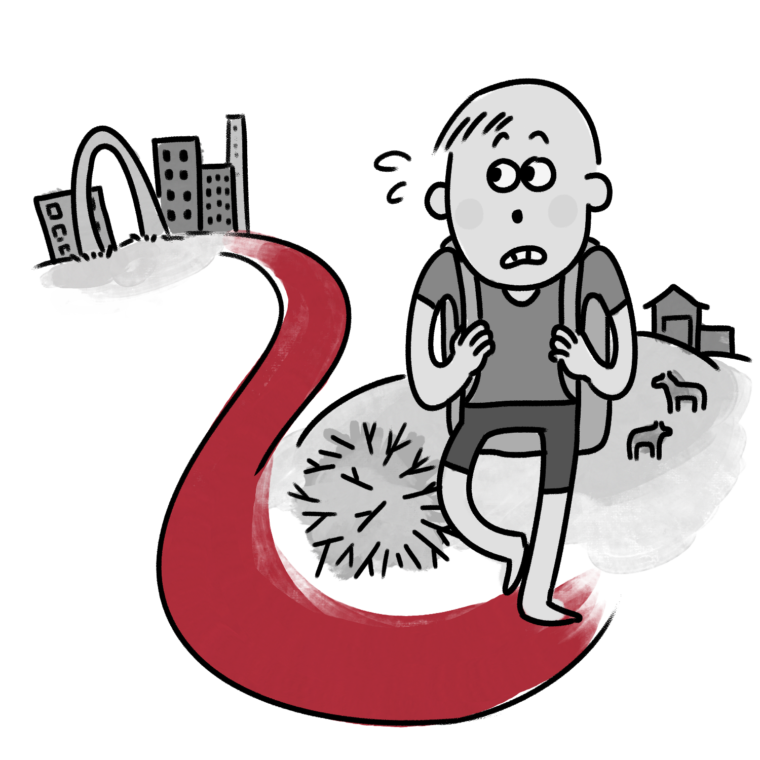
I grew up in a town of barely a thousand people that I had rarely left my whole life. Imagine living in a town where you knew everyone and every street; then, suddenly, you’re uprooted into a big city of strangers and Metros. It’s terrifying. It’s hard to explore St. Louis because you don’t know how to navigate a city. It’s hard to find people to go with you when it means admitting you have no clue what you’re doing. You can try to interpret the confusing signage on your own, but you’ll somehow keep taking the wrong train.
On top of this geographical difference, you face cultural change. The first time I realized I was different, I was in the Bear’s Den with my suitemate, and she complained about how few WashU students recycled and valued sustainability. Back home, only schools had recycling bins, and we were never taught what to recycle. The bins always sat unused. I had two choices: ask for help (embarrassing) or hope I didn’t recycle the wrong things (risky).
I could’ve told my suitemate that recycling costs money that we don’t have in rural towns. I could’ve told her that even my high school removed the recycling bins senior year because of budget cuts. I could’ve told her that there are so many economic barriers to sustainability that she doesn’t know. I could’ve told her that my ignorance came from a place of poverty, but it felt silly to say.
There were plenty of people of lower economic status here, so what made me any different? Rurality.
Rural communities have significantly less access to education, resources, and even social interactions with diverse groups of people. We are geographically isolated from the rest of the world, and some of us don’t even have Wi-Fi to learn about different experiences on the internet. We aren’t taught the vocabulary of colleges and cities. Very few even make it to college from rural communities.
We’re at WashU because we want to learn more than our underresourced hometowns could offer, but learning is a trial-and-error process. It’s hard to put yourself in a position to learn when people get labelled and condemned for one error. The amount of side-eyes I got when I asked my classmates what “diaspora” meant in a group discussion nearly scared me off speaking altogether. A conversation about gun control got really awkward when I asked about hunting. In these conversations, people jumped to conclusions when I was genuinely asking. It’s hard to grow with the fear of people’s judgments hanging over your head.
College is a place to learn. It is a miracle to people whose schools never had the money or geography necessary to effectively teach their students. The rural students of this school are here to learn, but we can’t do it alone.
The value of open-mindedness is immeasurable in the learning process. My suitemate listened to me about the inaccessibility of most environmental movements in rural communities, and she taught me how to recycle. When my friends trolled me for not knowing what a neopronoun was, I explained that any and all queer movements never made it to my hometown, and they caught me up without judgment. I finally swallowed my pride and asked how on Earth to work the Metro, and my friends didn’t belittle me.
But the stigma goes beyond friendships, especially with the divisive nature of politics today. When I’m not around my friends, I still hold my tongue for fear of people’s assumptions. Many people on campus resent rural folks for the current political state. They tend to have one view of the average Trump supporter, one that people in rural towns embody too well. I understand why it’s easy for people to reduce rural towns to this one stereotype, but I also understand the people in my hometown.
Being a rural student requires a constant act of translation. I always have to be defending the people I care about. At school, I have to prove that rural people are more than reductive stereotypes. Back home, I have to prove that academia isn’t the oppressive force keeping us down. It’s an exhausting experience, and one most rural students are all too familiar with.
We try to build community with the Rural Students Collective, but it’s hard to do so when we make up such a small part of the student body. We can understand each other, but we need more than that. We need you to understand us.
I know this is an experience most of you are unfamiliar with, but I assure you that you will learn something valuable if you take the time to listen. Rural students like me are adapting to a whole new landscape just to grow our perspective. All I ask is for you to put in the effort to listen to our perspective, too. The rural experience doesn’t have to be so isolating or overwhelming, at least not if you all take the time to understand it.
Stay in Touch!
Get the latest and top news from StudentLife delivered to your inbox