Forum
What happened to the Renaissance man?
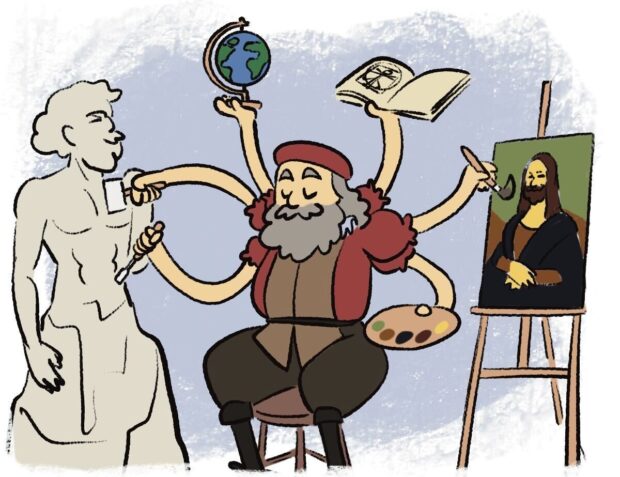 Illustration by Manuel Lopez
 Studying abroad in Italy this summer, I was caught in-between recognizing my own identity as a tourist and hating the influence of American culture on the rest of the world. When my family visited me, I guided them through Florence’s winding cobblestone roads with the self-assured confidence of a study-abroad student who thinks that living somewhere for 10 weeks is close enough to being a local. In my white button-down and long, flowing pants, I showed them the secret sparkling water fountains and the best non-crowded museums that still held Michelangelo’s and Donatello’s and Verrochio’s works.
Beyond it being the home of prominent Renaissance artists like Da Vinci and Botticelli and Brunelleschi, the art and detail of Florence extended into the architecture, streets, and conversations. It felt freeing being in a place where design and history were so highly valued, to the point that they quite literally made up the infrastructure of the city; it’s difficult to find a street that doesn’t have a beautiful gargoyle or intricate door handle or a building from at least the 17th century.
While I found myself to be an energetic tour guide and a captivated flaneur, my conflicting identity still troubled me. I enjoyed the paintings and sculptures and opera performances, but I realized that it had been a while since I’d made art out of passion myself. Throughout college, I hadn’t kept a personal sketchbook or drawn something that was for fun rather than for a school project. What inspired me about the values of Florence weren’t fully reflected by my own relationship to and practices with art.
In my early years of college, I chose the path of the Communication Design Major, which is, in many ways, the art-school equivalent of “specializing” in the Adobe suite, often with the intent of being more marketable in the design industry.
Even within my experience of being an artist, I’ve felt the pressure to specialize, to gain expertise in the “industry-standard” platforms, for the purpose of marketability rather than genuine interest.
Studying Renaissance history, rediscovering my own desire to sketch for the purpose of sketching, and enjoying the process of creating for the sole sake of enjoyment alone, I felt inspired to explore. Sketching (despite the complicated factor of keeping a sketchbook being a class assignment rather than a self-driven initiative) felt like a change in mentality. I found new materials to play with and drew the world around me, with no end-project in mind. With this feeling of self-discovery motivating me, I budgeted time to write and read in the evenings, making an effort to prioritize my own interests and develop my knowledge for no other reason than simply wanting to.
In my pessimistic, woe-is-me hours of contemplation, however, I pondered — what has happened to the Renaissance man? Wandering a quiet road that I convinced myself no one else had walked before, a warm breeze flowing through my hair, I romanticized this question into a grand revelation, the kind of enlightening moment that all Americans in Europe thirst for. At what point was art described to me as a career rather than a passion? What happened to being able to explore? Why can’t it be normalized to have an interest in science, art, politics, and literature, like the Renaissance thinkers?
The question “Who was the Renaissance man?” did cross my mind as well, as I realized it was only a wealthy white male elite with connections to the richest folks around town — the Medici family — that was granted the privilege of exploration in Renaissance times.
In a specialization-based world, there is now (in theory) an opportunity for everyone to contribute their expertise. No one can be a master of everything, and therefore, as everyone develops a mastery of one thing, we can invent and create in a much more productive — and arguably inclusive — fashion. But is intense specialization the only path to success?
Every so often, I’m surprised when someone makes a joke about majoring in a humanities discipline. Being surrounded by artists and writers in all of my classes and clubs has sometimes caused me to forget that there is still a stigma out in the world around studying something that isn’t STEM or that won’t lead you to an immediate six-figure salary.
Anyone who’s been met with an “Oh, that’s…interesting” after telling someone their major — or the more overt question that sometimes follows: “And what exactly do you plan to do with that degree?” — knows that the stigma around being a humanities major is very strongly present. Even if it appears in an off-shoot joke — like “Imagine paying college tuition for a major in art” — a societal idea is baked underneath the surface: anything that isn’t exclusively pre-professional, specifically in the highly coveted fields of medicine or computer science or engineering, are deemed a waste of a degree.
The ability to study for the purpose of enjoyment rather than employment comes with a level of privilege — one must be relatively financially stable to fully prioritize fun. That’s the sad but often true reality. Wealth barriers existed in the time of the Renaissance, and they continue to persist today. It is not my intent to suggest that everyone should follow their passions and not care about money, but rather to call attention to the depressing reality that pleasure and exploration and self-discovery are not valued by the long-standing pressure of specialization.
Being a generalist has marketable factors of its own. With the rise of automation, specialized fields are at risk of being taken over by machines. Also, majors such as English, History, Philosophy, Political Science, or Art teach analytical reading, writing, and clear-expression skills. These abilities are applicable to a larger number of fields, allowing students to apply for careers across industries rather than compete for the limited, exclusive opportunities available to someone with a pre-med pathway or Computer Science degree. And beyond avoiding that often toxic competitive culture, generalists can also be more involved in various, distinguished communities and therefore able to speak to a larger array of experiences.
Guilty of my own succumbing to specialization through learning the ins-and-outs of the Adobe suite to gain marketable knowledge — rather than picking up interests with the freedom of a true Renaissance man — I acknowledge that there is no way to avoid specialized learning to some degree. And I don’t encourage doing so. Specialized skills can be vital for long-term success.
Specialization is not, altogether, bad. Rather, college should not just be about learning one thing, becoming an expert, then cashing in the checks. College is an individual experience that should be about discovery and growth, whatever that means to a student. Just as it can be harmful to spread oneself too thin, narrowing in on one discipline from freshman to senior year can also have harmful effects.
In an article for Pan Macmillan, David Epstein writes about a Motley Fool investors’ event. The audience was asked what “the average age of a founder of a blockbuster tech startup when the company was first launched” was. The popular answer “was 25. When Facebook CEO Mark Zuckerberg said, at 22, that ‘Young people are just smarter,’ it resonated. And yet, researchers at Northwestern University, M.I.T., and the U.S. Census Bureau have shown that the answer is actually 45.”
Too much focus on specialization generates a false notion that massive, jackpot-level success right out of college is the norm and the goal. In reality, it is neither. Following the business-school–to–hedge-fund path into the world can accumulate large earnings in the long-run. However, the idea that pursuing something business or STEM related is a more worthwhile investment undermines the reality that nearly all college graduates, across all degrees, are still at the beginning of their careers.
Those studying art could benefit from finding their specialty — what makes them stand out as an artist — just as much as those studying computer science could benefit from finding an additional interest: what makes them stand out from those within their specialty. Nobody should be just one, a specialist or a generalist. People, especially students, should make room for both in their lives.
The world has changed, and the original idea of the Renaissance man has become antiquated, but the cultural values that created the Renaissance man can still be learned from. If anything, as tacky as it may sound, living in Florence showed me that a world where the humanities are prioritized just as much as the sciences is possible.
In a small mask-making shop, my friends and I shared with the owner that we were art students. In a response that I’ve only scarcely received in the U.S., the question that followed was, “Which school?” It was a simple question — the typical response you’d hear after telling an American you studied economics, and they were now wondering what tier the college you attended was at. A shift in cultural values is just the same: simple.
I admit to writing this with the self-justifying helplessness of a double major in English and Communication Design, confronting the precarity of post-graduate plans. Nevertheless, I quite simply believe that the stigma around being a humanities student stems from a problematic understanding of what defines marketability and what a standard path to individual success should be. There is power in being a generalist in a world which prioritizes intense, secluding specialization.
Stay in Touch!
Get the latest and top news from StudentLife delivered to your inbox