News
Can you change your personality? New “Lectures on Tap” series kicks off to say ‘yes’
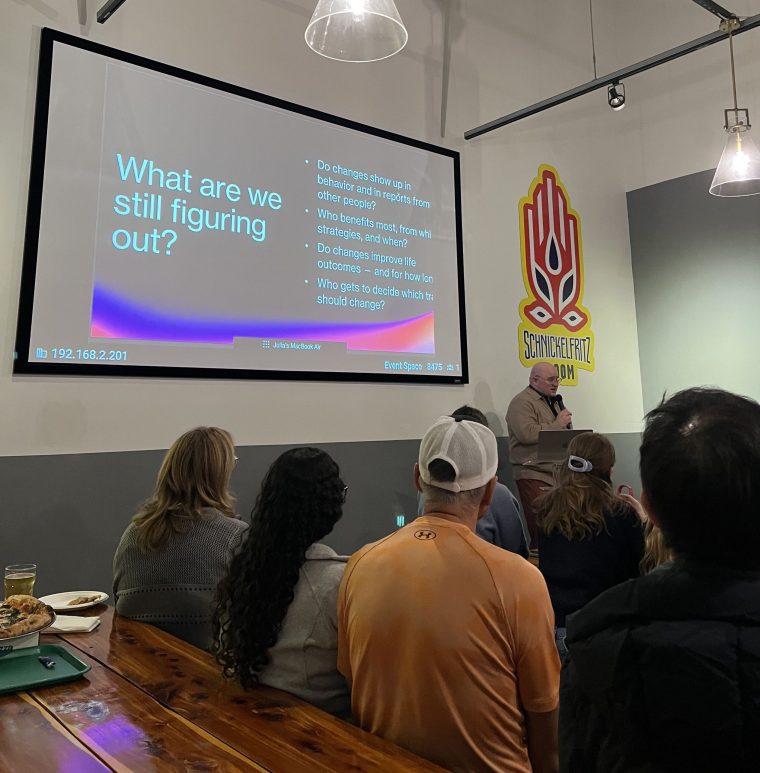
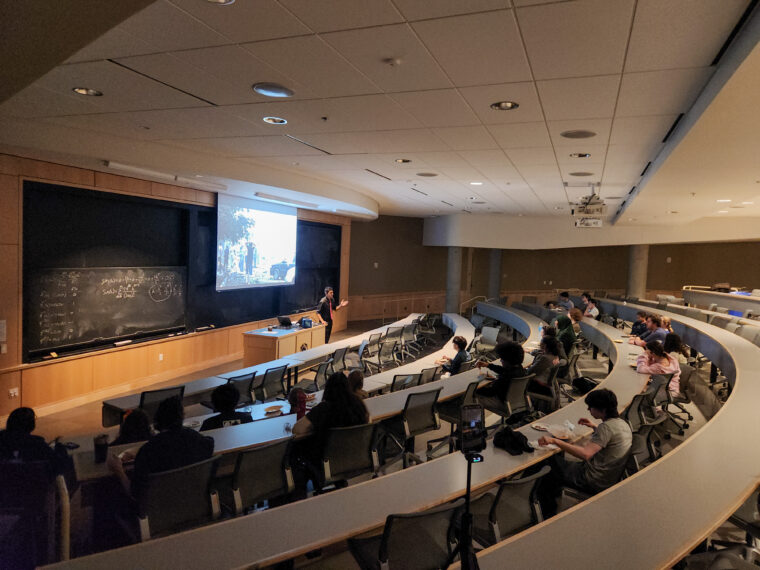
William Chopik spoke about the science behind personalities on Monday (Flannery Poon | Staff Writer)
Every seat was full, leaving room only as people crowded into Urban Chestnut Brewing Company in The Grove to hear William Chopik answer the question: can you really change your personality? Chopik, associate professor of psychological and brain sciences says yes — to an extent.
Chopik lectured on the psychology of taking specific steps to intentionally change personality traits. Chopik’s lecture on Monday, Nov. 17 was the first of a new series, Public Scholars on Tap, created by Julia Robbins, former Student Life editor-in-chief and the Communications Specialist of the Office of Public Scholarship. Inspired by the nationwide organization, Lectures on Tap, this program was created to host free academic talks from WashU professors for anyone in the St. Louis area.
“Our mission at the Office of Public Scholarship is to bring academic work to the public in accessible and dynamic ways, and this felt like such a perfect way to do it in St. Louis,” Robbins said.
Chopik highlighted one study that gave participants small actionable steps of increasing difficulty each day to try changing a specific personality trait. The example he gave to the audience was to increase a participant’s extraversion.
“So [the tasks] start out really, really basic, like [saying] hello to the cashier. You could probably do that, right? Introduce yourself to someone new. Do that tonight. Take the lead on organizing a social outing,” Chopik said. “Here’s the hard one: organize a meet-up event around your interest and invite total strangers to that thing.”
The more research participants engaged with these challenges, the more drastic their personality changes were, according to Chopik.
“So the take-home message for today is that personality isn’t quite set in stone, but changing it takes way more than just wishing it away. Wishing it [to change] will benefit you a little bit because you know that there’s something about yourself that you want to change,” Chopik said. “But then you really have to put more effort. Unfortunately, I wish I could give you a better message. You literally have to try.”
Leah Genth, a second-year student at WashU’s School of Medicine, said the event reminded her why it’s important to take action and not just hope for something to change.
“I think it just reminded me to be more intentional about my actions and more thoughtful about my day-to-day choices,” Genth said.
Chopik said that the goal with talks like this is to provide more accessible opportunities for people outside the WashU community.
“I think it all boils down to accessibility. I could give lectures like that every day for 30 years, but it wouldn’t penetrate the broader culture and society,” Chopik said. “A lot of times the people who need some of this help the most aren’t going to be sitting in a college classroom or they didn’t have that opportunity.”
WashU alumna Lila Zemil said that she would be interested in coming back for another lecture in the Public Scholars on Tap series.
“I really loved this experience. Being an [alum], you don’t really get much of learning like this in the wild. So having a time for the community to come together and … learn over some beers, it’s really rewarding and enjoyable,” Zemil said. “Best lecture I’ve ever been to. I wish all of it were like that.”
Genth added that she enjoyed the casual atmosphere and that people were comfortable asking questions during the Q&A section.
“It didn’t feel stuffy. I thought the question-and-answer part was really cool, and the general informality made it more accessible,” Genth said. “Even though [Chopik] was clearly a rigorous researcher, it didn’t feel academic to the point of being inaccessible.”
Chopik hopes the audience gained a broader appreciation of personality and their ability to change it.
“I think society is crying out for social connection,” Chopik said. “I think they’re crying out for ways to improve their lives, and I think it’d be a real shame if we couldn’t give them actionable stuff to improve their lives … the hope is that it gets people curious enough about themselves to maybe change their lives for the better.”
Stay in Touch!
Get the latest and top news from StudentLife delivered to your inbox