News
WashU leadership shares updates on University budget, projects a “smaller than anticipated” $7.4 million deficit in Fiscal Year 2026

WashU administrators shared updates on the University’s FY26 budget in a webinar emailed to faculty and staff Oct. 6. (Bri Nitsberg | Managing Photo Editor)
After finishing Fiscal Year 2025 (FY25) in a modest surplus, WashU projects to operate at a narrow $7.4 million loss in Fiscal Year 2026 (FY26), according to a webinar shared by the University in an email with faculty and staff on Oct. 6. Under the University’s approved budget for FY26, WashU is expected to bring in $5.04 billion in revenues, while spending $5.047 billion in operating expenses.
The projected revenue total marks a nearly $300 million decrease from FY25, when WashU made $5.3 billion in revenue, and spent $4.9 billion on expenses.
In recent weeks, the University has faced criticism from some students, faculty, staff, and community members over a lack of transparency with regards to its financial decision-making, especially after the announcement of over 300 layoffs last week. In the nearly 30-minute webinar, which featured Chancellor Andrew D. Martin, Chief Financial Officer David Gray, Chief Administrative Officer Nichol Luoma, and five other administrators, University leadership repeatedly emphasized a commitment to being open with community members.
“There are a lot of unknowns and we don’t have all the answers but we’re committed to being open and honest every step of the way,” Luoma said in the webinar. “Transparency isn’t only about sharing decisions, it’s about explaining the why and listening to your feedback along the way.”
In the comments section, however, some faculty and staff members expressed doubts over the University’s commitment to transparency. Additionally, some commenters, most of whom were anonymous, asked questions about whether there will be future layoffs, whether university administrators will take voluntary pay cuts, and how exactly the University will achieve additional savings.
Martin shared that WashU’s financial challenges stem from a range of factors, including an increased endowment excise tax, uncertainty regarding research and healthcare funding, and what he described as “a slowness to adapt to the financial realities that have evolved over the course of a decade or longer for the higher education sector.”
In the face of these challenges, WashU ended FY25 at a $335 million surplus, generating $5.3 billion in revenue and expending $4.9 billion. However, according to Gray, this excess is not actually available to WashU, and is largely the result of the way a gift of $335 million is recorded based on accounting principles.
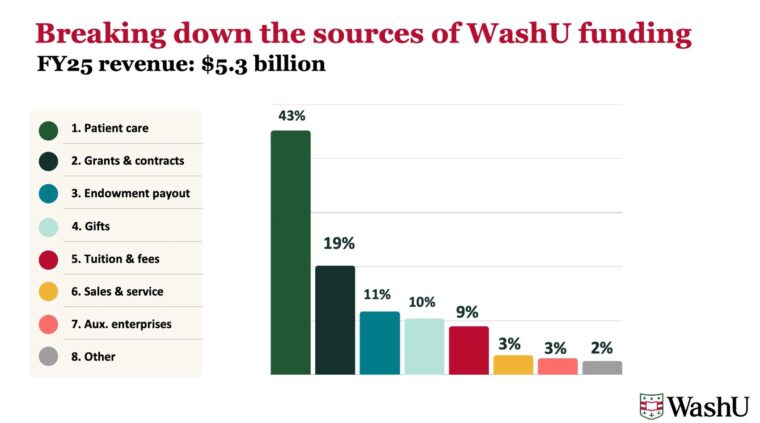
WashU made $5.3 billion in revenue in FY25, with 43% of it coming from patient care. (Screenshot of WashU Finance and Budget Webinar)
The University’s FY25 operating revenue was largely driven by the Medical Campus, which brought in $4.027 billion. In comparison, the Danforth Campus earned $877 million dollars. 43% of the university’s total FY25 revenue came from patient care, followed by 19% in grants and contracts.
Tuition and fees represented 54% of the Danforth Campus’ revenue, but just 9% of the university’s overall funding in FY25. WashU earned $882 million in tuition and fees across all schools, and granted $433 million in scholarships and financial aid. Gray shared that more than 40% of students receive financial aid, and that the average aid package for the most recent incoming class is more than $75,000 per student. Notably, the university has expanded its financial aid offerings in recent years, including through a new no-loan policy that began in fall 2024.
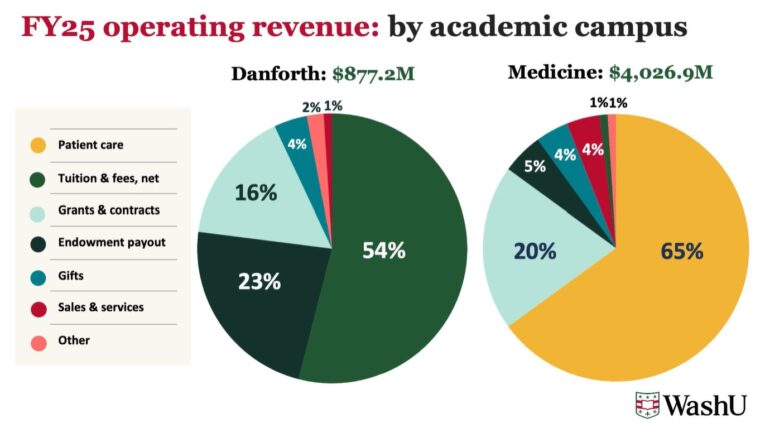
In FY25, WashU’s Medical campus made more than four times as much as revenue as the Danforth campus. (Screenshot of WashU Finance and Budget Webinar)
The University’s approved FY26 budget accounts for $5.047 billion in operating expenses, a small increase from $4.9 billion in 2025. Yet, according to Gray, the University is already implementing a number of cost-saving efforts to prevent a larger FY26 deficit.
“We’ve already implemented a number of strategic cost cutting measures in the Danforth Campus schools, the Medical school, and Central Fiscal Unit for savings of nearly $100 million reflected in our fiscal year 2026 budget,” Gray said. “Before we initiated this review, we were looking at significant deficits in all but the Medical School. As a result of our collective efforts, we are projecting a smaller than anticipated deficit of $7.4 million.”
Looking ahead, WashU expects to be back in the green in FY27, with a projected $11.1 million surplus in FY27 and a $49.6 million surplus in FY28. This growth is expected to be driven by the Danforth schools, which will be expected to improve from an $85.2 million deficit in FY26 to a $15.6 million deficit in FY28.
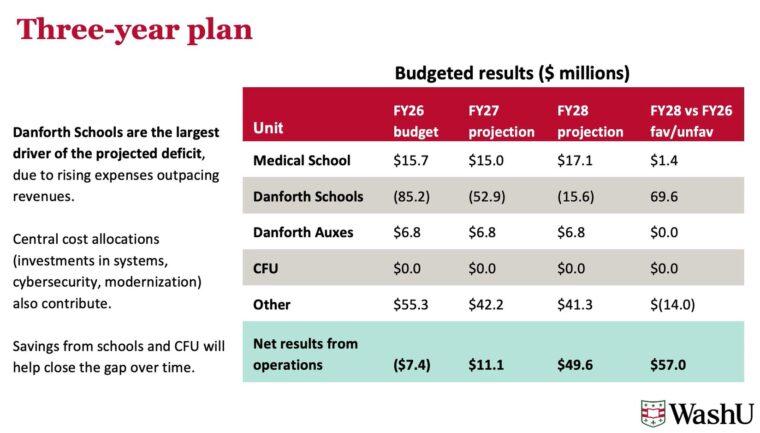
Though WashU projects a deficit in FY26, the University expects surpluses in FY27 and FY28. (Screenshot of WashU Finance and Budget Webinar)
One of the areas the University has targeted for cost reductions is staff. About two-thirds of the University’s operating costs are salaries and benefits for faculty and staff, and the University estimates it will save $52 million annually as a result of the decision to lay off more than 300 staff members and close almost 200 open positions, a move that was announced last week.
“While this particular round of staff reductions is now complete, looking forward, we still have some hard choices to make,” Martin said in the webinar.
Luoma addressed the difficulty of layoffs, and stated that the University is committed to supporting affected faculty and staff.
“We have taken steps to support employees who are impacted by staff reductions and have offered severance compensation and outplacement to everyone who was affected. These choices were not easy, but they were necessary to strengthen our financial footing and keep resources centered on our mission,” she said.
According to Luoma, the University is planning to bring back merit raises in FY27 after pausing them this year. She also shared that the Central Fiscal Unit, which handles human resources, information technology (IT), student affairs, finances, and more, reduced its budget by nearly 8%, and that those resources are going directly to the schools. For example, the University Advancement team laid off 38 employees last Monday.
In this time of uncertainty, some community members have pointed to the University’s large endowment as a source of funding. However, Gray emphasized that a significant portion of the endowment, which was at $13.3 billion as of June 30, 2025, is unavailable for operational use due to restrictions set by donors. The University can only spend a set portion of its endowment — known as the endowment payout — which is determined by the Board of Trustees. In FY25, the endowment payout represented approximately 11% of the university’s $5.3 billion in revenue.
“Most endowment funds are gifts restricted by donors for specific uses, and we are legally and ethically bound to honor those instructions,” Gray said. “So while the endowment is vital to our financial strength, we cannot rely on it alone to meet everyday needs.”
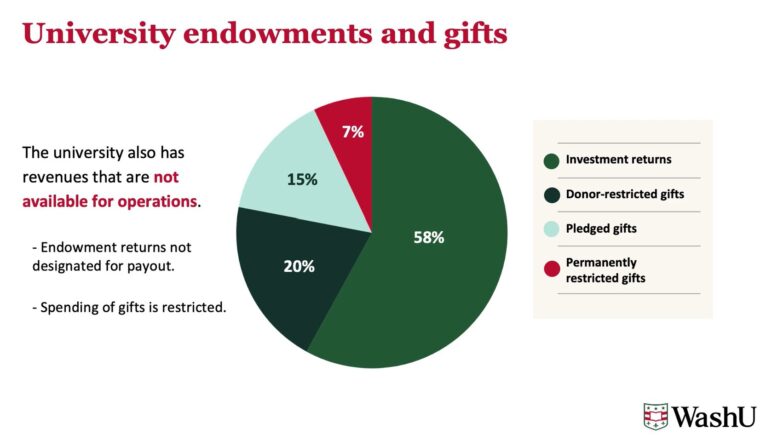
WashU’s endowment is worth over $13 billion, but a significant portion of it comes from restricted gifts that are not available for operations. (Screenshot of WashU Finance and Budget Webinar)
Uncertainty remains about the impacts that potential adjustments to federal research funding models and changes to Medicaid funding will have on WashU. In his concluding remarks, Martin emphasized a commitment to sharing information with community members as the University navigates the complex situation.
“We don’t have all the answers yet, but as we move forward, we will continue to communicate openly and regularly,” Martin said. “Transparency is essential and we want to keep you informed about where we are and where we’re going.”
Editor’s Note: This article was updated at 9:33 a.m. on Oct. 8 to clarify that the layoffs announced on Sept. 30 were just to staff, not faculty and staff.
Stay in Touch!
Get the latest and top news from StudentLife delivered to your inbox