Sports
Q&A with UAA Commissioner Sarah Otey and WashU Athletic Director Anthony Azama
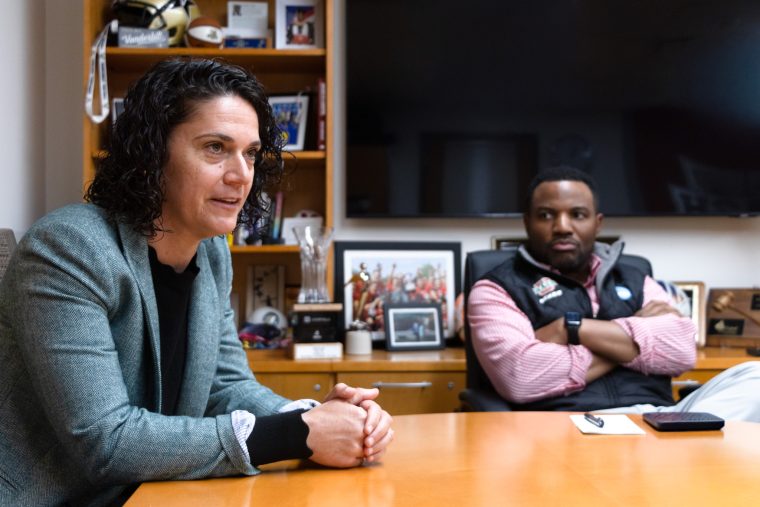
Student Life interviewed UAA Commissioner Sarah Otey on Nov. 6. (Isabella Diaz-Mira | Managing Photo Editor)
University Athletic Association (UAA) Commissioner Sarah Otey and Athletic Director Anthony Azama sat down with Student Life for an interview on Friday, Nov. 6. Otey and Azama discussed the UAA and WashU’s athletic success winning six national championships since 2020, the current landscape of college athletics, the conference’s broadcast deal with FloSports, and Otey’s vision of the future for the UAA.
This interview has been edited for length and clarity.
Student Life (SL): UAA teams have seen great success across Division III. What do you credit to the conference’s success on the national stage?
Sarah Otey (SO): I think leaders like you have here at WashU and at other UAA institutions are choosing to intentionally invest in success and to prioritize the student-athlete experience and use that as a way to get students on campus. The UAA has been incredibly successful. We won six national championships last year. We sponsored 20 sports and finished either first or second or both in 10 of the 20, which is incredible. I wish I could claim any degree of credit for that. It’s certainly not me. It’s the folks that you all have on campus.
SL: You touched on student leaders. What role do they play in the success of both the member institutions and the conference as a whole?
SO: I think on your member institutions’ campus, student leaders are the ones who are the biggest contributors to overall department culture. The way that they support and invest in not only the success of their own team but the success of other teams on your campus that elevates the culture of the campus, and then you know the rising tide theory, right? You saw that play out here last year with winning the Directors Cup. … At the conference level, I think we use student leaders to help identify issues that are important to student athletes, and then take those issues to administrators who can help create a conference culture and expectation of success in a way that benefits student athletes.
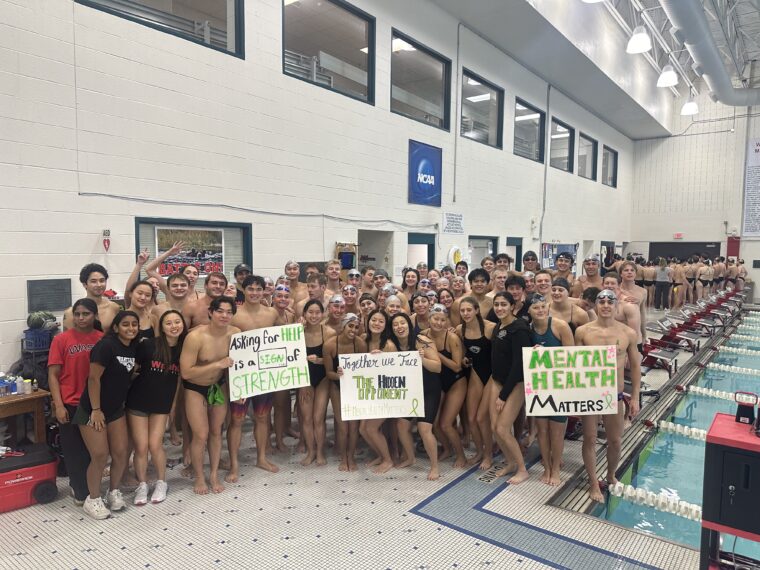
SL: One topic that’s been on a lot of people’s minds is student-athlete mental health. At the conference level, what is the UAA doing or planning to do to support the mental health of student athletes?
SO: We surveyed all of our UAA student leaders on whether we should offer some programming or invest in student-athlete development. And it was not specifically mental health, but kind of in the mental health landscape, they’re worried about burnout. … You’ve got students on these campuses that are pursuing perfection in every aspect. They are pursuing academic perfection. They’re pursuing athletic perfection, and needing help navigating what they might perceive as failure. I think that we try to reorient them to see [these moments] as growth or opportunity. And so we’re bringing, mostly virtually just because of our geographic landscape within the UAA, student-athletes together a couple of times per year to hear from professionals that can help them navigate some of the things that they are uniquely experiencing as student-athletes.
SL: There’s been a lot of changes at the NCAA level, especially Division I. How do you look forward and navigate the changing world of college athletics?
SO: It changes literally every single day. So again, I talk to student-athletes across the UAA and try to get their perspective on any of the changes. We talked about NIL [Name, Image, Likeness] this morning, and we talked about the age-based or the five-year eligibility model in Division I. [We are] trying to understand the student-athlete perspective, and then use that to springboard conversations with the administrators on campuses who are ultimately the decision makers for any NCAA policy. We’re in a world of incredibly rapid change right now, and it can at times be hard to keep up. But I think that what our administrators do a really nice job of is, I’m gonna steal [Azama’s] term, “keeping the main thing the main thing,” and knowing that our goal is to provide an exceptional student-athlete experience and to put our student-athletes in a position where they’re most likely to be successful and hear their voice on some of these national issues and policy issues.
SL: The UAA signed a deal with FloSports in 2025 to have all of the conference games live-streamed there. How have you seen that impact annual viewership, and what has the feedback from member schools been so far?
SO: The viewership question is incredibly difficult to answer, and the reason is the way that the services that our schools were using prior to us signing with FloSports count viewers very differently than FloSports counts viewers. FloSports is actually working on amending the way they count viewers to look a little bit more similar to everyone else in the landscape. So in six months, I might be able to more compellingly answer that question. … We’re in year two of our contract, and last year we had a challenging start, and I don’t think it was as much because we were on FloSports, but more this combination of we moved to a subscription-based service, and we were having some streaming issues. It’s way easier to say “too bad” when there’s a streaming issue that people aren’t paying for. It’s a lot harder to defend a streaming issue when somebody’s paying for a product. It has gone so much better this year so far, and I think this year our schools are really starting to see the value of the ways they’ve been able to reinvest the media rights distribution into improved production quality. And we also have worked with FloSports to make sure that they are regularly, through their platforms which have hundreds of thousands of followers, way more than ours do, support and promote UAA student athletes.
Anthony Azama (AA): We’ve seen an increase definitely in the branding because that’s the one thing we added, or what we wanted [the UAA] to negotiate into the contract is how FloSports can continue to help us elevate our brand through their communications. Because I think we’ve a great story to tell, and I think the experience that UAA student-athletes have is so different. Not just different from the majority of D-III, but I would even say like the Mid-American Conference that travels by bus. I mean, we’re traveling by plane and into these big cities, which is not the norm for D-III schools. … The fact that since the pandemic, this has been a very competitive league, … and in the Final Four, where three out of the four teams are UAA women’s soccer teams, I think that part of it says a lot about the value and kind of what [Otey] has brought in from a perspective of understanding the experience that we’re providing for student-athletes. That’s why we had to rebrand [the UAA] from the logo to the messaging, because I do think there’s something to be said about a student-athlete who experiences both academics and athletics in the UAA versus another comparable conference.
SL: The UAA, despite being one of the best conferences in the country, does not sponsor football. Are there any plans, either now or in the future, to either sponsor football or reevaluate whether or not the conference would do that?
SO: So, in the short term, probably not, and the reason is just a statement on the governance landscape in which we live. We have eight institutions. Five of them sponsor football. In order to get an automatic bid to the NCAA championship, you have to have six schools competing with each other in the same sport. … So right now, all of them have access to the NCAA championship, which they would not if we hosted it in the UAA. So it’s really just a practicality question at the moment.
SL: What are your goals and hopes for the conference over the next five to 10 years?
SO: Jokingly, not screw it up, because we’re in a great place. I’m starting my third year, and when I first started, my goal was we’ve got eight institutions, some of the best institutions in the world, and the name WashU in and of itself is a brand and is a recognizable brand. Same with our other seven schools. The UAA has historically not been a recognizable brand, and so I think it’s important for everyone across all divisions to understand that WashU is associated with NYU, is associated with Emory, etc. So I think that we need to continue to elevate the brand and identity of the UAA so that non-athlete students on WashU’s campus, on Case Western Reserve’s campus, are walking around and being like, I go to a UAA school. So, that’s one of my goals. I think continuing to provide and create an environment where our students can compete for national championships and do so with the support of both their institution and their conference.
AA: First, I think what Sarah [Otey] has brought to the UAA is a lot of clarity. Second, for us to understand our worth and our value collectively. I think when you look throughout the sports that the UAA sponsors, we’ve been able to compete at a high level and compete well into the postseason. And I think that says a lot about how the conference can get [teams] ready for the postseason, which is kind of exciting for us at WashU. As Sarah [Otey] alluded to, just trying to “keep the main thing the main thing,” and really focus and hone in on the process of development. The outcomes will be the outcomes, but let’s just own the fact that we have the ability to meet young people where they’re at, regardless of zip code, and get them to go beyond their initial aspirations. Our hope is that at the end of this, they are better versions of themselves. And along that ride, hopefully we can win more than we lose.
Stay in Touch!
Get the latest and top news from StudentLife delivered to your inbox

Bears in the Rankings
Week of
Fall
- #1 Women's Soccer
- Golf: #4 WGCA | #7 Scoreboard/Clipp'd
- #6 Volleyball
- #7 Men's Cross Country
- Football: #7 AFCA | #8 D3football.com
- #8 Women's Cross Country
Winter
- #10 Men's Basketball (preseason)
- #11 Women's Swimming and Diving (preseason)
- #12 Men's Swimming and Diving (preseason)