Scene | Scene Says
Review: ‘You Can See Everything’ is a riveting three-hour test of perceived reality
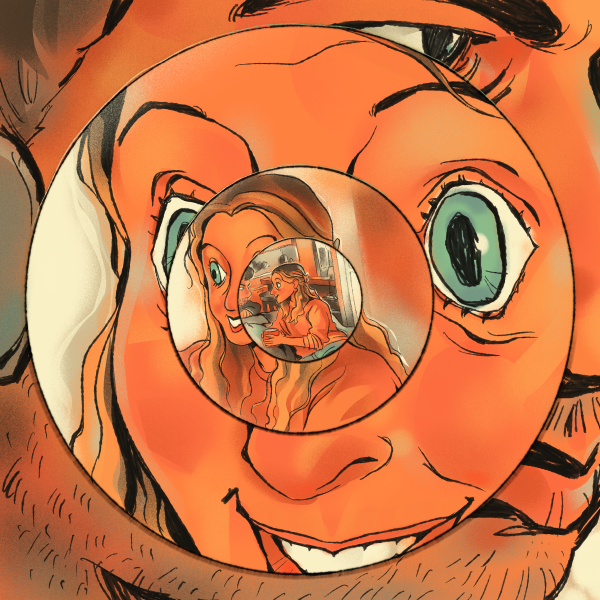
Reid Kellermann | Staff Illustrator
Even in observing Elizabeth Holmes’s every carefully-chosen word, wide-eyed stare, and waking moment, “You Can See Everything” proves that the most fundamentally inaccessible and incomprehensible place is the inner machinations of the infamous inventor-fraudster’s mind. In their enrapturing new documentary that tests the fundamental limits of the genre, directors Nathan Fielder and Lance Oppenheim were provided unfiltered access to record and live in Holmes’s shared home with her partner, Billy Evans.
At the beginning, Holmes is preparing to go to prison for her 11-year sentence for defrauding investors through her biotech company Theranos. Yet from its first moments and throughout the entirety of the film, Holmes vehemently insists she never did anything wrong and has never truly lied a single time in her adult life. She goes from carefully composed, beautifully articulated answers that artfully avoid substance to sudden, streaming tears that present her as a figure deserving of either deep respect or immense loathing.
This is not just a documentary about her psyche — it is also an exploration of three central figures: Holmes, Evans, and Fielder himself.
Evans reveals himself to be a fascinating enigma in all of his controlling machinations and blind faith in Holmes, disrupting Fielder’s interviews with Holmes and her family. For his part, although Fielder is one of the co-directors, almost every scene involves his awkward, belligerent, probing questions. His extreme self-insertion in the film becomes its own conflict within the documentary, with “You Can See Everything” intriguingly questioning the meta duties of documentarians and how far they can go.
Throughout, cinematographer David Bolen beautifully captures an orange- and blue-drenched world of over-exposed backgrounds in closely-cropped near-square 4:3 aspect ratio shots that heighten the film with claustrophobic close-ups of faces dominating the screen.
“You Can See Everything” is riveting, flying through its three-hour runtime with unexpected developments and perhaps ends in a questioning, uncertain place even more distant from its subjects than it began.
Stay in Touch!
Get the latest and top news from StudentLife delivered to your inbox