Scene
Armour launches 35th edition, ‘TRACE’
Courtesy of Nathan Yap
The creation of a student magazine rarely reflects a single voice. For Armour, one of WashU’s student-run fashion and culture publications, that multiplicity is the point. Built over the course of nine months, each issue exhibits not just the finished product but a process of collaboration, experimentation, and trust.
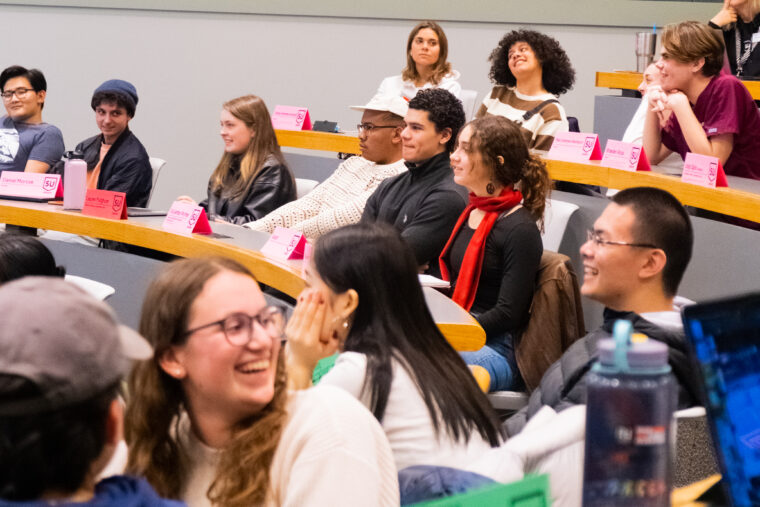
Production on this year’s issue began, as it always does, with a theme. This year’s concept, “TRACE,” was decided at the first full-team meeting in June, where the executive board gathered to begin shaping the magazine’s vision. The next step of the process is a pitch-fest, where all members of Armour (roughly 150 undergraduates) propose editorial concepts over the span of several hours. Ideas are debated, refined, and ultimately distilled into around 20 potential editorials.
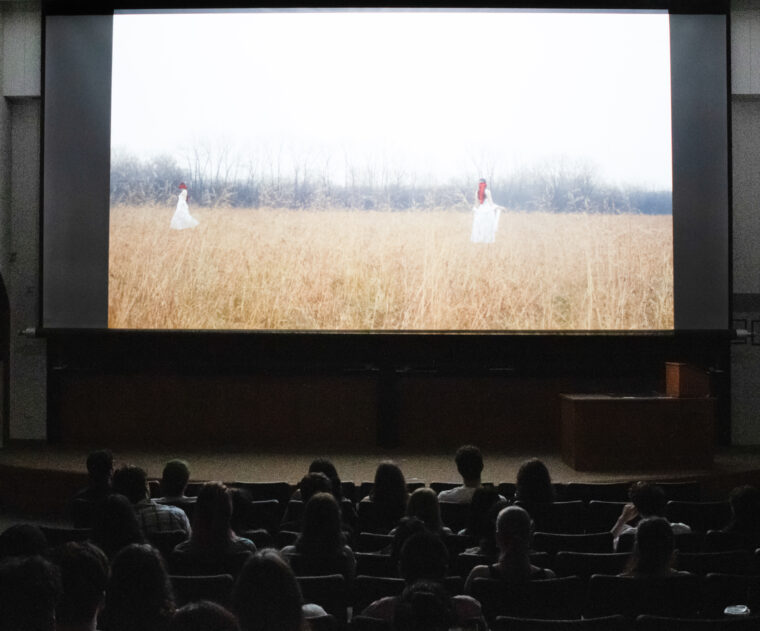
From that pool, a smaller selection — typically eight to 10 — makes it into the final print edition, while other editorials are published online. This year’s issue includes nine editorials, along with an additional spread dedicated to Armour’s inaugural short film, marking a new creative direction for Armour as it expands beyond print.
The short film, entitled “Where Sight and Sound Falter,” is directed by junior Ethan Kim and produced by Armour. It is the first non-magazine publication that Armour has sponsored and represents an expansion of creative endeavors piloted by Armour’s current editors-in-chief, seniors Max Selver and Seo-eun Kim. They emphasized the work and collective effort it takes to run a publication of this caliber, and the vast range of students and talents that made it happen.
“It’s really a labor of love,” Selver said. “I think we had 167 people contribute to this issue in some capacity — not just in Sam Fox, but across really all of WashU.”
Despite the scale of the operation, much of Armour’s identity lies in its decentralized creative structure. After concepts are selected, creative directors are given the freedom to shape projects according to their visions, and they are entrusted with everything from visual direction to budgeting decisions.
For first-year Morgan Montoya, a creative director, writer, and model, that freedom was one of the most defining aspects of her experience. She described being encouraged by the executive board to move beyond the confines of WashU’s campus and to engage more directly with the St. Louis community.
“[We’re encouraged] to be a part of the community and to express a message [that is] political, social, or just about how we feel as young adults in life,” Montoya said.
That balance between independence and collaboration appears across all roles in Armour. Evan Guyer, a sophomore who wrote for multiple editorials, emphasized the emotional investment in the projects that build over the course of production.
“It’s like it’s our child,” Guyer said. “I am so excited to see the culmination of all our work. And for it to be this tangible thing, I think is so cool.”
For many contributors, Armour offers a rare opportunity to move fluidly between creative roles. First-year Xavier Mason, who worked as both a creative director and a model, described the experience as both empowering and immersive.
“They gave us … the theme and they were like, ‘Do whatever you want — purchase whatever you want,’” Mason said. “They are supportive of funding whatever you need to do to get the vision done.”
Mason also pointed to the organization’s inclusivity, noting that Armour accommodates a wide range of interests and commitment levels.
“No job is too small, no job is too big,” he said. “If you want to be a part of Armour, there is a spot for you somewhere. You can find whatever your niche is. … If you’re just wanting to try and test it out, just do it. … Go all in, don’t be scared of it.”
That openness is supported by significant institutional resources. Armour operated during FY 2026 with a budget of $46,712.37, with $39,779.56 already allocated for FY 2027 — funding that enables the scale and ambition of its productions. According to Selver, the support received from Student Union is essential to maintaining both the magazine’s quality and accessibility.
“I feel so grateful that SU gives us the amount of funding and latitude that they do. … We really feel so lucky that we’re able to basically give whatever resources that students need to execute their creative vision,” Selver said. “When you take the financial element out of wanting to execute a project you’re passionate about, … it really makes such a big difference”
In an era dominated by digital media, Armour’s commitment to print remains central to its mission.
“I think in this day and age, there’s something that feels very radical about a print magazine because everything is online now,” Selver said. “We feel that it’s important, given the amount of work all our students do, to produce that print magazine so that [people] can have that tactile experience to actually turn their pages and literally hold their work in their hands.”
The 35th edition of Armour is available to view here.
Additional reporting was contributed by Elle Ludwin.
Stay in Touch!
Get the latest and top news from StudentLife delivered to your inbox