Scene
The past meets the future in Blas Isasi’s “Currents: 125”
Alex Dering | Photo Editor
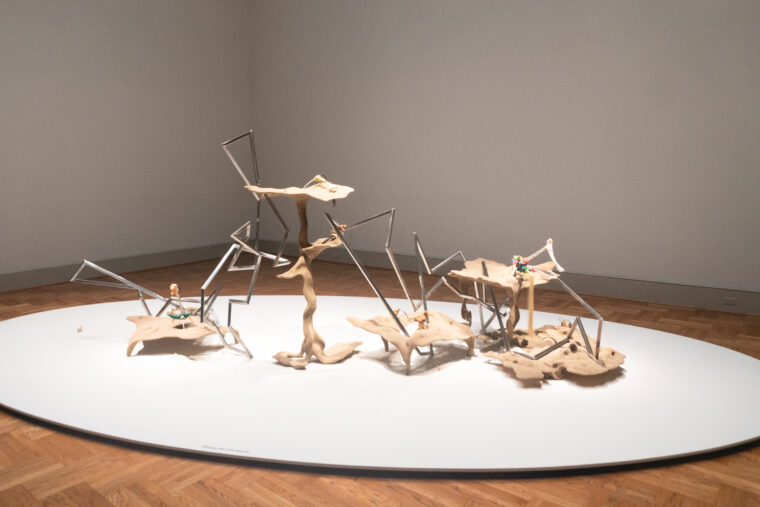
From one angle, the sculpture almost looks like a ballerina. But when viewing it from any other side, it changes entirely. The abstract figure arches and curves, bone shards jutting out like limbs, the bumpy green-red core arched like a spine, bending back in a graceful motion. Soft orange tendrils twine around the central section, winding rootlike around the bases of the bones. The small, vividly colored sculpture looks soft, even the solid fragments of bone which prop up the piece.
If you were to google “Currents 125: Blas Isasi,” a picture of this sculpture, on display at the St. Louis Art Museum as part of SLAM’s new exhibition, would be the first thing you see. On Feb. 6, 2026, SLAM opened Peruvian artist Blas Isasi’s “The weight of a gaze (is to listen to the sound of a kilogram)” as part of the museum’s “Currents” series. This series occurs annually as part of WashU’s Henry L. and Natalie E. Freund Teaching Fellowship.
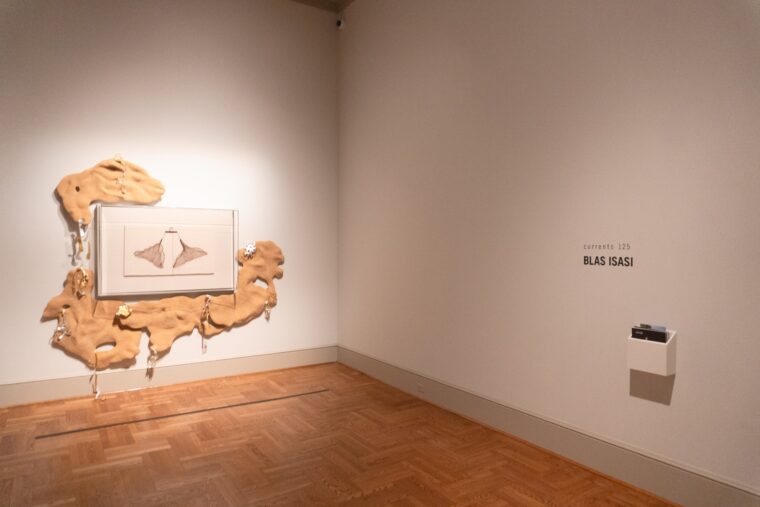
The fellowship, which includes a single-class teaching position at the Sam Fox School, offers artists a $45,000 teaching award, studio space, access to the Sam Fox facilities, and the solo exhibition at SLAM, which SLAM presents each year under the title “Currents.” However, Isasi also titled the exhibition, using his characteristic poeticism and meaning. “The weight of a gaze (is to listen to the sound of a kilogram)” is inspired by a Chicha Inka balance that Isasi came across in SLAM’s permanent collection. Isasi incorporated the balance itself into his exhibit, surrounded by sandstone sculptures with aluminum foil pieces.
Though “Sound of a Kilogram” is a sculptural exhibition, Isasi started his career as a painter, focusing on hyperrealism and photorealism. However, he eventually decided that spending several months working on a single painting was neither sustainable nor enjoyable so he shifted his focus to sculpture.
“I didn’t decide to become an artist to make money. I wanted to become an artist, to have an interesting life and to make something that I was very passionate about. And that’s how, in a very intuitive way, I turned to sculpture,” Isasi said.
Isasi began his shift toward sculpture with 3D objects such as paper weaving sculptures, a technique in which interlacing strips of paper are woven together to form complex and abstract shapes. However, it was only in the last few years that he was able to fully develop his distinctive sculptural style. Isasi’s current work strives to embody the desert geography of Peru, and especially of his home city, Lima.
“I tend to make these very organic looking forms that, again, defy or interrogate this nature-cultural divide, and the desert, again, is very much present as a landscape, but also as an environment that shapes life, shapes forms, shapes all of the non-human and human entities that inhabit it,” Isasi said.
Alongside the natural landscapes of Peru, Isasi has attributed much of his inspiration to ancient Andean civilizations, such as the Moche and the Sicán. He explores ancient Andean ontologies — analysis of the nature of existence through mythological narratives — and cosmologies — cultural narratives that explain the origin and structure of the universe — as well Andean art and architecture.
“They had a very specific, very particular approach, where they saw themselves as part of a larger society that was made up of not only humans, but many non-humans, mountains, outcrops, and many other geographical formations or animals,” Isasi said.
Material is key to Isasi’s process, and he has an interesting hypothesis on the intentionality of materials used by the ancient Andeans. In many ancient Andean civilizations, the most common building material was adobe, a form of mud brick. Adobe bricks are a softer material than stone, eroding far more quickly, and therefore structures built using adobe bricks are far less permanent than stone.
“My understanding is that, ancient Andeans, they knew this. And they did this with intention,” Isasi explained. “They understood that they had to negotiate their standing with other agents, cosmic agents, so to speak. And, they were just stewards of a certain landscape for some time, and then they knew that at some point in the future, they would have to give up and let other agents take over, … so that’s part of what my current show at SLAM is about.”
Material is also key to Isasi’s process, and his choice in media is heavily influenced by ancient Andean civilizations.
Alex Dering | Photo Editor
Isasi works with a wide array of materials, but he consistently uses sand and wood. More recently, he has begun incorporating bones and artificial hair, speaking to Andean practices of ancestor making. Ancestor making is a tradition in many indigenous cultures, including the ancient Andeans. The process is different in each culture, but the idea is to take physical elements of the deceased — such as bones or hair — and preserve them in some way, often transforming them into a different form, to honor and memorialize the deceased. In many cultures, death is not considered the end of a person’s existence, and ancestor making was important to their continued journey.
“In general, the approach to death, something that was just another step in the existence of a human being [on] the planet, just another stage — that’s what I’m trying to bring into the conversation,” Isasi said.
In this exhibition, Isasi shifted his focus to addressing colonization in Peru.
“I’m still tapping [in] on these ancient ontologies, but addressing more specific historical context, such as hybridization, that came as a result of the violent encounter between the European and the Andean cultures after the Spanish conquest,” Isasi said.
Although Isasi does not view his work as explicitly political, he acknowledges the social consciousness that it seeks to develop.
“We need to look back into the past into all of the non-Western or pre-Western cultures and the way that they understood, how they understood the world, and how they managed the relationship between other non-human entities … I feel like we’re in a moment in history, we’re looking to the past [as] a way of looking into the future. My work is establishing a critical dialogue with current events and current conversations,” he said.
In addition to exploring the histories and mythologies of non-Western and pre-Western cultures, especially those of the Andes, Isasi hopes that his art can bridge the gap between the future and the past, allowing people to envision a different world.
“I feel like we are stuck in this moment where, for many reasons, we feel like we’ve lost the ability to have agency over reality, and the ability to shape the world and to imagine different futures and worlds,” Isasi said. “And I feel like that’s something I would love for my work to do, to help people, or inspire people to imagine things, imagine a different world.”
“Currents 125: Blas Isasi” is on view at SLAM through Aug. 9, 2026.
Stay in Touch!
Get the latest and top news from StudentLife delivered to your inbox