Scene
Paws and gourmet: Cooking a beef Wellington with only Paws & Go ingredients
Mac Motz | Photo Editor
The beef Wellington is the epitome of fine dining. It oozes elegance, class, and a refined palette. Constructed in layers, it begins with only the most expensive cut of beef: a buttery and tender filet mignon seared to perfection, coated with a subtle yet complex Dijon mustard. The next layer is a luxurious helping of duxelles (that’s finely chopped mushrooms sautéed in butter and herbs, you Neanderthal), followed by a thin layer of melt-in-your-mouth prosciutto. Finally, these rich and complementary flavors are surrounded by delicate puff pastry and rolled into one stunning supper centerpiece, perfect for your genteel soiree. Gathering the ingredients for this delicacy can be a job only for WashU’s distinguished convenience store, Paws & Go!
The goal is simple: Make a beef Wellington exclusively with ingredients from Paws & Go. It will not be easy. It may not even be remotely possible. But there’s only one way to find out, and that’s to go grocery shopping. I decided to go with my friend, first-year Diya Gupta. As it turns out, Paws & Go is not really into the whole “groceries” thing, so we’re really going to have to get creative. The only ingredient our recipe and the original beef Wellington have in common is Dijon mustard, which, for some reason, Paws & Go sells. Beyond that, it’s a complete wasteland. If, for some forsaken reason, you’re cooking along at home, here’s what we walked away with:
- Roast beef sandwich
- Dijon mustard
- Three bell peppers
- Ham and cheese sandwich
- White bread
- Eggs
This ingredient list may feel small, but real beef Wellington recipes also have short ingredient lists. Stop doubting us.
The Frank E. Hurd first-year dorm kitchen isn’t ready for us. I’m sure it’s seen some horrors over the years, but this has to be up there. Another hurdle — our cling wrap contact has fallen through (someone stole it from his dorm’s kitchen), so we’re going to be rolling this thing up with baking sheets and tin foil.
We begin with the center. Instead of a gorgeous filet mignon, the closest Paws offers is the roast beef from a roast beef sandwich. It will have to do. We roll it into a small burrito-esque shape, using the Dijon mustard as a sort-of glue. Appetizing. It goes into the fridge to firm up.
The duxelles are next. Predictably, Paws & Go does not have mushrooms. In fact, they only sell two vegetables, as far as I can tell: cucumbers and bell peppers. The lesser of the two evils here, I feel, is bell peppers. As we do not have oil, the sautéing process is fraught. The charred bits add flavor, or something. Again, we season with mustard.
Paws & Go also does not have prosciutto, so in its place, we use ham from a ham and cheese sandwich. I’d issue an apology to the entire nation of Italy, but desperate times call for desperate measures. With this, we can begin assembly of the Wellington innards. We lay out overlapping slices of ham, followed by a layer of our “duxelles” joined with Dijon, before retrieving our cold beef cylinder from the fridge and placing it in the center. Rolling it up with the tin foil is a complete mess, but eventually, we form a stable enough log to put it back in the fridge.
The final and most difficult hurdle awaits us: the puff pastry. Our plan is to roll the bread flat into a crust using a water bottle. At first, this plan works, but then the individual bread pieces stop adhering to each other; in classic Paws & Go fashion, the bread is a bit stale, and it falls apart on the baking tray. Clearly, the bread will need to be wet. In a beef Wellington, the final step is to apply an egg wash to the outside to achieve a lovely golden hue. For ours, the egg wash is going to have to step up in a big way. It must hold the crust together. We whisk two eggs in a bowl and soak the bread in the scrambled egg mixture. Finally, it has the moisture and structural integrity to wrap completely around the meat, mustard, and bell pepper log.
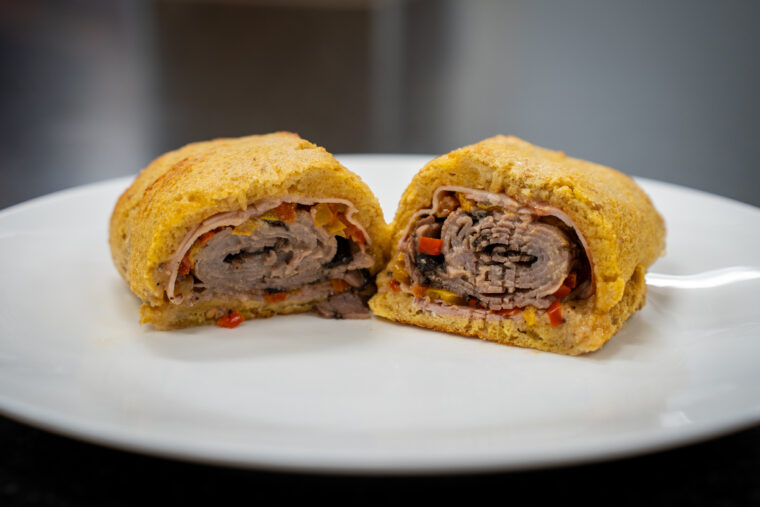
We put it in the oven for a while at 350 degrees Fahrenheit. Do you really care how long? Until crispy, or whatever. This isn’t a recipe — please don’t attempt! Upon removal from the oven, it actually looks better than I thought it would. The egg has given it a nice yellow-gold color, and it’s rather Wellington-shaped as well. Jolly good! Cutting it open, though, reveals a much sadder sight. It looks bad, just really not good. The roast beef is a distressing gray shade, and the pops of color from the bell peppers make it look more sickly than anything else. The taste is also bad. It’s shockingly salty — so much so that no other flavor can come through. This is baffling, considering we did not add any salt. Not even the copious amount of mustard is discernible as a flavor. The texture? Generally unpleasant, as you likely suspected. The beef is shockingly wet, and the bread is too thick to cook through properly, so it remains soggy as well. The bell peppers are not a nice paste like real duxelles; instead, they are a sort of disconcerting chunk. Somewhere in England, Gordon Ramsay sheds a single tear.
If there’s one takeaway from this sad experience, let it be this: The spirit of culinary experimentation is not dead on college campuses! The UCLA tiramisu guy proved it, and we have continued his work. Though today ends in failure, it is not for a lack of trying. Paws & Go has a wealth of ingredients, though it may take a bit of creativity to access some of them, so go forth, brave reader, and cook nonsense. Take pride in breaking free from the prison of college dining and make something on your own!
Stay in Touch!
Get the latest and top news from StudentLife delivered to your inbox