Scene
From Marxism to ‘Finnegans Wake’: Inside WashU’s humanities book clubs
Manuel Lopez | Staff Illustrator
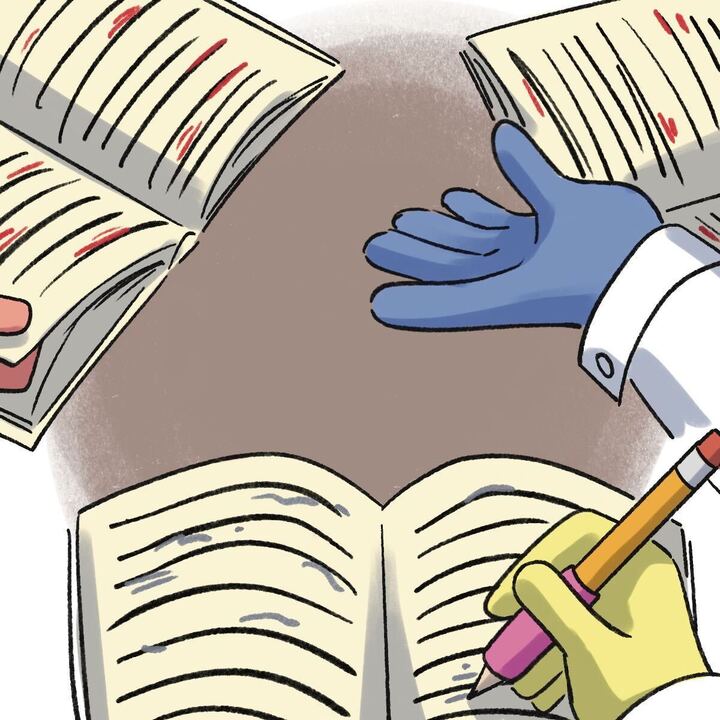
Book clubs aren’t just for Oprah. At WashU, 19 reading groups funded by the Center for the Humanities and led by professors and graduate students meet regularly to discuss themed reading lists. Topics range from the digital humanities to medical anthropology to a singular, famously intricate book.
Ph.D. student Varun Chandrasekhar, a co-convener of the Marxism and Literature reading group, observed that graduate study can sometimes feel isolating because “you’re in class with…the same people every day for two years, and then you’re…in your room, writing your dissertation. That can get a little siloed.” For Chandrasekhar and his co-convener, Ph.D. student Tad Biggs, the Marxism and Literature group is a community of peers with different research backgrounds and varying opinions on big economic questions.
“I find that the discussions are consistently really generative, and I come away with a different set of thoughts,” Biggs said.
Rebecca Weingart, the leader of the Digital Humanities (DH) reading group and a Ph.D. student, also noted that meetings invite interdisciplinary discussions.
“Rarely is someone working alone on a DH project (teams are made up of faculty, students, librarians, etc.), which is why the reading group is so appealing,” she wrote in an email. “We get to talk through new thinking/debates in the field with a group from a wide range of disciplines and roles at the University.”
Ph.D. student Max Carol leads a group that exclusively reads “Finnegans Wake” by James Joyce, and he said that knowledge from different disciplines is not just beneficial — it’s fundamental to understanding the book.
“Finnegans Wake” is written in a “crazy, made-up dream language”, according to Carol, which he has spent years parsing. In his free time, Carol has contributed close to 2,000 annotations to the Finnegans Wake Extensible Elucidation Treasury (FWEET).
According to Carol, the language in the novel “lends itself to [Comparative Literature] because of how multilingual it is. It lends itself to even kind of STEM people too, because it’s almost something kind of mathematical about it. It’s kind of like a puzzle you have to decode.”
Carol noted that while many groups read a book in advance and then discuss it together, the “Finnegans Wake” group reads aloud together.
“And it’s really, I think, the best way to read the book because it’s a book that encourages collaboration, because of how weird and dense it is and how everyone’s coming in with different perspectives and different references and allusions that they know,” he said.
While the “Finnegans Wake” group focuses on one novel, other groups seek out recently-released works, sometimes leading to conversations directly with authors.
Katherine Tilghman and Paco Tijerina Martinez, both Ph.D. students, are co-conveners of Gender and Sexuality in Contemporary Latin American Literature, a club which highlights new Spanish-language stories. “We’ve been lucky enough that either through our reading group funding or through our department or through the library, we’ve been able to actually meet a lot of the authors whose works we’ve been reading…Just this last year, we had a Zoom call with Gabriela Jauregui, a really important Mexican feminist,” Tijerina Martinez said.
Ph.D. student Gloria Fall, who runs the Medical Anthropology group, said the club’s reading list is composed of books published in the last three years and shared plans to also hold discussions with authors over Zoom this semester.
Just as author talks and collaboration are valuable parts of the reading group experience, so are the books themselves. Several students said that the books they read impacted them.
“It is incredibly eye-opening to be able to work with this material that really elucidates what is happening in the world,” Chandrasekhar said of Marxist literature. He often finds himself wondering, “What is the sort of economic driver of this? What is the sort of influence this has on the consuming public?,” even while scrolling TikTok. “It becomes a moment to reflect, to think ‘What is actually happening here?’ in a way that I think is incredibly valuable and part of the reason that we are fundamentally scholars,” he said.
Echoing Chandrasekhar, Carol said that “Finnegans Wake” is a book that challenges how you think. “Aside from the actual fun of reading it, the actual meaning you can get out of reading it…I feel like it’s a book that helps you think critically…It makes you read differently.”
When asked if the reading group might one day finish the 650-page tome, Carol said, “It’s kind of a book you’ve never really finished…Some pages I’ve read upwards of 50, 60, almost 100 times…It’s a book that every time you read it, you notice something new. So I think what’s so great about the reading group is it evolves over time. People come and people go as they graduate.”
“It’s about this experience more than coming to a conclusion,” he said.
Stay in Touch!
Get the latest and top news from StudentLife delivered to your inbox