Scene
“We have come so far”: Inside Ella Scott’s term as Speaker of SU Senate
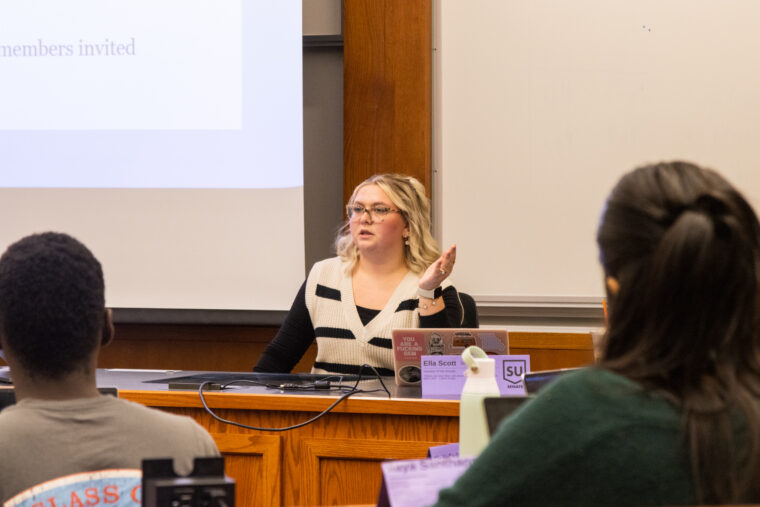
Junior Ella Scott leads a weekly SU Senate meeting in Seigle Hall (Anna Calvo | Staff Photographer)
For her entire life Ella Scott has been obsessed with pink.
Growing up it was just a favorite color, but after she watched “Legally Blonde” in high school for the first time, the hue “revolutionized” her life. A couple years later she walked across the stage at high school graduation with Elle Woods’ iconic line, “What? Like it’s hard?” on her cap.
In the movie, Woods wins a tough case despite being underestimated by numerous other characters. Like Woods, Scott, the current Speaker of the Senate, is not someone to underestimate. She has earned her peers’ respect over the course of the semester.
On Nov. 19, during a bonding activity that closed the final Student Union (SU) Senate meeting of the semester, sophomore senator Maya Santhanam highlighted Scott’s insistence on being herself.
“You’re so everything and I respect your badassery so much. You find a beautiful way to be gentle and assertive,” Santhanam read from a letter to Scott as part of the exercise. “I love how you command a room without ever being rude or overpowering … I am so proud of you and all that you have accomplished.”
When Santhanam finished reading, the room erupted in cheers.
The meeting, in a Seigle Hall classroom, had run well into its third hour. Everyone could have been doing homework and cramming for exams that night. Instead, the 21 senators present chose to stay and participate because of the culture Scott rebuilt in Senate. The toxic atmosphere and intense political discussion had pushed the body to the brink early in the semester, causing multiple senators to resign and even more to reconsider their involvement.
Junior Omar Abdelmoity acknowledged that Scott “took on probably one of the hardest climates within Senate,” but still made this his best semester in SU Senate since joining his freshman year.
“I don’t think it’s an exaggeration to say we were hanging on by a thread at that point,” Scott said, looking back at the start of her term.
Scott ran for SU Senate during the spring of her freshman year in an election where there were not enough candidates to fill all the open seats. She says that joining SU has been “one of the best things I’ve done since coming to WashU” and the place where she has met her closest friends.
Scott’s mom, Sarah Scott, says she could have seen the decision to join student government “coming from a mile away … It’s right up her alley.”
Ella, her mother says, loves participating in “idea exchanges” where she can question, learn, and expand upon the ideas of peers around her while simultaneously developing as a thinker and leader herself.
Ella grew up in Marthasville, Missouri, a town of “family dynasties,” in her words, with a population of about 1,200 located an hour west of WashU’s campus. There she lived on 100 acres of mostly wooded land and attended the same elementary school as her grandma had decades before.
During high school, Scott served as the student representative to the Warren County Board of Education, where she was first exposed to civic engagement and a rancorous political culture. At her first meeting, citizens flooded the auditorium to voice discontent with mask mandates and other COVID-19 policies impacting the schools.
Scott recalls a moment when an older woman was scolding the board and they turned off her microphone. “She turned around to face the audience with the rest of her speech, and the whole room erupted [in support].”
Scott, who is a first-generation, low income student, barely ate during Bear Beginnings, because she was so overwhelmed by the “elite university culture.” After a few days, however, she started hanging out with the other students on her floor.
That week she met junior Evan Becker, who lived on the same floor and is from St. Charles, Missouri. The duo hit it off, clashing enjoyably on political matters when they joined the debate club. At the end of the day, they were always able to find common ground.
“That’s one of the things I love about Ella,” Becker said.

SU Senate meeting on the resolution to divest from Boeing. With backs to camera, left to right: junior Ashton Lee, Scott, and junior Natalia León Díaz. (Managing Photo Editor | Bri Nitsberg)
Scott’s experience on the County School Board helped prepare her for the intensity of some Senate meetings, especially one last March regarding a resolution for WashU to divest from Boeing.
Scott chose not to speak during the meeting, instead stepping back and reflecting on what she was hearing and what would be the best decision for the WashU community.
“I didn’t want to be virtue signaling or anything,” Scott said. “I wanted to understand what these people were saying.”
Junior Ashton Lee, who sat next to Scott during the Boeing meeting, thinks she was “crazy to want to be speaker” given the explosive climate on campus and in SU.
He thinks Scott chose to run because she is optimistic about what student government can be.
Lee and Scott are part of a group chat with two other senators, juniors Natalia León-Díaz and Beni Bisimwa. Three of the four are first-generation, low-income students, hence the chat’s name: “economically disadvantaged.”
For Lee, the group is his “safe space within SU” and a place to collaborate on new resolutions and ideas. It was with this group, during debriefs in the dining hall after late night Senate sessions, where Scott felt most affirmed in her decision to dedicate so much time to SU.
At the end of her sophomore year Scott ran, and lost, for speaker against then-junior Lauren Fulghum, who stepped down for personal reasons a few weeks later.
After hearing her ideas for Senate, Bisimwa spoke in support of Scott when she ran a second time, and was elected in the fall.
“She’s the type of person to give her all,” Bisimwa said.
Scott’s tenure was immediately tested in her first meeting as speaker. It focused on a resolution to drop suspensions for students arrested during the pro-Palestinian encampment the previous April, but also included demands for WUPD to disarm, for Chancellor Andrew D. Martin to resign, and for the creation of an Indigenous Studies department, among other things.
Scott was jarred by the intensely polarized atmosphere. When senators came and told her they were considering resigning, the need for a culture reset became clear.
“Everybody was miserable, everybody was having a really difficult time in that session and was very stressed and could not engage with one another,” she recalled.
In the following two weeks, three senators would resign and others would complain that being in Senate was becoming increasingly toxic.
Right after the resolution to drop suspensions, Scott shifted her focus. She told senators during the following session that in the next two weeks they would have a discussion about interfaith dialogue and a T.R.U.T.H. facilitation — a session designed to help student groups have honest conversations about race, power, and privilege.
Both helped create a space where senators could feel comfortable talking, questioning, and challenging each other’s beliefs while maintaining healthy personal relationships. The sessions were closed to the public, allowing senators to fully share their thoughts with each other.
Scott also began working on a set of community agreements for Senate discussions. After finalizing them with other senators, she made sure each one had a copy and she displayed them for the entirety of the T.R.U.T.H. session.
Scott attributes these dialogue skills to her current involvement as an Interfaith Fellow at WashU, where she practiced how to adhere to community agreements, actively listen, and have conversations with those who hold different beliefs.
She also decided to enforce Senate’s attendance policies this semester. Currently, they state that after two unexcused absences a member may be removed. Absences do not include missing sessions for health or academic reasons. She believes that despite how awful a removal may feel, enforcing procedure ensures that only those who are fully committed to the body can participate.
During her term, Scott has removed two senators because they violated the policy. Rather than decide on her own, Scott consulted Senate’s committee leaders to ensure they were all on the same page.
“These are also our peers … It’s not like it’s an employee-employer situation.”
While adding the workshops to Senate’s agenda and enforcing the attendance policy helped turn around the culture, so did Scott’s overall willingness to support her peers in SU.
Multiple senators talked about how she is always available in the SU office or willing to help them late at night with a technicality. She does not interfere with someone else’s project, but is never hesitant to jump in and help brainstorm how to overcome an obstacle. She also brings candy and snacks to every meeting, and on rare occasions sings Whitney Houston songs in the SU office during late-night work sessions.
Jacob Goedde, Campus Life Coordinator for Diverse Communities and Group Development and Scott’s former admissions counselor, was in student government as an undergrad and has attended a majority of Senate sessions since starting their job last November.
“Scott is someone who works very, very hard and is good at what she does and takes the time to step back and reflect on those community pieces,” Goedde said, adding that Scott is able to “have fun whenever the time calls for it.”
Another key part of Scott’s term has been biweekly meetings with Associate Vice Chancellor for Student Affairs and Dean of Students, Rob Wild. Even though those meetings are a chance for her to strengthen her relationship with a key administrator, Scott frequently brought other senators so they could ask questions for their projects.
“Ella doesn’t really have much of an ego. She’s more about empowering people and not empowering herself,” Wild said.
He watched with admiration as she constructed a “spirit of togetherness” among a group of students who seemed destined for fallout at the beginning of the semester.
Scott wants all of Senate’s work to be shareable with the whole University community. That includes encouraging senators to prioritize reports, which present data and recommendations, over resolutions, which do not have to include either.
Wild said that reports are “a slightly softer approach” for Senate to take but are much easier for administrators to work with and respond to.
This semester Senate released reports on WUPD mental health response, the add/drop deadline, and getting communal fridges in Sam Fox buildings.

Scott presents SU’s report on WashU’s dining services alongside Bisimwa and León Díaz during the final session of the semester. (Managing Photo Editor | Bri Nitsberg)
Of the reports SU has released this fall, Scott is proudest of the report on WashU’s dining services because of the issue’s importance to the student body, and the work Senate is doing for the creation of a potential Native American Studies department, which is highlighting an extremely underrepresented population on campus.
Sarah Edmondson, Associate Director for Student Involvement in Campus Life and the primary SU advisor, said Scott is a leader who commands respect because of her work and reputation rather than her title as speaker. Edmondson believes the T.R.U.T.H. work and attention to detail have made a tremendous difference in Senate’s success, and she attributes that progress to Scott’s leadership.
“She’s first-gen, limited-income, and very much comes from a working background, and she works as well, and she juggles all that on top of the purely volunteer labor that is Student Union,” Edmondson said.
Next semester, Scott will be studying in France and unable to serve as speaker. Between other senators going abroad and the usual turnover from fall elections, only one person currently serving in a Senate leadership role will be involved this spring.
Scott is willing to serve in a mentorship role for the next speaker, who will be determined via internal elections later this semester, but is looking forward to her future adventures abroad.
This past summer, Scott interned at a law firm. Her plan for after college has always been to go to law school, just like Elle Woods, but now, in part because of her SU experience, she is considering going into public policy instead.
Scott’s time in student government has taught her to navigate bureaucracy, difficult dynamics, and what it is like to be a real politician, even if only on a campus scale.
Senior and SU president Hussein Amuri served for two years in the Senate and was speaker for the spring 2023 semester. He was at the final Senate session on Nov. 19 and highlighted the work Scott did building community while sticking to her values of integrity, honor, compassion, and empathy.
“She leads with people, she doesn’t lead people,” he said.

Scott, gathered with all of the SU senators and advisors after their final meeting. Scott is second row fifth-from-left in the green blouse. (Photo Courtesy of Ella Scott)
After the final session was adjourned, multiple senators went up to Scott to give her hugs and say thanks for an amazing semester. At first she accepted the gratitude, but soon became overwhelmed and started to cry.
“My cup is very full,” Scott said.
“We have come so far,” she said a week after the final session, “and I can’t wait to see what happens next … I think everybody did put so much care and so much work into [Senate], and everyone genuinely wants to be there now. I’m excited to see how people harness that energy and what they do with it in the future.”
Stay in Touch!
Get the latest and top news from StudentLife delivered to your inbox