Scene
The downfall of the Gargoyle and WashU’s social scene
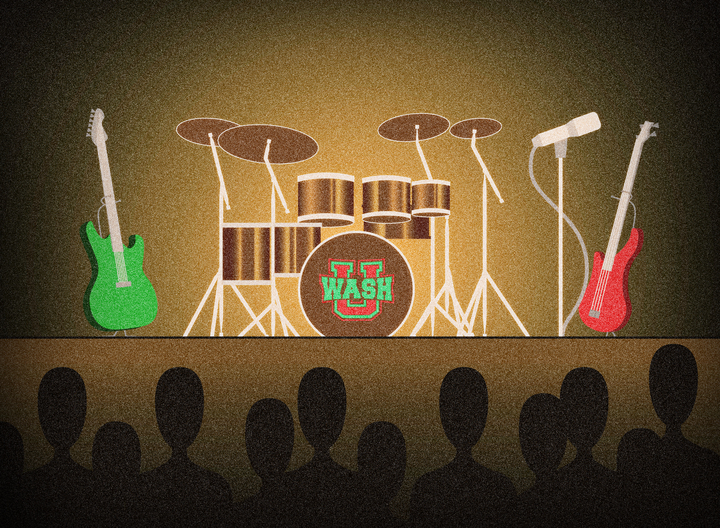
(Niyati Naveen | Student Life)
Upon entering Mallinckrodt, the scent of bread and cheese from Subway is inescapable. The sandwich smells immediately ruin the ambiance as you descend the Mallinckrodt stairs to your Writing Center appointment. Talk to any alum, however, and this never would’ve been their experience with this building. Instead, they might recall the Gargoyle: a space filled with buzzing conversation by day and the bright lights of a club-like scene by night.
For avid fans of live music and indie concerts, as well as enjoyers of monthly Thursday night Happy Hours, the Gargoyle was the place to be. For years, it was a hub for on-campus events and student socializing. But, in the months leading up to 2019, a different idea for the space emerged.
In response to a growing demand for centralized academic support, a decision was made to close the Gargoyle and replace it with academic offices. Despite strong student protests and a popular petition signed by over 1,000 students, this plan moved forward. This marked the loss of the venue, and as former student and Social Programming Board President, Adin Ehrlich, explained, a “significant part of the student experience on campus.”
Despite the very vocal and public outrage at the time, hindsight tells a different story of the Gargoyle as meek and, quite frankly, unexceptional. Katy Przybylski, class of 2017, explained the Gargoyle as “not something that was forgettable,” but also not something that strongly stood out from her time at WashU.
“I don’t think there was anything special about it,” she said. “I think it was less about the space and more about the programming that people would do around it.”
The memories and experiences that students associated with the venue were brought to fruition not by the Gargoyle specifically, but by the onus of using the space that fell on student groups.
“A lot of it was dependent on SPB, or the Social Programming Board. Whoever was on that committee at the time really had to take the initiative to plan those types of events, whether it was a Happy Hour, or a meet and greet sort of thing, [or] a concert. It was more of a resource for other people to use,” Przybylski said.
Her account of the Gargoyle mirrored the perspective of Associate Vice Chancellor for Student Affairs and Dean of Students, Rob Wild.
A WashU alum himself, Wild remembers the Gargoyle flourishing during his time as a student in the ‘90s.
“The problem was, after we opened the Danforth University Center, Mallinckrodt became less and less interesting to students,” he said.
During an evaluation of campus spaces, administrators found the Gargoyle’s decline in popularity.
“We ran a list over the last four or five years of spaces at the time and how they were used, and the Gargoyle was just used so lightly during the course of the year. Maybe it was reserved one or two times per week, and that’s a big space to have only a few hours of events in a week,” Wild said.
Towards the end of its life, the Gargoyle was used primarily as a rehearsal space. After it closed, many options were made available to accommodate student needs. Locations such as the Mudd Multipurpose Room, the then-new Sumers Recreation Center, and dance studios in the Women’s Building were provided for students’ rehearsals.
“The problem isn’t that we don’t have enough space necessarily,” Wild said. “It’s that all groups want the same time slots. If groups at the time would have been more willing to spread out when their rehearsals are, we definitely could’ve met demand.”
Despite the relatively limited influence the Gargoyle had on students during the time of its closure, some current students feel a need for a more active social scene on campus.
After learning about the Gargoyle, freshman Rachel Kravtsov expressed interest in the idea of having a similar space on campus.
“I think it would be super fun. I think it would centralize something going on on campus, and it would open up the opportunity to meet more people, because not everyone does something on a Wednesday night, for example, and not everyone has the time to join a club,” she said
For those who share this sentiment, the lack of a campus social scene is something the administration is aware of and is currently working on changing.
“I don’t want to share the details yet,” Wild said, “but we’re hoping to be able to announce something very soon where we’re going to try a kind of ‘pop-up’ social space concept on the Danforth Campus using some of our existing spaces.”
Stay in Touch!
Get the latest and top news from StudentLife delivered to your inbox