Scene
They haven’t taken the tracks since the pandemic, but WU’s racing team is still moving
“I saw a race car sitting on the grass on Mudd field and that was it. I was like, I’m doing that, that’s gonna happen,” said Shannon Coupland, the recruitment lead for the Washington University Racing team.
That was three years ago when Coupland made the decision to join the school’s Formula SAE racing team. This year, there wasn’t an activities fair or race car sitting on Mudd field, but the University’s Racing team hasn’t slammed its brakes for the pandemic.
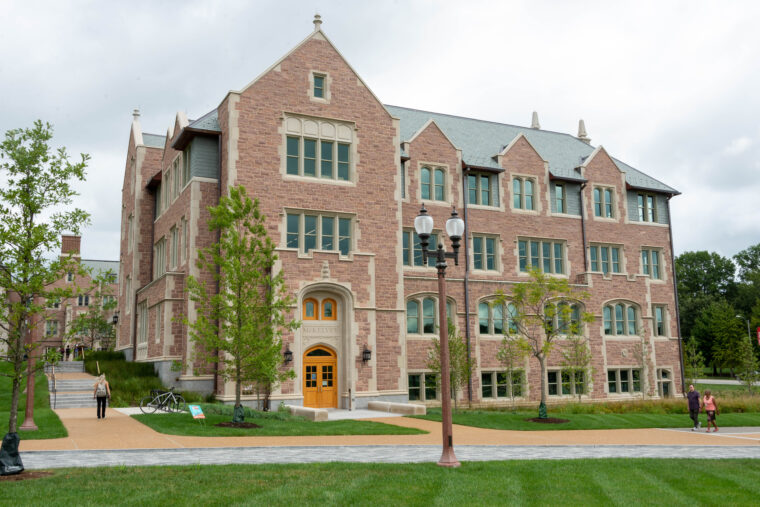
 Stephen Huber | Student Life
 Connected Bryan and Jolley Halls sit along the overpass connecting Danforth Campus and the Delmar Loop.
The racing team at the University designs and develops a new car every year before competing at the Formula SAE-Michigan competition. This annual competition, which takes place in May at the Michigan International Speedway, draws over a hundred teams from schools across the world.
A whole year is spent developing a car that can perform well in four events: acceleration, endurance, auto crass, and skidpad. It is first designed online in a 3D mockup throughout the summer and fall. It is then physically constructed throughout the winter before testing and tweaking aspects of the vehicle in March and April.
That “normal” schedule came to a pause last year due to the pandemic. Alex Levy, the president of the team, wrote in a statement to Student Life that the team decided not to compete in the online event.
While the team has restructured its timeline and will most likely not be participating in the annual competition this year, which will be held online, the club is still busy working to develop its fastest and most innovative car yet for next year’s competition.
The team is looking to finish the research phase of their process by Thanksgiving and then finalize the bulk of the design afterward, with hopes to start manufacturing parts of the car by the end of the spring semester.
Levy said the goal for next year is to be the tenth best team at the competition, which would be a significantly higher placement than in years past. The team placed 47 out of 108 teams in 2019 and 61 out of 114 teams in 2018.
While a jump of nearly 40 spots in the rankings might seem far-fetched, Levy thinks the team can do it if they make certain adjustments to the design of their vehicle. In past years, the team has been able to make significant jumps in the rankings by altering the car’s wheel size and changing how its suspension works, he said.
While the club has always brought joy to its members, the pandemic is bringing out new reasons that students are finding fulfillment from being part of the team.
“[The team is] an escape from stresses of COVID and other things,” Levy wrote, “and keeping the team functioning even when it’s difficult to rally people virtually can mean a lot to them because it’s a place they can go where their friends are; where they know they can interact with others; where they know they can be working on something that matters to them.”
Seth Kleinberg, a freshman on the team, shared similar sentiments to Levy.
“[Working on the car] is really helpful for me especially now in COVID times where it seems like all we do is class and it’s really hard to do practical things over Zoom,” Kleinberg said. “It’s grounding to see everything in practice.”
To keep the team members interacting, this year has required a complete redesign to team bonding and club meetings.
Pre-pandemic, team bonding took the form of barbeques and late-night donut runs, while this year, trivia and the online game ‘Among Us’ have filled their void.
Members of the team also bond during their weekly meetings. The whole team meets online every Thursday and Saturday, in addition to smaller meetings that occur throughout the rest of the week in smaller groups.
On Saturday, Zoom links to the different parts of the team—based on which part of the car people work on—are placed in a Discord chat where members can go to whichever room they want throughout the day to ask specific members of the team a question.
“The idea is basically: have Zoom open and work on your computer and it’s like we’re in the same room together,” Levy wrote. “[This setup] means that people are socializing which is good because staying at home and quarantining can be very isolating, but it also increases communication.”
Additionally, the messaging of the team has changed because the end goal for this year is no longer to finalize and race their car.
“So before the team’s been like, alright, we’re gonna build a race car,” Coupland said. “The point now is that we’re teaching people to be engineers.”
Coupland said that she’s learned more about how to be an engineer from working on the team than she’s learned from her classes.
“I’ve learned the theory from my classes, but as far as debugging when things go wrong, not only in software but in hardware, that’s the experience I’ve only gotten from the race team,” she said.
Coupland said that while it was always a goal to develop engineers, this year that goal has been made more explicit to meet the new conditions.
However, even before the global pandemic hit, the racing team was already undergoing a redesign.
“I think one of the things I at least tried to do when I started was being like, okay, we can take people of different interest levels and different skill levels,” Peter French, one of the 2018 team heads said. French, who now works in Research & Development at Boeing, said that making the environment more supportive of all different abilities and interests has allowed for more than just “car nuts” to feel comfortable to join.
Levy echoed French’s point.
“We had a team-wide discussion [about how] we are a field, an area of study, and then a specific niche of automotive and motorsport engineering, that is extremely generally exclusionary and kind of boys club-esque, and we didn’t want to be that way,” Levy said. “We don’t want to be that way, so we spent a lot of time trying to combat that attitude from within.”
In the last several years the team has stopped tolerating behavior that creates an aggressive or unwelcoming environment, Levy said.
Coupland added that “the culture is becoming a lot more explicitly supportive of diverse opinions.” This culture has been materialized in a new bias reporting form and a procedure to ban or suspend people who are hostile to people based on their identity.
This environment has found favor in newcomers like Kleinberg who said that the environment is really supportive and people feel free to joke around and ask questions with the team. “It’s really an inclusive atmosphere. I feel totally comfortable in the meetings and everything.”
At the end of the day, there might have been no car on Mudd field to gawk at, but Coupland is still confident that the team has been successful: “We may not be building a car, but we’re still building engineers as best we can, and I think we’re doing a pretty good job of it.”
Stay in Touch!
Get the latest and top news from StudentLife delivered to your inbox