News
Changes to McKelvey PhD admissions bring an end to lab rotations
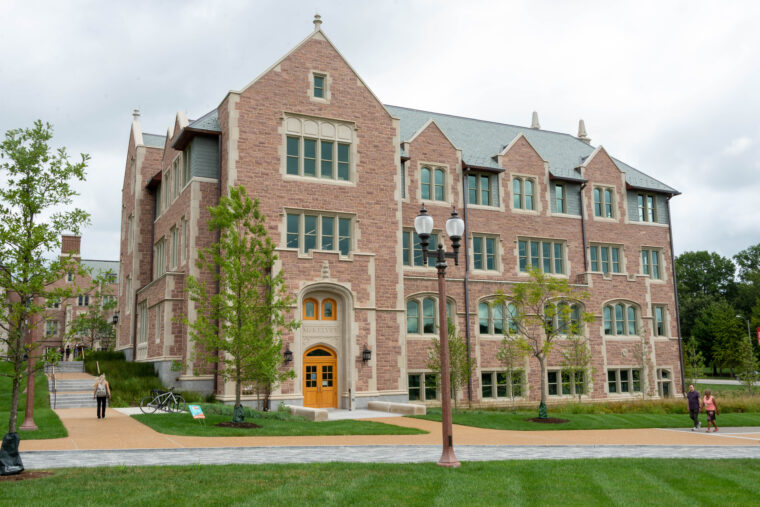
McKelvey PhD programs recently shifted from a lab rotation system to direct admission (Nathan Springman | Contributing Photographer)
For decades, the lab rotation has been a chance for incoming PhD students to shop around, test mentors, and find their fit before committing to four or more years of research. That option disappeared at WashU’s McKelvey School of Engineering in the 2025-2026 admissions cycle, leaving some of its PhD students with limited autonomy over their research.
All of McKelvey’s PhD programs have transitioned away from rotational admissions this year, moving to a fully direct-admit model where incoming PhD students are matched with a single faculty advisor before setting foot on campus. The shift mirrors a broader national trend driven largely by one factor: funding. McKelvey is not alone. Across the country, some engineering PhD programs have been making the same shift.
Previously, McKelvey funded PhD students for a full year before moving them onto faculty research grants. Under the new model, that transition happens faster, which requires students to be attached to a specific principal investigator (PI) and project from the start. Jai Rudra, Associate Director of Graduate Studies for McKelvey’s biomedical engineering (BME) department, put a finer point on the savings.
“By taking away the rotation system, I think it’s about $40,000 per student saved, and that includes stipend and health and all that,” Rudra said.
With an average incoming BME class of around 25 students, Rudra said the department saves about a million dollars.
Rudra said the University eased into the program through stages, with rotations shrinking from 10 months to six before being eliminated.
“It was not like the ax was brought down,” Rudra said. “We were ready for this for almost a year and a half.”
How it used to work
Under the rotational model, incoming students could spend half a semester with one professor, then half a semester with another professor, before choosing a permanent lab.
For Sarah McMahon, a current undergraduate researcher preparing to begin her PhD at McKelvey, the process was designed to prepare students for one of the PhD’s most consequential and least discussed variables: the advisor-advisee relationship.
“If you don’t have a good advisor, you’re not going to have a good experience, and you might even drop out,” McMahon said. “It’s so dependent on their ability to help you and how you guys match.”
The political reality no one warns you about
To Student X, a first-year PhD student in McKelvey who chose to be anonymous out of fear of retaliation from supervisors, the PhD placement process is far more political than prospective applicants realize, and the stakes of getting it wrong are significant.
“What no one really tells you about a PhD program is how political it is,” Student X said. “It’s not like [if] you have the best grades and the most research experience, you get to go into your top [choice] lab. It is very much funding-oriented.”
PhD students are paid through their PI’s grants, and a professor, for instance, who has already committed funding to incoming direct admits may have no room to absorb a student looking to move to their lab.
The problem is especially acute under direct admissions. If a PI has already committed funding to incoming direct admits, they may have no room to absorb a student looking to transfer labs.
“If a PI knows they have two direct admits coming in, they’re like, ‘I can’t take someone who’s already here,’” Student X said. “If you can’t find another PI with funding, you’re kind of screwed.”
The problem is compounded by how difficult it is for prospective students to vet a lab from the outside. Student X said that when they tried to reach out to current graduate students for candid feedback before applying, they got little response.
“It was kind of a shot in the dark,” Student X said. “If you ask the current graduate students, they’ll be like, ‘Don’t do this,’ or they’ll be like, ‘OK, he’s actually a good PI, his one issue is X, Y, and Z.'”
Who benefits from direct admissions?
Administratively, the shift is less about saving costs and more about research alignment, according to Dr. Katharine Flores, Vice Dean of Graduate Education for the McKelvey School of Engineering.
“From that perspective, there isn’t a big impact on long-term financial planning,” she said. “The determining factor for cohort size is still tied to the availability of research grant dollars.”
In practice, most PhD students were already funded through faculty research grants, meaning cohort sizes have long expanded or contracted based on available funding. Under direct admission, that structure remains the same but grant support simply begins earlier.
For departments, the math is straightforward: Direct admissions makes funding commitments more predictable. For students, the picture is more mixed.
On the upside, direct admits get moving on research immediately. There is no reorientation lag and no need to repeat the same onboarding processes in two different labs. Student X noticed a real gap between themselves and their direct-admit peers during their second rotation.
“They had so many more actual deliverables, and I was having so much imposter syndrome because I didn’t feel like I was up to speed with them,” they said.
But momentum is not the same as fit, according to McMahon. And for students entering a niche research area with only one viable faculty match, the stakes of a poor placement are especially high. McMahon said she was only able to accept direct admission with confidence because she had worked alongside her future advisor for two years as an undergraduate.
“If it didn’t work out with the one professor, I would have been kind of lost at what to do next,” McMahon said.
That risk in PI matching may be shaping who applies and who is admitted. Rudra observed that a large share of students in the first direct-admit cohort in the BME program already had ties to WashU.
“I would say at least 12 [of 22] were pre-existing student body [and staff] at WashU, or they were WashU undergrads,” he said.
The pattern Rudra observed was reflected school-wide. Flores confirmed that offers declined across McKelvey for the fall 2026 cohort, attributing it to faculty being “very conservative about committing to support the incoming students immediately.” She expects numbers to recover as faculty grow more comfortable with the new recruiting rhythm.
The advisor relationship: Everything depends on it
Both McMahon and Student X came to the same conclusion: the advisor-advisee relationship is the single most important factor in whether or not a PhD goes well, and it is also the hardest thing to evaluate before you arrive.
At certain high-profile programs, McMahon said, prominent advisors can go weeks or months between meetings with their students.
“PhD students didn’t really work out unless they found a good postdoc, because the experience was so … you just get lost,” she said when paraphrasing her advisor’s account of the culture at one institution where he did postdoctoral research.
What McMahon wanted, and what she said incoming students should actively seek, is an advisor willing to engage frequently and substantively — not just to sign off on work, but to think through problems alongside their students.
“You learn the most from the conversations about random topics,” McMahon said. “It’s really nice to have someone willing to sit and talk with you through it.”
Under the new system, students have fewer opportunities to find the right fit.
“If you don’t know how the PI is, or the lab culture in the group you’re joining, and then you get there, and you’re like, ‘Oh crap, actually this is not what I envisioned. This person’s not a good mentor,’” Student X said. “That’s why I was scared of doing direct admit.”
Research by Stanford researcher Chris Golde found that doctoral attrition has long identified the advisor relationship as one of the primary reasons PhD students leave their programs. Doctoral turnover rates have hovered around 40 to 50 percent for nearly four decades and can be a high cost to students, departments, institutions, and society. Under a rotational system, students have a structured opportunity to identify a poor fit before it becomes a years-long commitment. Under direct admissions, that safety net disappears and the consequences of a mismatch fall almost entirely on the student.
A national shift — but not a universal one
McKelvey is not alone. Across the country, engineering PhD programs have been quietly moving away from rotational admissions, driven by the same pressure its students identified: funding. But the picture at peer institutions is more varied than a simple trend toward direct admission would suggest.
Even within McKelvey, the shift wasn’t uniform. Flores emphasized that the transition was not imposed from above.
“The school did not apply a top-down direct admission plan on all of the programs,” she said. “We asked each of the programs to develop an approach that would work best for their local situation.”
Admissions directors met repeatedly to compare approaches, and differences still remain across departments. A follow-up meeting is already scheduled to assess what worked and identify best practices after the first direct-admit cycle.
Peer institutions reflect the same variability. Stanford’s Chemical Engineering PhD programs still require first-year students to rotate through multiple labs before committing to an advisor. This is a deliberate choice that signals the rotational model is not impractical at scale, just increasingly rare. Johns Hopkins Biomedical Engineering, by contrast, has moved decisively toward direct matching, with rotation offers now reserved primarily for students funded through National Institutes of Health (NIH) training grants.
That divide points to the underlying dynamic: Rotations tend to survive where external fellowship funding makes them financially viable. When funding from the NIH, US National Science Foundation (NSF), or Department of Energy, becomes scarcer or more competitive, programs lose the flexibility to bring students in without immediately slotting them into a specific grant-funded project.
The cuts are also landing unevenly. Most major external fellowships, including the NSF Graduate Research Fellowship and Department of Defense grants, are open only to domestic students, even as international students make up the majority in many engineering programs. In fall 2025, 71% of PhD students were international. The result is a system in which a student’s ability to explore labs before committing depends less on academic fit and more on what funding their program has secured, and from whom.
For domestic students, that pressure takes on a personal dimension. Student X described an unspoken expectation to constantly pursue external fellowships — not just for professional development, but to relieve funding pressure on their advisor.
“There is some pressure on the domestic students to be constantly looking for external fellowships so that you can keep your professor happy,” they said.
Dean Aaron Bobick of McKelvey pushed back on the notion that federal funding turbulence would derail the school’s long-term research agenda.
“What’s happening this week is not going to determine our research strategy for the next decade,” Bobick said. “In engineering, the types of areas that we do research in tend to be of tremendous interest on the part of all aspects of the federal government.”
But he acknowledged a specific source of near-term uncertainty.
“There’s this whole question on overhead, which has to do with how you spend the money, and that will impact the ability to spend some of those funds on things that are outside the direct charges for the grant,” Bobick said. “That’s the main uncertainty that we’re operating under.”
What’s lost
Student X was among the last to go through McKelvey’s rotational system. They chose it deliberately, turning down a direct-admit offer from the same program because they wanted the flexibility.
“I didn’t want to commit to a professor and then be like, this doesn’t work,” they said. “I knew I wanted that option.”
Flores acknowledged the anxiety but emphasized that formal pathways still exist.
“If the match does not work out, the programs still have processes for the student to find a different advisor and switch labs, as long as the new advisor is able to support the student,” she said.
But for students like Student X, the availability of that process and the practical reality of navigating it are two very different things.
Under the old system, the program absorbed some of that risk, building in structured opportunities to course-correct. Under direct admissions, that risk shifts almost entirely to the student.
“Know what’s good for you,” McMahon said, offering her advice to prospective PhD applicants. “That’s something I struggle to work out, and I’m still working out.”
Stay in Touch!
Get the latest and top news from StudentLife delivered to your inbox