News
McKelvey Engineering Communication Center to be phased out by 2028

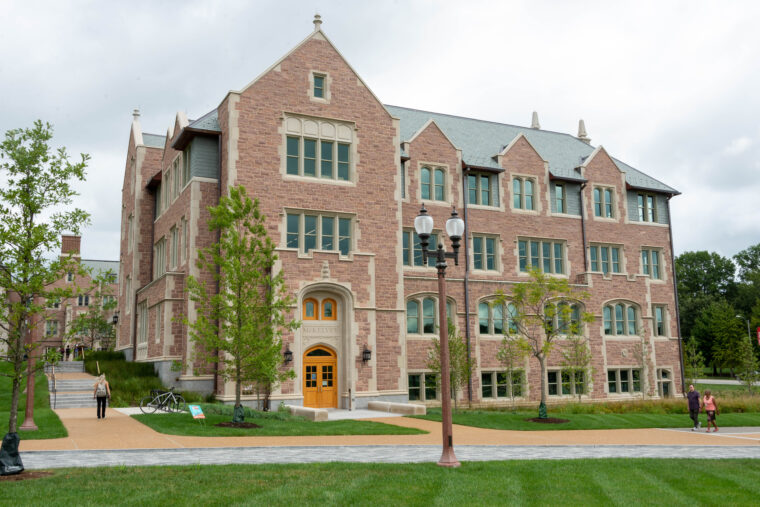
The Engineering Communication Center (ECC) at the McKelvey School of Engineering will be phased out by May 2028 (Tamiah Woodfork | Staff Photographer)
The Engineering Communication Center (ECC) at the McKelvey School of Engineering will be phased out by May 2028, Dean Aaron Bobick wrote in an email to the school’s faculty, staff, and students on Feb. 3.
The ECC currently employs seven full-time faculty members, only one of whom will have their employment contract renewed by McKelvey. Using WashU salary data, Student Life estimates that the center’s closure will save McKelvey roughly $500,000 to $600,000 annually.
Since its founding in 1994, the ECC has offered a range of undergraduate and graduate courses covering topics such as writing, ethics, and team collaboration. Among these courses is Technical Writing, a required course for all undergraduates pursuing a bachelor’s degree in engineering. Future plans for the previously taught ECC courses have not yet been formally announced to the McKelvey community.
In addition to their course offerings, the ECC offers students, faculty and alumni resources and guidance on journal articles, dissertations, presentations, and resumes, among other materials.
The ECC’s phasing out follows the quiet closure of the Women & Engineering Center over the summer. Bobick told Student Life that McKelvey currently has no additional plans to close any other student-facing centers.
Cathy Essner, a senior lecturer in the ECC, said that she was shocked and disappointed when she learned, in mid-January, that the center was closing.
“It’s sad to be laid off; it’s sad to see your friends laid off,” Essner said. “But I think we’re sad for what our students are losing.”
Bobick said the decision to close the ECC was driven by a desire to avoid duplicating courses already offered elsewhere at the University.
“We don’t want to be redundant with what other offerings are being done on campus. That’s not particularly efficient or effective,” Bobick said. “Effectiveness and efficiency, in terms of how we invest our funds, is fundamental, and that’s true regardless of how many funds you have.”
In his email, Bobick wrote that McKelvey students will be encouraged to use other University resources to develop their communication skills. He also announced that McKelvey undergraduates will now be required to take College Writing, a course of which McKelvey students could previously test out.
“This does not represent a change in our values with respect to communication,” Bobick wrote in his email. “We remain committed to ensuring all McKelvey students develop professional communication skills through a variety of communication-focused educational opportunities available across campus.”
The decision to close the center was first communicated to Seema Mukhi Dahlheimer, the director of the ECC, in early January. The six ECC lecturers were informed of the closure at an in-person meeting on Jan. 14, and adjuncts were notified via email later that same day.
A full time lecturer in the ECC who asked to remain anonymous due to retribution concerns said the center’s staff was told the decision was made due to budget constraints.
“What we were told was essentially an extension of messages that we’ve already received about McKelvey being in some tough financial straits,” they said. “That they just needed to make hard decisions about what was ‘core’ in engineering and what was ‘nice to have.’”
Lecturer J. Tucker Krone was told via email that his contract would be renewed. Krone, a McKelvey alum, has taught courses within the ECC and in the wider Division of Engineering Education since 2017. He will continue to teach courses such as Engineering Statistics within the Division after the center’s closure.
On Feb. 13, proposed ways for maintaining communication skills in other departments will be presented and voted on in the faculty assembly. Dahlheimer said she thinks plans will be shared with the broader McKelvey community after a decision has been reached. However, Bobick said that the Curriculum Committee has two years to solidify the new plan.
In the 2026 fiscal year, the Danforth Campus aims to operate at a $7.4 million deficit. This past fall, these budget cuts resulted in layoffs across the University. Bobick noted that when school budgets are decreased, certain departments within schools may be prioritized for funding over others.
“We have things that we need to do within the core academic disciplines, and so it’s just a matter of making choices of what we need to offer,” he said.
Another anonymous lecturer employed by the ECC told Student Life that McKelvey is losing out on a critical resource that gives both the school and their graduates a competitive edge.
“If you look at our peer institutions, they all have robust communication centers and programs so that they can graduate students who are ready and have the basic competencies to navigate these responsibilities that they’re inheriting in our world right now,” they said. “My real concern is that our students aren’t going to be as prepared anymore.”
Retiring adjunct lecturer Jeffrey Hamilton, who has taught writing classes in the ECC and in the English department of Arts & Sciences, said he felt that the primary aim of classes like Technical Writing was to provide an engineering-specific writing class.
“It’s always been my understanding that McKelvey wanted a course specifically tailored to their students,” Hamilton said. “An upper-level writing course like they do over in the School of Arts & Sciences, but to do it on more technical, scientific grounds for their students.”
In addition to teaching undergraduate and graduate courses, the ECC also serves as a writing center. An additional anonymous lecturer at the ECC said they have noticed a decrease in appointments at the center, possibly due to the rise of generative AI.
“I have heard through professional organizations that, nationwide, writing centers are seeing less traffic, and they do connect that to the advent of widespread generative AI,” they said.
However, Krone thinks that it is important that students learn writing skills as they will not be able to rely on AI in the workforce.
“There are going to be situations in which engineers, whether it’s a security clearance, whether it’s working with HIPAA, they’re not going to be able to use AI to write,” Krone said.
Essner said that the ethics and analysis skills taught through the ECC are especially relevant for current engineering students.
“The times that we’re in right now really mandate that engineers be able to recognize the complexity and the human stakes behind the technical decisions that they are making,” Essner said. “That kind of awareness does not develop automatically. It has to be cultivated, and that’s exactly what the ECC is for.”
Erin Ritter, who received her bachelor’s degree from McKelvey in 2024, said that the skills she learned in the ECC have helped her stand out in an increasingly competitive job market.
“The skills that we learned from the ECC, like resume writing, personal statement writing, were especially important for getting people into positions that could potentially open up other doors,” Ritter said.
While the Writing Center at WashU offers similar resources, Ritter told Student Life that a center geared specially towards engineers offers something irreplaceable. She added that the ECC’s closure poses an equity issue.
“There’s a lot of students who are neurodivergent or who might speak English as a second language, and that’s the type of support that can be necessary for success,” Ritter said. “Being neurodivergent myself, that’s something that I’ve struggled with a lot and got adequate support for from the ECC.”
Stay in Touch!
Get the latest and top news from StudentLife delivered to your inbox