Scene
Disrupting whiteness at the Women’s March on St. Louis
It was 8:30 a.m. on Saturday morning. Up until that point, I had never seen that many white people on the University City-Big Bend Metrolink platform before.
In retrospect, I would think that it was great that the Metro was so packed with the estimated 20,000 people who went to the Women’s March on St. Louis. I would scroll through my Twitter feed and see the aerial shots of Washington, D.C., Chicago and St. Louis later in the day and feel a semblance of the unity that the march was meant to foster. Later, I would take in how impressive it was that this march was born out of a Facebook event—one of the only Facebook events I’ve ever seen where all the people who hit “going” actually went. It’s a testament to the fact that frankly, we’re pissed. Even white people are pissed. And that will make me hopeful.
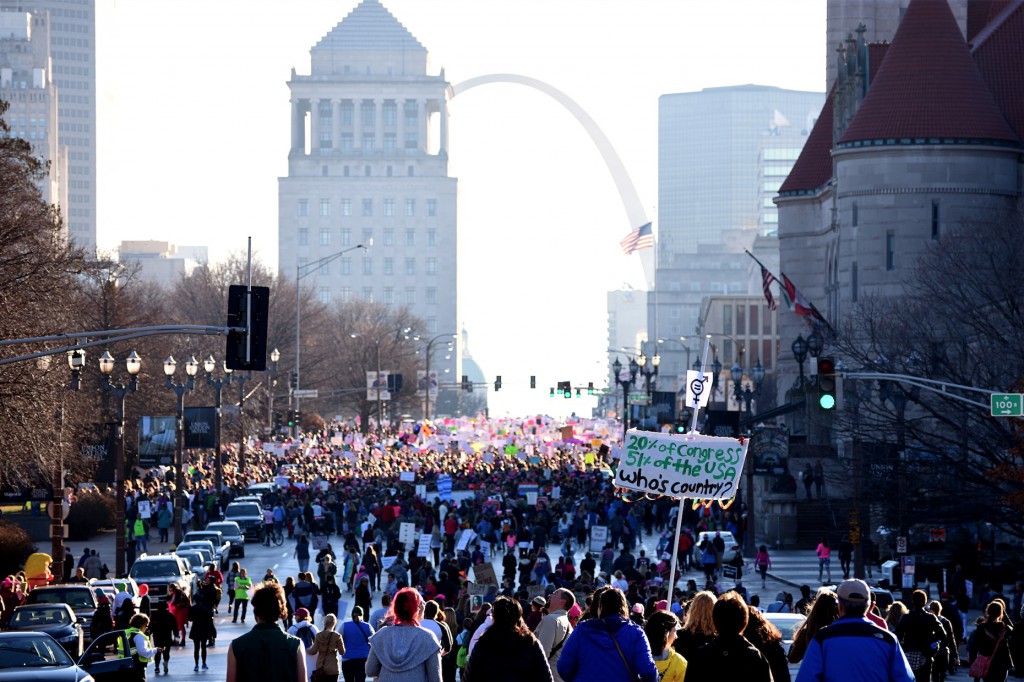 Jordan Chow | Student Life
 Attendees of the Women’s March on St. Louis walk from Union Station down Market Street to Luther Ely Smith Park on Saturday, Jan. 21. Estimates on the number of people who participated in the march and following rally, which was one of many held around the country ranged from 10,000 to 20,000.
But that morning, I’m still uneasy. The idea of a women’s march is great and all, but the controversies surrounding the march’s lack of intersectionality—both on a national and local level—left a bad taste in my mouth. My decision to attend was last-minute.
When the Facebook event for the Washington, D.C. march was made, the organizing team was overwhelmingly made up of white people with little activism experience and little concern for issues brought up by women of color on the Facebook event page. The initial title was the “Million Woman March,” which blatantly ignored the fact that this was receiving criticism, the movement recruited prominent activists Tamika Mallory, Carmen Perez and Linda Sarsour to head the event; the name was also changed to “Women’s March on Washington” as a deliberate homage to Martin Luther King Jr. On a local level, St. Louis organizers had a similar story: They started out almost all white, with minimal organizing experience. On the Facebook event, 17-year-old activist Mya Petty was chastised by white women for pointing out the march’s exclusion of women of color. The organizers eventually diversified their team and invited veteran activists of color to speak at the rally. My decision to go was largely influenced by the speaker lineup, which consisted entirely of women of color, along with a white LGBTQIA+ activist.
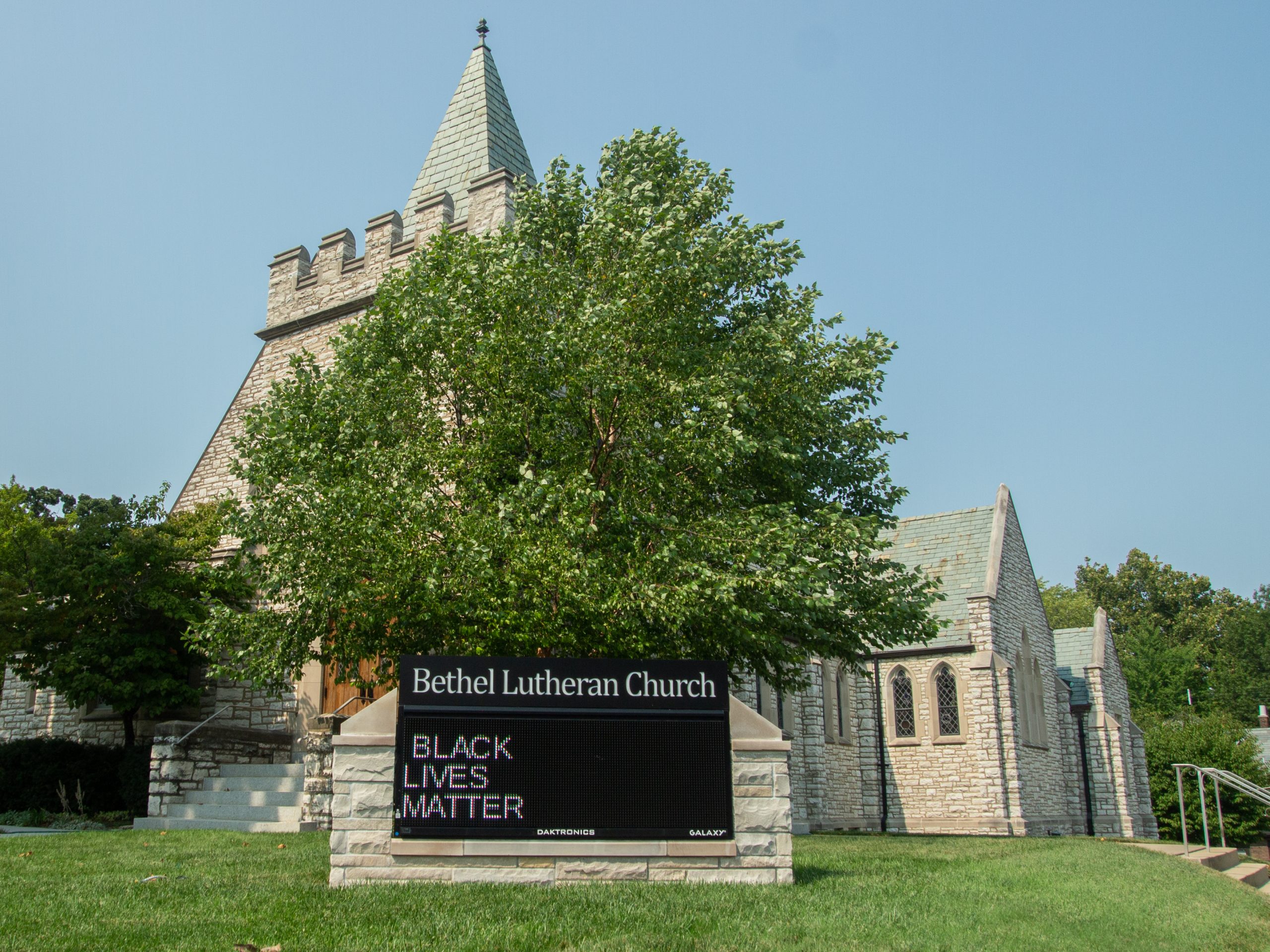
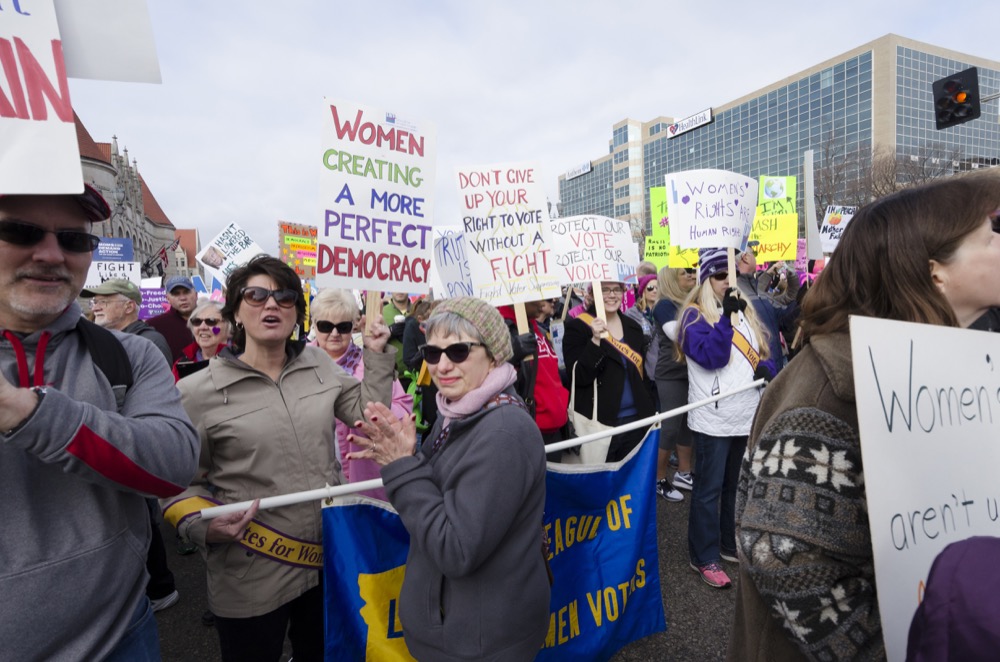
The march started downtown at 18th and Market Street and concluded with a rally at Luther Ely Smith Square, near the Gateway Arch. I started near the back of the march, but through some expert crowd-weaving with a couple friends, I made my way to the front. The demonstrators were, as expected, overwhelmingly white women. I was pleasantly surprised by many of the signs that I saw. In addition to clever puns and messages of support to Planned Parenthood, I saw a decent number of signs emphasizing intersectionality—that Black Lives Matter, that Muslim women should feel safe, that trans rights are a non-negotiable demand. It was a self-imposed acknowledgement of whiteness.
Still, I couldn’t help but think about the limitations of this acknowledgement. The march has been marketed as a demonstration on behalf of the rights of all women and marginalized groups. But I wondered what “all women” meant. For every woman that believed in intersectionality, how many out there believed that diversity was a secondary concern? I found myself wondering how many of the swaths of white women here were conscious of their whiteness. I wondered how many of them find it natural to substitute intersectional feminism with Lena Dunhamism: prioritizing the straight-cis-white-woman identity, becoming angry and defensive when called out on it and then offering an apology that is, at best, deflective from personal blame.

Protesters assemble in front of the courthouse. The Women’s March on St. Louis was one of many similar marches held around the country the day after the Presidential Inauguration.
The march ended near the Arch, and the rally commenced. It began with opening remarks from Senator Claire McCaskill, who made a surprise appearance. The speakers included: writer and educator Marshata Caradine-Randall, Missouri State Senator Maria Chappelle-Nadal, Southern Illinois University Edwardsville professor Saba Fatima, neurologist Dr. Ghazala Hayat, queer activist Margaret Flowing Johnson, two young activists named Lauryn and Macy, community organizer De Andrea Nichols and educator Treasure Shields Redmond.
Through each of their respective stories, the speakers framed the patriarchy through its connection to whiteness. One notable instance of this was during Nichols’ speech, in which she discussed the responsibility white women had in supporting Black Lives Matter. In another speech, Fatima also brought up the responsibility of nonblack women of color to acknowledge their privilege—a conversation that is often missing from mainstream dialogues. She reminded me that, even as a child of Indian immigrants, I am not blameless. I have benefited from the Civil Rights Movement as much as I’ve benefited from structures of white supremacy. Even though Nichols didn’t explicitly name nonblack women of color, I know I share that responsibility.
The speakers succeeded in reminding us that the march was, of course, a starting point. If we want our demands to turn into progress, we need to stay involved by calling their representatives, joining local and national organizations, educating ourselves and fighting for those who are most vulnerable. I’m glad that more white people (and non-black people of color, for that matter) are waking up to this nightmare. I just hope it lasts.
Stay in Touch!
Get the latest and top news from StudentLife delivered to your inbox