Campus Events
Holocaust survivor discusses American politics, experience in concentration camp
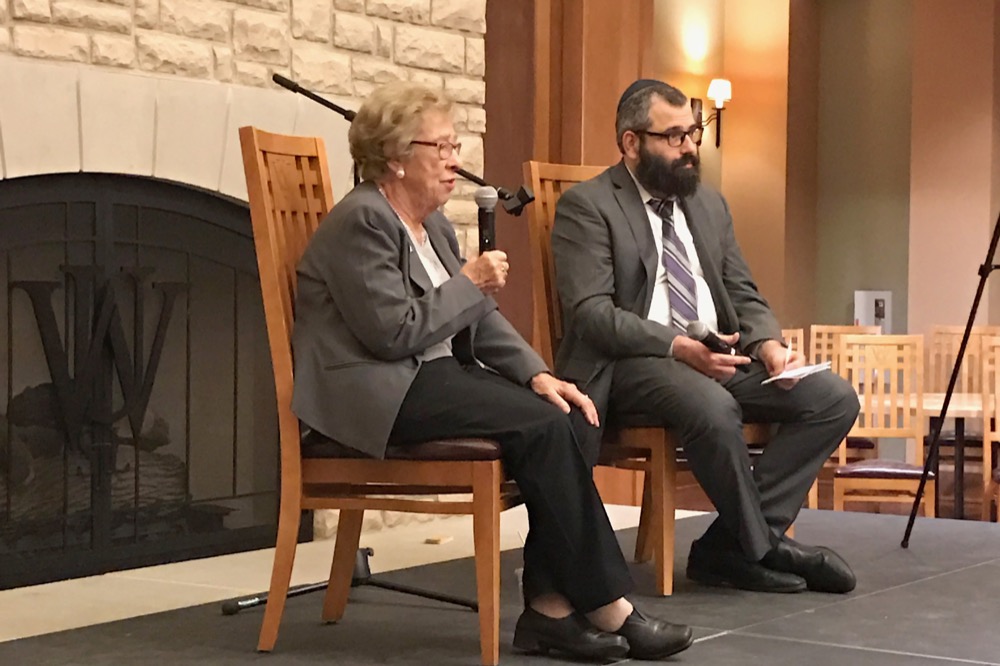
Anne Frank’s stepsister spoke about her time in hiding during the Holocaust, her year in Auschwitz and the current state of politics in America in College Hall Thursday.
87-year-old Eva Schloss described her childhood growing up in Vienna, Austria as a happy one. She later moved to Belgium to escape anti-Semitism, but religious persecution followed her there, and her father acquired visas for the family to travel to Amsterdam for three months. It was during this time that she met the famed diarist Anne Frank and her family. It wasn’t long though before the Nazi forces grew too strong, forcing Schloss’ family, and the Franks, into hiding.
 Kayla Steinberg | Student Life
Eva Schloss, Anne Frank’s stepsister, speaks in College Hall about her time in a concentration camp. Schloss was brought to campus by Chabad for the event that was held on Thursda
Schloss said she only began talking about her experience in the concentration camps four decades ago, while at an Anne Frank exhibit in London.
“The organizer said I should say a few words, and I was put on the spot, and that kind of made me talk,” Schloss said. “Then, I realized how interested people were and how it was beneficial for me because [of] how I had suppressed it, and suddenly, I could open up. So, it was for me a revelation, and I could let go.”
She noted that the differences between her and Frank were the result of growing up in different parts of Europe.
“When I came to Holland, I had experienced already prejudice and anti-Semitism [and] bullying, which she hadn’t because she left when she was four,” Schloss said. “She left Germany and became a real Dutch girl, so she was very sure of herself and a chatterbox. And I think quite intelligent.”
Despite her praise for Frank, Schloss disputes the famous diary line, “In spite of everything, I still believe that people are good at heart.”
“If she would have lived through it, I don’t think she would have said that,” Schloss said. “She was looked after very well by her family, and the helpers who risked their lives, so she had this experience only of the decent things. Coming out of the camp, you could not have believed people are good at heart, you couldn’t. I don’t think anybody could.”
Schloss spoke about her worst times in the concentration camp where she experienced starvation, diseases and death. She vividly remembers being separated from her father and brother but said that her worst memory was when her mother was selected to be gassed. Instead, her mother was hidden in a barracks by cousins.
“I had thought that I had lost her,” Schloss said. “That was for me the worst. I was only 15. You know at 15 you don’t want to die—you want to laugh, I wanted to taste life. So I never ever gave up hope.”
When released from Auschwitz, Schloss and her mother returned to the Netherlands. However, her father and brother did not survive. Otto Frank, who also returned to the Netherlands, later married Schloss’ mother.
Schloss reflected on this time after the war, saying it was a terrible period in her life.
“I was full of hatred, especially because I had lost my father and brother. My own suffering I got over, but the loss of your family you just never get over,” Schloss said
Schloss also expressed her concerns about Donald Trump’s recent refugee ban, comparing it to her own experience attempting to seek refuge in other countries during the time of the Holocaust.
“The refugee ban I think is very, very bad,” Schloss said. “I was a refugee and I suffered a lot because of that. The Holocaust would not have happened if people would have had their gates and doors open for people who had to escape from Germany, Austria and Czechoslovakia.”
When asked her opinions on Trump’s election as a whole, Schloss responded that she believes he was elected out of the nation’s desire for change.
“It’s not that the whole country was against him; it was that a great proportion of the population wanted change,” Schloss said. “I don’t think they necessarily wanted Trump, but they wanted change.”
Before her talk, some students were able to attend a dinner with Schloss which—like the event—was sponsored by Chabad. Many of those who attended said that being in her presence was an honor. For many, her story struck a chord.
“As the granddaughter of a Holocaust survivor, I feel privileged to have grown up in a household where I learned about the [Holocaust] from a very young age and had the opportunity to hear the stories of many survivors,” freshman Rachel Kleinhandler said. ”For me, having dinner with Eva Schloss at Chabad was a true honor, and it felt like a celebrity was sitting in front of me. I’ve always loved hearing the inspiring stories of finding triumph over adversity and finding the strength to go on in troubling times.”
Stay in Touch!
Get the latest and top news from StudentLife delivered to your inbox