Assembly Series
Assembly Series speaker discusses ‘culture wars,’ modern partisan politics
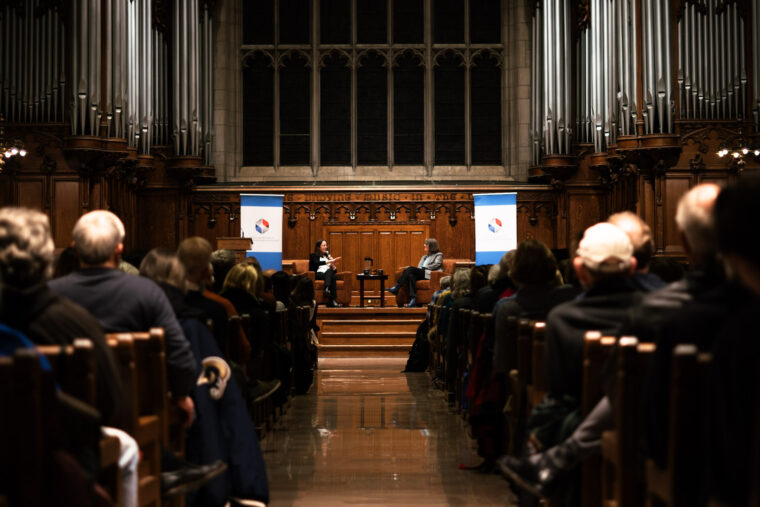
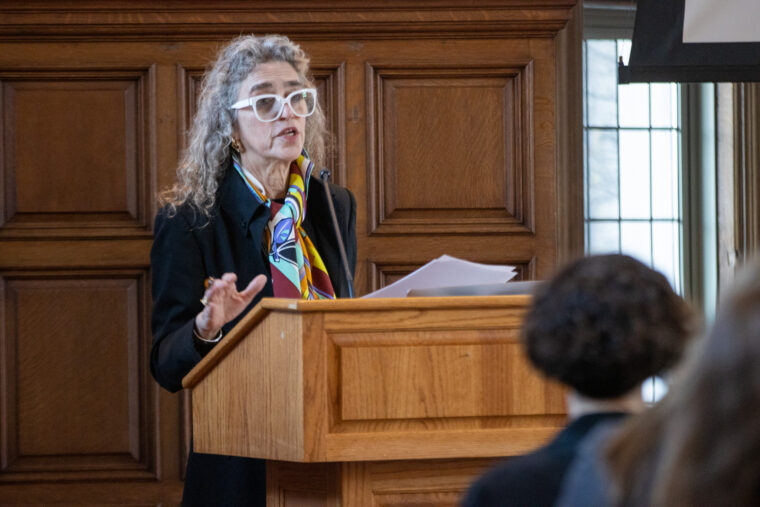
Students at Stephen Prothero’s Assembly Series lecture on Thursday dove into the chasm of culture wars and partisan divisions in American politics.
The event, which was sponsored by the Danforth Center on Religion and Politics (DCRP), drew many members of the St. Louis community as well as students. Prothero, a professor of religion at Boston University who has previously appeared on “The Colbert Report,” discussed his research into culture wars, or the conflict between cultural values that are growing more or less prominent in society.
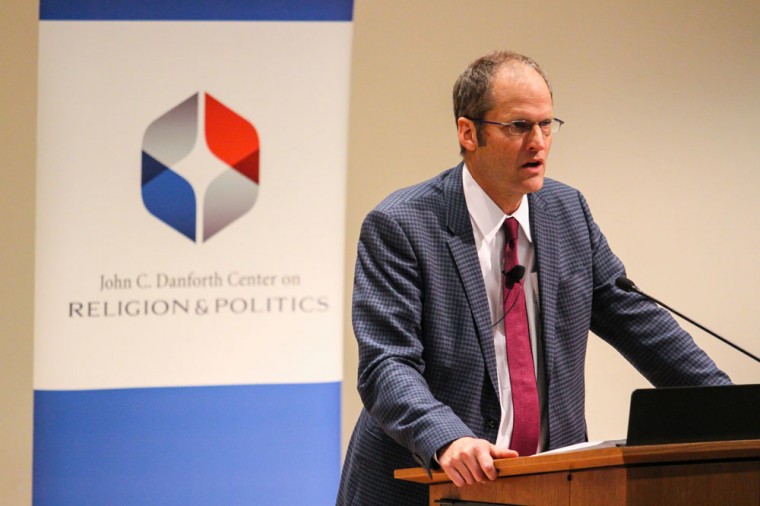
Stephen Prothero, a professor of religion at Boston University, speaks about his book on America’s ‘culture wars.’ The talk was sponsored by the John C. Danforth Center on Religion & Politics.
Rachel Lindsey, associate director of the DCRP, hoped that the lecture would help members of the University community look beyond the terms “conservative” and “liberal” and their usage in society.
“I hope that this discussion helps [students] to think outside of the standard categories that are bandied around in media and public discourse, generally without a whole lot of thought behind them,” Lindsey said.
Prothero began to study culture wars after the Ground Zero Mosque controversy in 2009-10, in which many people were angered by the potential construction of a mosque at the site of the destroyed World Trade Center buildings. A book by Prothero on the subject is tentatively scheduled to be published in April 2015.
In his speech, Prothero discussed the five main culture wars in U.S. history: the election of 1800—in which newly formed political parties clashed over whether to increase or reduce the federal government’s power—Protestant opposition to Catholics during the 1830s, Protestant attacks on Mormons during the mid 1800s, the Prohibition era and today’s withering of the traditional definition of family values. He provided the context and results for each of these battles and explained why conservatives have always lost the culture wars they have launched.
He noted that today’s culture war began with the IRS’s attempts to tax segregation academies, or white-only private schools, to combat the Supreme Court’s Brown v. Board of Education decision. He also claimed that conservatives have taken issues of race and converted them to arguments about family values and religions.

Prothero touched on other aspects of the modern culture war as well, including the controversial Roe v. Wade court case that allowed women to get abortions, the Pledge of Allegiance, same-sex marriage and Islam. He foresees the family values aspect of today’s war coming to an end in around five to 10 years, but he added that the issues of race and religion will continue for years to come.
Lindsey planned the lecture and said the DCRP had brought Prothero to campus because of his extensive experience with religion and politics.
“He has a public profile,” Lindsey said, “and we wanted to draw on that. He is a leading expert in this field. He is well known in the history of religion and American history, generally speaking, and he’s also a public intellectual.”
Madeline Pensiero, a sophomore, had to attend the event for a course but said she was pleased she went.
“I thought it was really informative,” Pensiero said. “I’m in a religion and politics class right now, Religion and Politics in American History, and I thought it went along really nicely with that class.”
Pensiero added that she enjoyed the question-and-answer session with the audience afterwards.
Senior Krupa Desai said she was fascinated by Prothero’s speech.
“I thought it was really, really good,” Desai said. “I thought he was really riveting, and he was a good orator in general.”
She also enjoyed the background he provided on the subject.
“I thought the historical perspective on culture wars was really interesting because I think we think of it in a contemporary sense, but it was really cool to hear about the historical part of it,” Desai said.
Stay in Touch!
Get the latest and top news from StudentLife delivered to your inbox