News
Computer science major sees a decline in major enrollment, results in TA cuts

The computer science (CS) major in the McKelvey School of Engineering, once the biggest major at WashU, is seeing a dramatic decline in enrollment in the 2025-2026 academic year.
According to CS Department Chair Roch Guérin, national trends over the past decade show that enrollment in CS programs was increasing rapidly until about a year and a half ago, when it began to plateau and then decrease slightly.
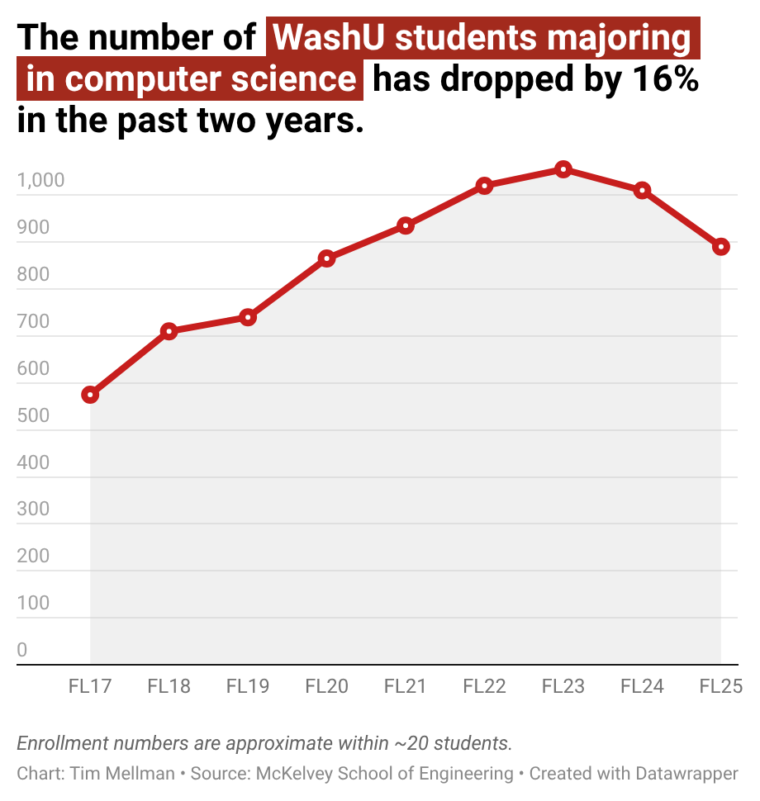
Guérin said this surge in the program’s popularity, beginning in 2013, resulted in massive waitlists for CS classes and a scramble to find more qualified professors.
In the past year, teaching assistants (TAs) in the department have noticed a decline in class enrollment.
“When I joined as a TA for Data Structures and Algorithms for the very first semester [in the spring of 2024], the enrollment was about 350 students,” Weizhi Du, the head teaching assistant for CSE 2407 Data Structures and Algorithms, said. “Now the number has dropped to below 170 — so [by] nearly 50%.”
However, Guérin said this decrease is not inherently bad.
“This is a little bit of a relief, in the sense that we were in a catch-up mode pretty much for the past 10-plus years,” Guérin said. “The fact that the enrollment growth has abated is in some sense helping us take stock of where we are.”
Junior studying CS and TA, Daniel Palmer, attributes the decline in CS majors to the new data science major and an increase in required classes to complete the CS major.
“A lot of previous CS-inclined people want to be data science majors because they’re more interested in data management, machine learning, that track,” Palmer said. “So the creation of that major, and then the stats and data science department a few years ago, definitely takes a lot of enrollment away from computer science.”
Another factor in the decline in students majoring in CS is the changing technology. Current TA and fifth-year student, Edgar Palomino, attributes this decline in class and major enrollment to generative artificial intelligence and its effect on the industry. Whereas there used to be high demand for CS students from companies, now that excitement has begun to die down, according to Palmer.
“From a student’s perspective who is trying to get a job, it definitely feels like the golden age [of CS] is kind of finished,” Palmer said.
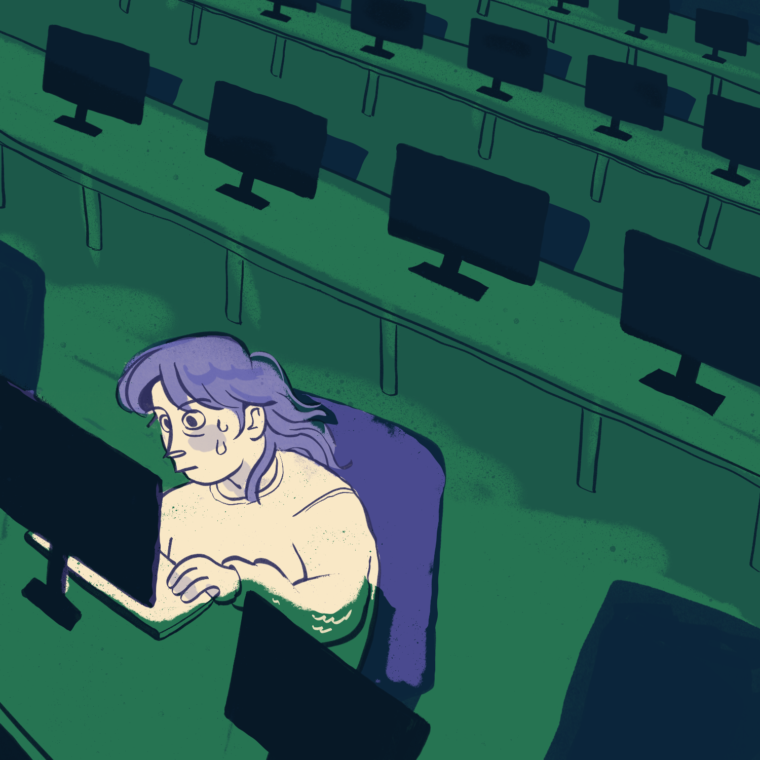
August Moon | Contributing Illustrator
Guérin elaborated on this sentiment, citing students’ fear that all the entry-level jobs were going to be taken away by AI as a reason for the declining enrollment.
“Whereas you used to need a person, or even a team of people, to set up a new website, to pitch a new product, or whatever it is you’re trying to do now, you can AI that in a matter of minutes,” Teaching Professor of CS Douglas Shook said.
While fewer students are choosing to major in CS, Guérin has not seen an exodus of students already in the program.
“There’s considerable uncertainty in terms of where the job market is headed,” Guérin said. “And so [the lack of clarity regarding which] skills do you need is affecting the choices that students make, and that, I believe, is largely responsible for the decline that we [are seeing] now.”
As AI and machine learning skills become more important to employers, the electives within the program are beginning to change, and a master’s in AI engineering is under development, Guérin said.
While algorithmic thinking has always been at the core of CS, the program is in the process of moving the focus away from technical skills like writing code to more big-picture analysis and soft skills, according to Guérin.
Shook argued that people are still necessary to oversee and direct AI, since AI cannot predict human desires but only do what is asked of them. He said he hopes the industry will continue to invest in training entry-level employees to set themselves up for success in the future when those in senior roles retire.
Palomino said students majoring in CS are pivoting their focus to better prepare themselves for the industry.
The decline in enrollment has affected the number of TAs hired, as well as their workload.
While it was difficult to quickly find qualified professors during the CS boom, TAs were in high supply. In the hopes of providing students with enough support, more TAs than needed were hired, Guérin said. With the slowing and decline of enrollment over the past couple of years, however, the program has created and enforced guidelines for how to allocate TAs based on class size so as not to waste resources.
Lower enrollment in CS courses has led to a decrease in the number of CS TAs because enrollment levels directly influence the allocation of budget for course resources.
According to Du, in spring 2024, there were more than 90 TAs in CSE 2407, but now, that number has dropped to 23.
Shook said that he wished there were more TA positions available for higher-level courses. However, supply is limited due to the enrollment-based budgetary limitations. He said he has 28 TAs in his 170-person Introduction to Computer Science class but only two in his 90-person Programming, Tools, and Techniques 2000-level course.
Student usage of office hours has also declined as students can now rely on AI to answer questions instead of going to a TA, Shook said.
Palomino said that, ultimately, while CS will continue to change, it’s important to continue to pursue aspects of CS that interest you.
“Try to specialize, especially in the things that interest you,” Palomino said. “If you want to stay in CS, try to focus and know what you really want.”
Stay in Touch!
Get the latest and top news from StudentLife delivered to your inbox