News
Enrollment in Bursky School of Public Health master’s program declined in 2026
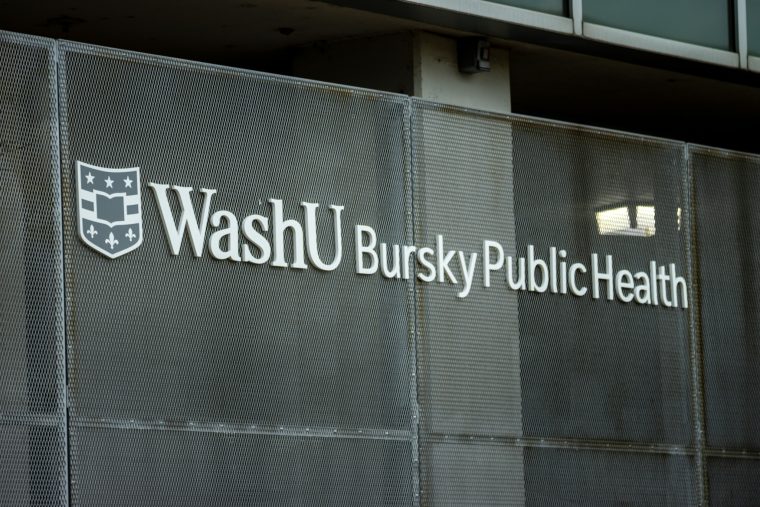
The WashU Bursky School of Public Health (Kate Westfall | Managing Design Editor)
Preliminary reports indicate that the incoming Class of 2028 of the Bursky School’s Masters in Public Health (MPH) has seen fewer applicants this year despite an anticipated 15% increase in enrollment. The Association for Schools and Programs in Public Health (ASPPH) estimates a 25% to 30% decrease in enrollment in schools of public health within its member institutions, including WashU, for the 2025-2026 school year, according to an email from Associate Dean for Education Angela Hobson.
Hobson predicts that declining enrollment within Bursky has been impacted by decreased funding to public health programming, restrictions on borrowing federal loans for master’s students, and new policies preventing international students from obtaining visas.
Regulation on immigration particularly impacted the Bursky School this application cycle. Out of the 90 international students who matriculated to Bursky last application cycle, more than half deferred or withdrew enrollment after being unable to obtain a visa, according to Hobson.
“Our MPH cohorts have leaned heavily international in the last few cycles,” Hobson wrote in an email to Student Life. “This last cycle confirms the need for our efforts … to think and act strategically around domestic, including local and regional, recruitment efforts.”
The Bursky School plans to make several changes in an attempt to increase enrollment for the following cycle, including lowering the number of credits required to earn an MPH from 52 to 42 and offering accelerated graduation options with a 1.5 or one-year track.
The Bursky School also plans to capitalize on WashU undergraduate students majoring in public health, offering a new four-in-one program to engage them in the MPH program.
“The Bursky School of Public Health co-leads the new undergraduate major and minor in Public Health & Society with the College of Arts & Sciences,” Hobson wrote. “We anticipate that many of those students will also engage in graduate public health in coming years.”
The Class of 2029 will also all receive an additional $5,000 scholarship on top of their original financial package to help pay for their required courses.
While the low enrollment numbers align with national trends, Ph.D. candidate within the Bursky School Raul Gierbolini-Rivera is not surprised by the low enrollment due to the program only having been established for a year.
“The Bursky School of Public Health is still relatively new,” Gierbolini-Rivera said in an email to Student Life. “While it recently achieved full accreditation, it continues to build its infrastructure, programs, and faculty, all of which can influence enrollment patterns during a period of growth.”
Although enrollment numbers were lower than expected, Hobson said the institution is not discouraged.
“While right now is a challenging time for public health in the US, we believe that education and training in public health are needed now more than ever,” Hobson wrote. “We see the enormous potential for the future of public health.”
Associate Vice Chancellor of University Communications Kedra Tolson declined to comment.
Stay in Touch!
Get the latest and top news from StudentLife delivered to your inbox