News
Sam Goodwin speaks about enduring uncertainty through gratitude
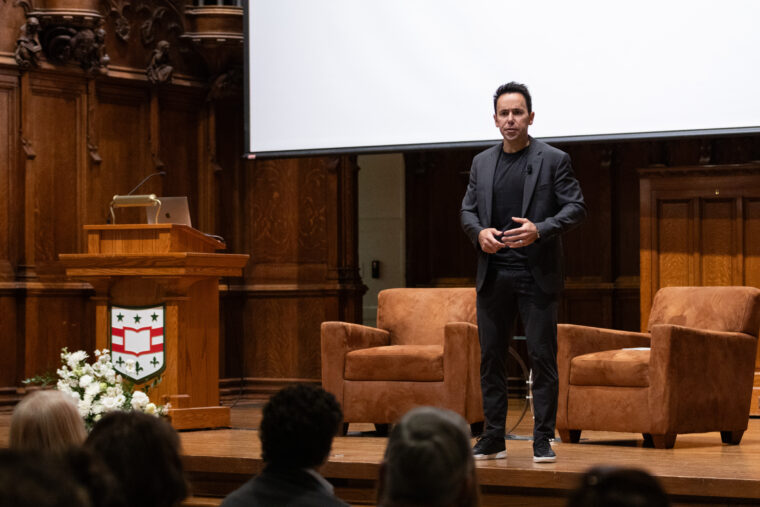
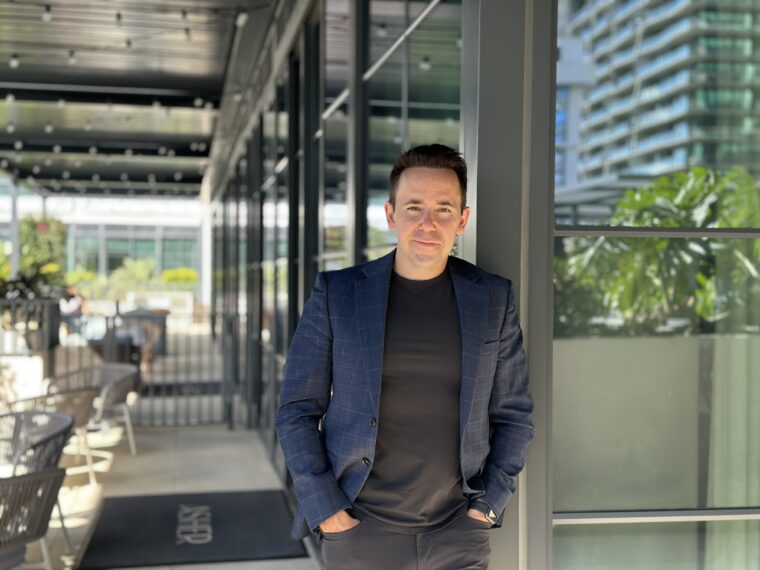
Sam Goodwin speaks about how he overcame uncertainty and adversity. (Bri Nitsberg | Managing Photo Editor)
Author, entrepreneur, and hostage to the Syrian government, Sam Goodwin, told the story of his wrongful two-month detainment in a Syrian prison as a part of WashU’s Assembly Series. The speech was paired with the launch of Goodwin’s new class in WashU’s School of Continuing & Professional Studies (CAPS) on global entrepreneurship titled “The Entrepreneurial Edge.” The audience attending Goodwin’s talk filled Graham Chapel, Jan. 21.
Goodwin opened his talk by pacing four steps forward, pivoting, and walking four steps back to his initial position. He did this to demonstrate the dimensions of the concrete prison cell he was placed in after being forced into a van by two armed men and transferred onto an airplane to Syria’s Military Intelligence Branch #215, a center notorious for housing Syria’s political enemies.
He had initially made the trip to Syria in 2019 to complete his lifelong goal of visiting every country in the world. Syria was country 192 he had visited out of the 193 countries in the world.
He remained in solitary confinement for 27 days, and he said the only human interaction he had was with the guards who brought him bread, boiled potatoes, and water. Although Goodwin himself was not physically harmed, he said he could hear the cries from other inmates being beaten or tortured around him.
“I couldn’t help but wonder, ‘When was it my turn?’ I realized I was in an environment where nothing was off-limits,” Goodwin said. “I never stopped caring about dying or the long list of other bad things I thought might happen, but I began to lose the energy to be afraid.”
Goodwin said he had to practice radical gratitude for things he might have otherwise overlooked if he hadn’t been in a prison cell.
“I actually said to myself, ‘I’m grateful for the air that I’m breathing, and that the guard who just delivered me a boiled potato smiled at me for one second.’ These things may sound elementary or insignificant, but I found that each one of these small expressions of gratitude became this silent rebellion against the uncertainty of the situation,” Goodwin said.
Goodwin was later transferred to Syria’s central federal prison called Adra and placed in a cell with 40 other men, where he remained for another month. He said that he befriended the men at Adra Prison. They taught him Arabic; he taught them English and how to play knock out on the basketball court.
“Virtually none [of these men] were true criminals,” Goodwin said. “They were just victims of a corrupt system and civilian conflict.”
One of the men Goodwin knew from Adra managed to smuggle a letter out of prison that reached Goodwin’s father and confirmed his son was alive.
This letter led to a cascade of unfathomably lucky events. Goodwin’s sister’s college roommate was able to leverage her family connections in Lebanon to free Goodwin with the help of General Abbas Ibrahim, who was Lebanon’s security chief at the time. Goodwin was moved to Beirut, Lebanon, and became the only American civilian the Syrian government has ever released from captivity.
In 2019, shortly after his rescue, Goodwin was able to travel to Brazil (the final country on his list), making him one of 100 people in history who have traveled to every country in the world.
After everything he went through, Goodwin struggles with mild episodes of post-traumatic stress disorder, but he mainly identifies with the experience of post-traumatic growth, which he attributes to the perspective imprisonment gave him.
He asked the audience to compare their struggles to those of the average person alive on Earth when they need a perspective shift.
“If there was a list that ranks every person in the world based on overall success and happiness, from 1 to 8 billion, where do you rank?” he said.
He listed his gratitude for the things he said many people in a country like the United States take for granted, such as the health of their friends and family or clean drinking water.
“I’m so happy in life because I literally play this [ranking] game all the time,” Goodwin said. Goodwin acknowledged how uncommon his rescue was and mentioned he feels “survivor’s responsibility” to share his experience with others.
“A lot of cases like this don’t end the way that mine did; they end very differently,” he said. “So that’s what I’m really focused on today. To have the opportunity to reflect on this [experience] and share something that I learned is a real privilege.”
Goodwin himself is an alumnus of WashU’s CAPS program. He said one of the first things he did after returning from captivity was enrolling in a master’s in international affairs, an experience he said helped ease him back into his life post-imprisonment.
“I don’t know that I would be where I am today without WashU grounding me in the wake of all of this,” he said.
For his new online CAPS class on global entrepreneurship, Goodwin mentioned he will bring in guest speakers from around the world, and he reopened the class application for the event.
Those interested in enrolling in Goodwin’s course “The Entrepreneurial Edge: Navigating International Affairs through Innovation” should visit the CAPS website or email [email protected] with questions.
Stay in Touch!
Get the latest and top news from StudentLife delivered to your inbox