News
Chancellor Martin defends decision to meet with Trump administration amidst student, faculty criticisms

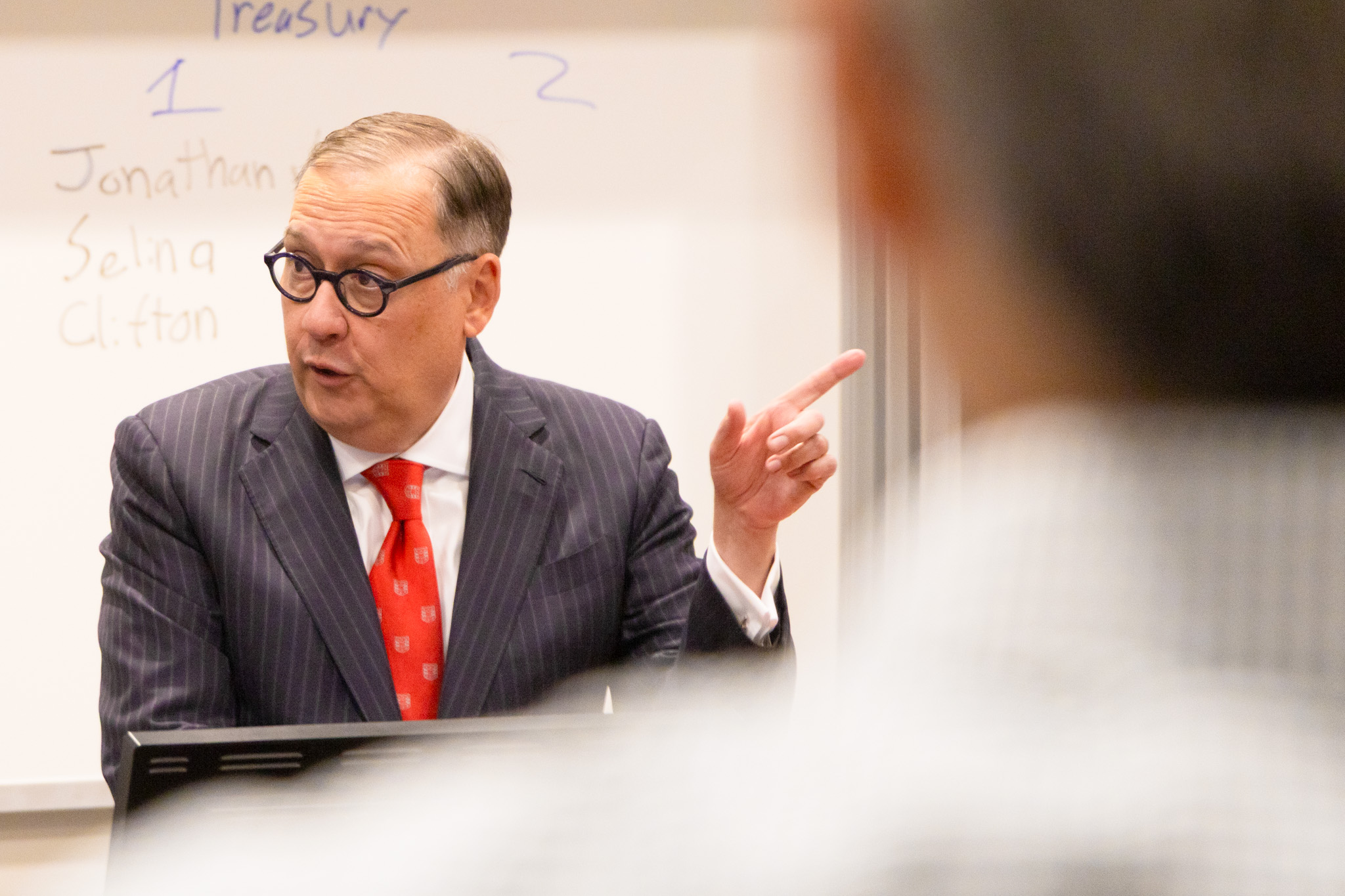
Chancellor Andrew D. Martin sent an email to the WashU community regarding his decision to meet with the Trump administration to discuss its higher education compact. (Grace Bruton | Student Life)
Chancellor Andrew D. Martin explained his decision to meet with Trump administration officials to discuss their proposed compact for higher education in a University-wide email sent Monday morning. He also noted in the message that his participation in the meeting does not mean WashU has endorsed or signed the document.
WashU was among eight schools that met over the phone with White House representatives to discuss the provisions in the Trump administration’s Compact for Academic Excellence in Higher Education on Friday, Oct. 17.
In his email, Martin said he chose to participate in the meeting to encourage open communication between universities and the federal government.
“We firmly believe meaningful progress will best be achieved through open, ongoing dialogue,” Martin wrote in his email. “We appreciate the invitation to participate in this critical conversation and are showing up ready to engage, listen, and work collaboratively toward positive change.”
Martin also wrote that the decision to join the meeting was not made in an attempt to advantage the University or to receive preferential treatment from the Trump administration.
White House spokesperson Liz Huston described Friday’s meeting with Martin and other University leaders as “productive” in a statement to the New York Times.
“[Universities] now have the baton to consider, discuss, and propose meaningful reforms, including their form and implementation to ensure college campuses serve as laboratories of American greatness,” she told the outlet.
The compact requires schools to make a range of policy changes in exchange for “multiple positive benefits,” including preferential access to funding. These changes include limiting international student enrollment, protecting conservative speech, restricting diversity, equity, and inclusion (DEI) initiatives, and committing to institutional neutrality, among other measures.
On Monday morning, a statement urging Chancellor Martin to not sign the compact was posted on Instagram by several student groups, including the Coalition for Liberated Students, WashU’s National Association for the Advanced of Colored People (NAACP) chapter, and WashU’s Association of Latin American Students (ALAS). Endorsed by 19 student organizations overall, the statement said the compact “puts academic freedom in jeopardy and threatens WashU community members that hold marginalized identities.”
“This proposal represents a frightening attack on the well-being and success of students of color, queer students, and disabled students, who collectively comprise a majority of the WashU undergraduate student body,” the post reads.
On Friday morning, WashU’s chapter of the Association of American University Professors (AAUP) released a message on their website urging WashU not to sign the compact, as it threatens the “mission of our university.”
WashU AAUP executive member and law professor Gregory Magarian told Student Life that he hopes WashU will not sign the compact.
“I desperately hope that we will emerge from this historical moment and return this country to a path of, at least, relative decency and sanity,” Magarian said. “When [that happens], there is going to be a reckoning, an accounting of which institutions collaborated and sold out their values, and which resisted and stood up for their values. When that reckoning happens, I sure as hell want to hold my head up and say, ‘I work for and am a part of an institution that resisted.’”
In his email, Martin acknowledged that there were strong opinions in the community regarding the compact and WashU’s decision to participate in conversations with the federal administration.
“We believe it is in the best interest of our university, and higher education more broadly, for us to participate constructively, share our experience and expertise, and help inform policies that strengthen the nation’s research and education ecosystem,” Martin wrote.
The compact has faced growing opposition from several other schools since its introduction earlier this month. Seven universities have publicly announced that they have declined invitations to sign, including three that made their decisions following the meeting with Trump administration officials on Friday.
It is not yet known when WashU will announce its decision on whether to sign or decline the compact.
Trump officials requested “limited, targeted feedback” in writing from university leaders on the compact by Monday, Oct. 20, according to The Washington Post. WashU has not responded to a Student Life request to confirm whether or not Martin submitted written input.
Trump officials plan to revise their compact based on universities’ feedback and will release an updated version by Nov. 21, The Economic Times reported.
Martin’s email also emphasized the importance of the partnership between universities and the federal government generally.
“The long-standing relationship between the federal government and higher education is one of the most vital and enduring partnerships in our nation,” Martin wrote. “Together, we have fueled discovery, driven innovation, and created opportunity for students and communities across the country for generations. We believe it is imperative that this partnership continues to thrive.”
Stay in Touch!
Get the latest and top news from StudentLife delivered to your inbox