News
Student Union releases dining survey report; administrators share potential changes to food options
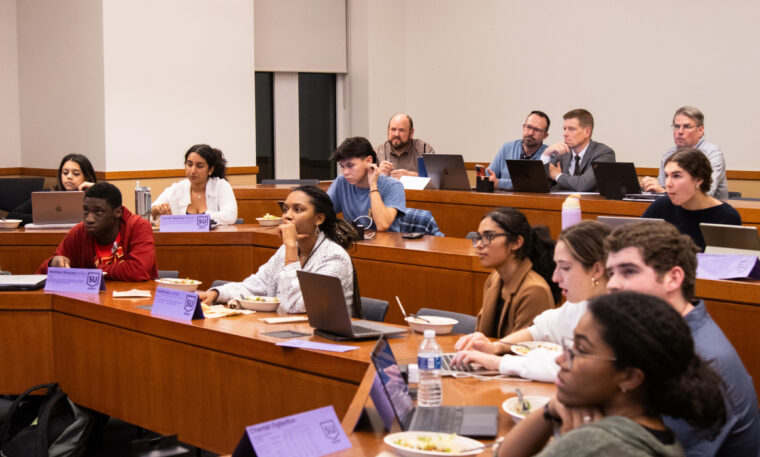
Student Union Senators meet with Dining Services administrators to discuss issues with campus food prices and meal plans. (Bri Nitsberg | Managing Photo Editor)
Student Union (SU) Senate released its dining survey report — titled “Where is My Money Going?’ Dining Services Costs and the Effect on Student Well-being” — on Nov. 21. The report highlights key issues with campus dining, including its financial strain on students, widespread dissatisfaction with food options and quality, and its broader effects on student well-being.
Two days before the report’s official release, senators presented its contents to WashU Dining Services administrators at an SU meeting. Dining administrators then fielded questions from SU representatives and shared potential plans to expand dining options and lower meal prices for the spring semester.
SU Dining Report Findings
The dining report was based on findings from an SU and Student Life survey distributed to the student body through posters, social media, and newsletters in late October and early November.
Notable findings from the survey include widespread dissatisfaction with the quality of meal services on campus. 96% of the 540 respondents rated the value of campus dining as “poor” or “very poor” when comparing the food’s cost to its quality.
Over 60% of respondents said that they skip meals weekly due to the high cost of meals, indicating that students might be altering their eating habits because of dining prices.
The survey also suggested that the high prices of meals may be affecting student well-being; 95% of respondents reported dining costs as a source of stress, though the vast majority of these students described the stress level as “slight” or “moderate,” rather than “high” or “very high.”
Additionally, 69% of survey respondents said they are likely to run out or have already run out of meal points this semester.
75% of respondents said that they would eat on campus more often if prices were lower, presenting an opportunity for dining services to encourage students to eat on campus.
The report also referenced dining plans at similar universities, including Tulane University, Emory University, and the University of Chicago. It noted that while Tulane’s meal plan cost is comparable to WashU’s platinum plan, first-year students at Tulane receive unlimited meals.
The unlimited number of meals that Tulane grants its first-year students prompted SU Senate to recommend that WashU adopt a similar plan and grant first-year students unlimited meal points.
The report also urged Dining Services to create a kosher meal plan because it would benefit students who keep kosher and currently have limited meal options on campus.
“These new plans could encourage a more inclusive approach to dining at WashU and serve as a model for other dietary accommodations, including halal, celiac disease, and vegan/vegetarian,” SU senators wrote in the report.
Other recommendations outlined in the report include reducing costs of meals, conducting a nutritional review of meal plans, and increasing dining options in the East End, among other recommendations.
Dining Administrators’ Response to SU
After several SU senators presented the dining survey report to Dining administrators, the administrators came to the front of the room and spoke to and fielded questions from SU representatives.
Greg Minner, Executive Director for University Services, told SU representatives that inflation rates over the past 18 months have posed challenges for dining services in setting prices for campus meals and meal plans.
James Dwyer, Vice Chancellor for University Business Services, told SU senators that Dining Services’ number-one priority is to reduce meal prices for the spring semester, though the exact meal prices have not been determined yet.
“Your [meal] points will remain the same, but now that value will go further,” he said.
Dwyer added that he hopes meal price reductions will alleviate student anxiety and concerns about having enough meal points to get through the semester.
Both John Ruppert — Resident District Manager for Sodexo at WashU — and Minner noted potential changes to dining options at Bear’s Den. They said they are collaborating with the campus nutrition specialist to improve the vegetarian, vegan, and gluten-free offerings on dining menus.
Additionally, they said they hope to have the salad bar open for lunch next semester and are looking at adding more affordable meal options at Cherry Tree — including a potential Taco Tuesday — as an alternative to the All You Care to Eat (AYCTE) program.
Senator Emaan Sayied asked the Dining administrators about expanding food options on the East End of campus to better accommodate students in Sam Fox and McKelvey who may be on campus late into the evening. In response to Sayied, Minner said that dining services hopes to meet with East End food vendors soon to discuss potentially extending their operating hours, particularly during finals and reading week.
Minner noted, however, that past assessments of the East End suggest that there is not a sufficient student presence there to justify a major expansion of food options or significant extension of operating hours in the area.
Junior and Speaker of the Senate Ella Scott wrote to Student Life after the meeting that she hopes administrators will make adjustments to dining options where possible. However, she said she remains skeptical that meal prices will actually decrease in the spring semester.
Junior and Senator Beni Bisimwa, who co-sponsored the dining survey report and is a member of the Dining Services Advisory Team, told Student Life that he appreciated Dining Services’ receptiveness toward SU’s and the student body’s concerns.
“I’ve appreciated the relationship that we’ve developed with Dining Services,” Bisimwa said. “As we [were presenting] the report, I could see them in the back, jotting down notes and everything.”
Bisimwa told Student Life that it is now up to Dining Services to improve dining options for students.
“The ball is in their court,” Bisimwa said. “They’ve heard our complaints this whole semester … [We’ll] see how they react.”
Additional reporting was done by Avi Holzman, Tanvi Gorre, and Elizabeth Stump.
Stay in Touch!
Get the latest and top news from StudentLife delivered to your inbox