News
WashU reckons with re-election

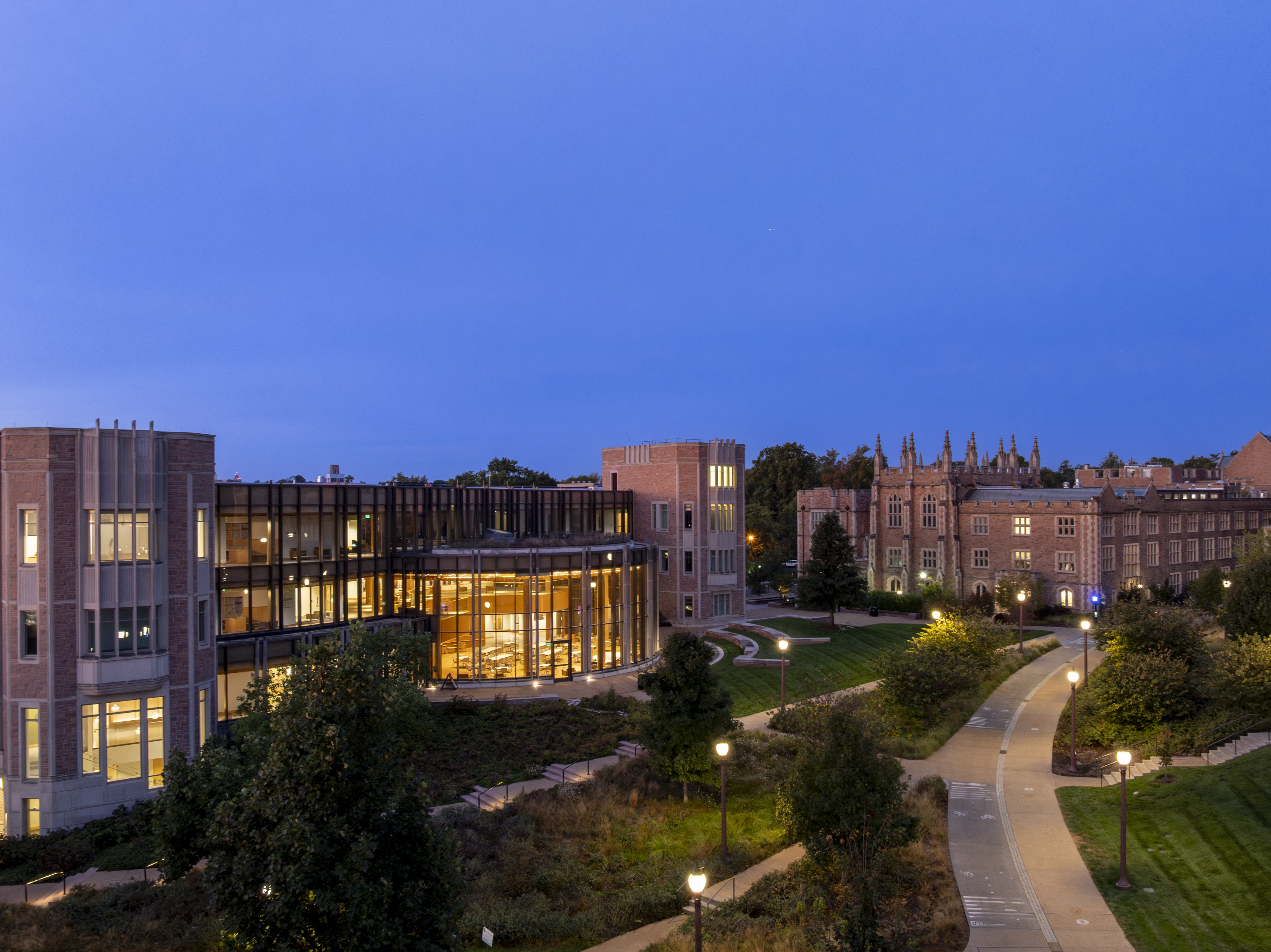
WashU community members were part of nearly three million voters in Missouri who cast ballots in the 2024 presidential election, with the state eventually going to president-elect Donald Trump. (Bri Nitsberg | Managing Photo Editor)
After president-elect Donald Trump secured a decisive victory in the presidential election on Tuesday night, many WashU students came to campus the next day grappling with the news and processing a wide range of emotions.
For some, Wednesday was a celebration of a strong showing by Trump. But for many students on WashU’s predominantly Democratic campus, the day was marked by sadness, fear, and uncertainty about the future of the country.
Katie Pope — a senior from California studying Psychology, Spanish, and Marketing — said she felt devastated by the election results.
“I actually went to bed early hoping I’d wake up for good news, because I just couldn’t handle it,” Pope said. “I woke up, and it was definitely not what I’d hoped for. It definitely gave me a pit in my stomach.”
Senior David Cui — a Computer Science and Math major from California — voted for Donald Trump, in alignment with his parents’ political preferences. He noted that his parents had examined each candidates’ policies more thoroughly than he had, and they ultimately decided that Trump’s policies would be better for their family.
“My dad’s a businessman and he used to be a rice farmer in China. Some of the policies that Kamala was fighting for would really devastate my dad’s business,” he said. He also noted that if he was financially independent, he likely would have voted for whichever candidate benefited his financial interests, while also weighing issues like environmental policy, gun control, and education.
Cui said he felt mostly indifferent upon hearing of the election results this morning.
“I feel a little more pleased that I think the new president can hopefully improve our nation,” he said. “I don’t know. We’ll see.”
Senior Elie Weitzman, a Political Science and History major from New York, was surprised that Donald Trump won the election by such a large margin.
“Watching all the early results come in and see Michigan and Pennsylvania swinging far more red than I thought they were gonna be was jarring,” Weitzman said. “I felt probably an irrational level of optimism going in [to election night].”
Although the final vote count has not been reported yet, as of Wednesday night, Trump has over 72 million votes compared to Vice President Kamala Harris’ 68 million, per the New York Times. Polling data prior to the election showed Trump and Harris in a dead heat.
Senior Ethan Holz said the election results showed him that living in a largely Democratic area had limited his perception of American politics.
“My reaction is like, wow, I have such little understanding of so many people,” Holz said. “Because I was just like, how is Donald Trump winning? I’m living in some sort of bubble where I can’t relate to so many people, and I just feel bad about that.”
Throughout the day, Holz found himself enjoying class discussions that feel like a departure from the doom and gloom that has permeated campus.
“Something externally is happening in the world, [but] there’s still so many things that I can do that affect my well being and how I feel,” Holz said. “It sucks. But it happened, it is the reality, and I’m not really willing to walk around sullen for days or weeks.”
Senior Aarav Dubey, who is originally from India but has also lived in California and Georgia, said did not vote because he didn’t want to support any candidate who “supports the cruelties occuring in Palestine.”
Dubey also expressed frustration with the Electoral College.
“The system feels unfair because unless you’re in a swing state, your influence on policy is severely compromised,” he said.
Similar to Holz, Dubey was struck by just how differently people viewed the outcome of the election.
“Some people think this means the end of the world, and some people think that democracy just got saved,” Dubey said.
Dubey said that following the 2016 election he “gave up on politics” and that he does not feel extremely impacted by the outcome of the 2024 election.
“I feel a little bad because people seem very influenced by it, so clearly it matters,” Dubey said. “I just think we overestimate how much influence we have on national politics and underestimate the huge impact we can have on the people around us locally, just by being a nice person and being in tune with local causes. So I think we should focus on little steps like that.
”In response to student reactions, some professors made the decision to cancel classes to give students the space to process their varied reactions to the election outcome.
Lucas Drummond, a lecturer at the Sam Fox School, knew ahead of time that he wanted to cancel his Wednesday class, no matter the outcome.
“I canceled my class prior to the election last week, knowing that regardless of the result it would be a valuable time for space and reflection,” Drummond wrote.
Professor of Biological Anthropology David Strait, who teaches Human Evolution, made his class optional and uploaded his lecture in advance.
“My reasoning was simply that I knew that elections can be stressful and also that some students would want to stay up late to watch the returns,” Strait wrote. “I told students about the video before we knew who the winner was.”
After an emotional night watching the election results roll in, Wolfram Schmidgen, a professor of English, found himself asking if he should teach class.
“This morning I thought, am I going to even go in? I mean, am I going to teach?” Schmidgen said. “But I felt like it would actually be more important for me to be there with [students] to talk about this, rather than stay away and avoid conversation.”
Schmidgen led a conversation in class, Secret Life of Things, to connect the outcome of the election to literature. He remembers other times in his career when he made similar decisions to bring current events into the fold rather than shy away from them.
“I remember teaching a Jane Austen class and it was the day that we attacked Iraq,” he said. “I felt that day too that I couldn’t just teach Jane Austen, so I walked in and actually talked about war and whether Jane Austen is, in fact, a kind of escape from that.”
Going into class on Wednesday, Schmidgen admitted that he was nervous because the election is a sensitive topic, acknowledging that there may have been Trump voters in the room.
“I also didn’t know whether there would be willingness among students to take the courageous step to actually talk about it,” he said, noting that students actively participated in the conversation. “I was surprised by how emotional I was, but I just wanted to open it up.”
Stay in Touch!
Get the latest and top news from StudentLife delivered to your inbox