News
JSP asks University to prevent displays of “Israeli nationalism” on one-year anniversary of Oct. 7
WashU Jewish Students for Palestine (JSP) emailed administration asking for the limitation of displays of “Israeli nationalism” on the one-year anniversary of Oct.7. In the email, which was sent last week and posted on Instagram last night, JSP said that the displays will negatively impact students’ ability to mourn.
“A sanctioned display of Israeli nationalism on campus would function as propaganda for a belligerent occupying force that we, as Jewish students, in alignment with the vast majority of the people of the world, condemn for its crimes against humanity,” the email states.
Junior Max Schreiber, a member of JSP’s executive board, said “Israeli nationalism” could look like Israeli flags lining Brookings Quad or Mudd Field. He called on the administration to recognize the potential harm to students who are mourning those who died on Oct. 7 or afterwards.
The email, signed by JSP, was addressed to Associate Vice Chancellor and Dean of Students Rob Wild, Executive Director of Campus Life Stan Sweeney, and Campus Life Coordinator for Diverse Communities and Group Development, Jacob Goedde. JSP explained that a flag display would imply support of the entire University for Israel, which they say should not be granted given what they describe as the country’s “ongoing genocidal campaign.” The display, the email states, would also “alienate and ostracize” many students on campus.
In response to an email from Student Life, the University did not indicate whether or not Mudd Field has been reserved by any group on Oct. 7.
In an email to Student Life, Wild wrote, “The University allows recognized student groups to reserve space and organize events on the Danforth campus in accordance with our policies.”
Chabad Board Co-President, sophomore Matthew Isaacs wrote, in an email to Student Life, that he was “deeply concerned” by the JSP statement.
“I believe JSP has grossly mischaracterized Israel’s war against barbaric terrorism,” Isaacs said. “As a Jewish student who is proudly and unapologetically Zionist — or even simply as a human being — I cannot overstate the importance of honoring the tragic loss of innocent Israeli lives on the one-year anniversary of this brutal act of terror.”
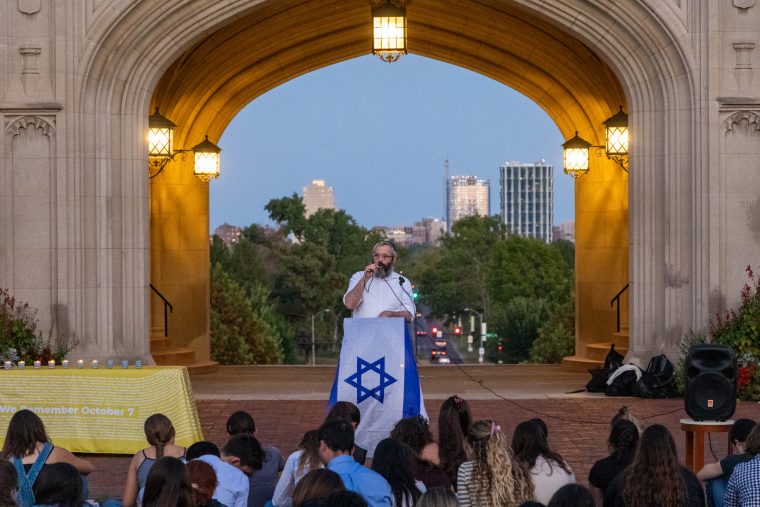
Hours after JSP’s initial post, the Jewish Advocacy Council (JAC) responded in their own post that an upcoming vigil on Oct. 9 is meant to honor the victims and remember the hostages taken on Oct. 7. They also emphasized that organizers for the event have worked to “ensure the event follows all Campus Life regulations.”
The JSP email, which was sent to administration before the vigil was announced, argues that allowing any event that contains forms of “Israeli nationalism,” whether it be the vigil or something else, would also be overlooking Israel’s actions since Oct. 7.
“This type of display serves to legitimize the subjugation, occupation, dehumanization, and genocide of Palestinians,” the email states. “This use of space neither correctly represents the University community nor makes the campus a safe environment for all members of its community.”
In the email, JSP describes how restrictions were placed on pro-Palestine demonstrations last semester due to student safety concerns.
“Memorials that are explicitly supporting the state of Israel and its violent response to Oct. 7 make other students feel unsafe, having lost loved ones to the actions of the state,” the email reads. “We insist that the same consideration be applied to any demonstrations memorializing the Oct. 7 tragedies.”
Schreiber acknowledged that WashU is a private institution and that even though there are policies on demonstration and the use of campus facilities, administration can use their judgment when it comes to enforcement.
The email said that a Nov. 27 event last year, in which chairs were set up all day on Mudd Field to commemorate the hostages taken on Oct. 7, should not have been allowed by the University because it took place in a communal space for an extended period of time.
“If the University were to sanction an event like that of Nov. 27 to take place in October 2024, not only would it further reinforce the invalidation of pro-Palestinian voices on campus, but it would also significantly diminish our ability to grieve on our own terms.”
According to Schreiber, administrators have never acknowledged JSP’s concerns and he is doubtful they will do so regarding this email. He wants the University to apply policies equally among groups especially on and around Oct. 7.
“We hope the University will consider the impact that [it] has and give equal space and equal representation to different groups,” Schreiber said.
This Article was updated at 8:45am on October 2nd to highlight that the JSP email was not sent in response to the announcement of the October 9th Vigil.
Stay in Touch!
Get the latest and top news from StudentLife delivered to your inbox