News
Discussion about shared humanity and North Sentinel Island
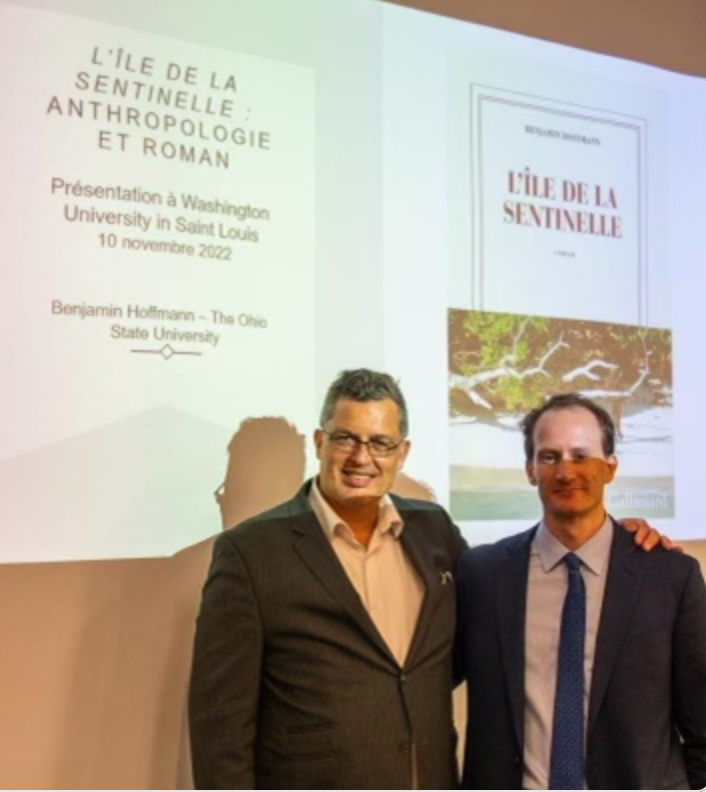
Lionel Cuillé (left) and Benjamin Hoffmann (right). Photo by Jimmy Hu.
Benjamin Hoffmann, associate professor of French from Ohio State University, discussed his recent novel, “L’Île de la Sentinelle,” that celebrates the utopian values of a shared humanity anchored to the destiny of the North Sentinel Island and its people, the Sentinelles, Nov. 10.
With about two dozen attendants, the event hosted many native French speakers or students majoring or minoring in the language. The event took place in French, and was sponsored by Professors Lionel Cuillé, Director of the “French ConneXions” at the University aiming to “promote and interpret Francophone culture in all its diversity,” and Tili Boon Cuillé of Washington University’s French Department as a part of Tili Boon Cuillé’s seminar on Utopian Fiction.
“L’Île de la Sentinelle,” or the North Sentinel Island, is one of the Andaman Islands, an archipelago of India. The Sentinelles, an indigenous people who live on the Island, voluntarily isolate themselves and have actively defended their isolation from the rest of the world.
The novel features two protagonists, Krish, who is an anthropologist emigrated from India, and Markus, an inheritor of fortune involved in the art market. Despite their differences, the two have a united interest in the Island and the Sentinelles. Ultimately, the protagonists find the same humanity in the Sentinelles that were denied by hundreds of years of unjust discrimination and beastly portrayals of the indigenous group.
Hoffmann began by placing the story in the larger historical context of British imperialism in India, and in turn, Indian exploration of the Island, shrouded in a mystery difficult to comprehend by the rest of the world.
“No one knows from where [the Sentinelles] are from, what language they speak, what beliefs in which they profess,” he wrote for the introduction of the novel. Their lives seem to be “nomadic” and “aboriginal,” and they have taken advantage of the remoteness of the archipelago to achieve an “insularity” from the outside world.
Hoffmann explained that the Western dehumanization of the Sentinelles goes back many centuries.
“An example of this contact between the Sentinelles and the Occident is characterized by the account from the late 13th century of Marco Polo, who said that these people live like beasts, without being governed by laws…these are ferocious people who devour all,” Hoffmann said.
The Island surfaces as well in Sir Arthur Conan Doyle’s “The Sign of Four,” an 1890 novel featuring Sherlock Holmes as the protagonist.
Holmes, according to Hoffmann, extends his “condescension” to the indigenous people, characterizing them as “ferocious” and “morose” with a “middle-sized body” that truly makes them the “small ones of the Earth.”
Beyond the realm of literary endeavors, British Administrator Maurice Vidal Portman also demonstrated these prejudices a decade earlier in his anthropological work on the Andaman Islands, portraying bizarre, erotic portrayals of kidnapped natives that satisfied his sexual appetite.
“The final objective of Portman’s work is to situate the Sentinelles at the bottom of the ladder of humanity,” said Hoffmann.
He named three types of prejudices that the rest of the world has held against the Island and the Sentinelles: being a place of exotic nature, of physical permanence, and of cannibalism.
“The Island is represented as an exotic place of adventures of danger, and as a situation beyond the reach of history as if the Island is a place that has never changed or evolved,” said Hoffmann.
Beyond the principal thread of the encounter with the Sentinelles, Hoffmann also used the dichotomies of the protagonists’ characteristics to foreshadow the interactions between them and the indigenous peoples.
“A duality serves as the basis of the text, and through recounting the history of these episodic relationships between the Sentinelles and the rest of the world, [the book] sublimates in merging the duality together at its conclusion,” Hoffmann said.
Hoffmann also mentioned the significance of the element of childhood in his novel.
In one of the novel’s excerpts he read to the audience, Krish reflected on the power of connection within humanity as he looked at a baby of the Sentinelles, “because this child — he is me and he is you as well.”
“This universalist sentiment which I talked to you about — it is built in the novel on the emotion and the tenderness for childhood — [looking at the baby] provokes, from my point of view, a sentiment of belonging to the shared humanity, by [generating] the sympathy and the tenderness while having the extreme fragility [of the baby] in conscience,” Hoffmann said.
In concluding his talk, Hoffmann emphasized the importance of “respect” and “compassion” with regard to how the world should regard the Sentinelles. He also hopes, with this novel, to fundamentally change the world’s mindset toward those who choose to seclude themselves — to see them as equal and to render them the long-lost respect rightfully due.
“The objective of my novel is, in a certain way, to go from the faraway representation that perpetuates the prejudice that we see [in the past], to another representation in which we recognize in [the Sentinelles] ourselves, and their belonging to the shared humanity,” Hoffmann said.
Stay in Touch!
Get the latest and top news from StudentLife delivered to your inbox