Administration | News
How Wash. U.’s administration is structured, explained
Over the past few years, Washington University has seemed to appoint individuals to new administrative positions with increasingly complex titles. For example, Rob Wild serves as both vice chancellor for student transition and engagement and dean of students. These new titles, which are updated with the evolving needs of the University, are integrated into the administration’s generally vertical chain of command.
The University’s organizational hierarchy can be simplified to at least five levels, which consists of chancellor, executive vice chancellors, vice chancellors, associate vice chancellors and assistant vice chancellors.
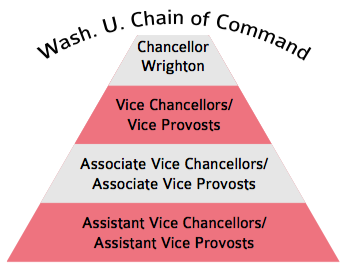 Graphic by Josh Zucker
What is the chain of command?
Chancellor Mark Wrighton effectively serves as the University’s chief executive officer, and he is responsible for all University operations.
The chancellor is advised by his executive vice chancellors, who manage broad sectors of the institution.
“There are four executive vice chancellors: One for medicine (the executive vice chancellor for medical affairs), one for academic affairs (which is also the provost), one for alumni and development affairs and one for administration,” Executive Vice Chancellor for Administration Henry Webber said.
Vice chancellors lie below executive vice chancellors in the organizational hierarchy. Vice chancellors have responsibilities for specific administrative functions, such as human resources or student affairs. Although most of the vice chancellors report to one or more executive vice chancellors, there are a few who report directly to Wrighton.
While associate vice chancellors act as deputies to vice chancellors, assistant vice chancellors are one step further down, with less authority than associate vice chancellors.
“Generally speaking,” Webber said, “associate vice chancellors have a broader span of control, with larger areas under their control and influence, than assistant vice chancellors.”
On the academic side, there are vice provosts, associate vice provosts and assistant vice provosts. Their duties largely correlate to those of the chancellors’, but exist in the academic realm which includes, but is not limited to, admissions, graduate education and libraries.
Why do some administrators have two titles?
“Chancellor” titles primarily focus on administrative capabilities, and “faculty” titles are reserved for academic roles. However, individuals can assume both administrative and academic responsibilities with the appointment of both “chancellor” titles and “faculty” titles.
For example, Provost Holden Thorp is both the executive vice chancellor for academic affairs and the provost. The former title involves administrative duties and a functionality as the University’s chief academic officer. The latter title indicates his involvement in the academic side of the University’s operations.
“I don’t see [the two titles] being any different. It’s just a longstanding convention. For people who look it up, finding out that I’m the executive vice chancellor helps them understand that I’m in the group of the most senior officers that report to the chancellor,” Thorp said.
Customarily, if a member of the staff or faculty retains two titles, the titles are related to each other in subject and inherently interact with each other. The titles are kept separate merely to reflect different sides of the overall operation.
Do titles affect the general operation of the University?
Although the University maintains a hierarchy for organizational purposes, Webber believes that the administration is more collaborative than hierarchical.
“There’s a lot of autonomy to senior decision makers here [at the University]. I would say it is relatively flat organization, and I think most universities are,” Webber said.
Thorp agrees that the hierarchy at Washington University isn’t particularly rigid but believes this differentiates the University from its peers.
“It sure seems like [there is a hierarchy] from all the titles,” Thorp said. “But this is a very porous administration compared to a lot of our peers.”
Thorp wants the communicative nature within the administration to also be accessible to students. He encourages students to share their thoughts with members of senior leadership, either directly or through a student representative to the board of trustees.
“I don’t think the students here take advantage of the fact that there are four students going to the board meetings,” Thorp said. “Students should share things with them; that’s what it’s for.”
Even though administrative titles are getting more complicated, administrators believes the system itself is becoming less complex.
Editor’s Note: This article has been updated to reflect Rob Wild’s titles with accuracy.
Stay in Touch!
Get the latest and top news from StudentLife delivered to your inbox