News
J Street U at WashU speaker criticizes Israeli government, policy on Palestinian village
J Street U at WashU and Hillel joined with the St. Louis Central Reform Congregation Saturday to host an event during which prominent activist and Rabbi Susan Talve called on the Israeli government to not allow the demolition of the West Bank Palestinian Village of Susya, which is an issue the Israeli Supreme Court is currently considering and will release a decision on Nov. 15.
Talve, who’s known for her social activism in areas of race, gender and religion, urged the importance of connecting with younger Jewish students to change mainstream Jewish-American discourse. Her remarks from this weekend are her first public comments on the topic of Susya and mark a bold departure from mainstream Jewish-American thought, which tends to support the Israeli government’s actions.
 Courtesy of Brent Efron
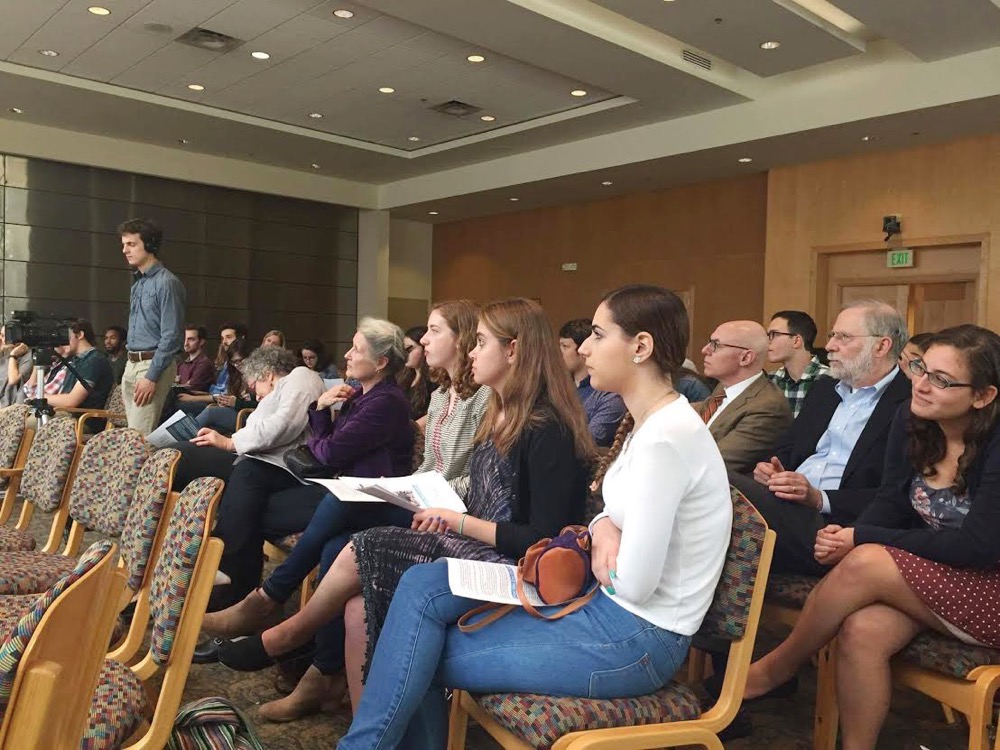
Students and community members listen to activist and rabbi Susan Talve speak on the Israeli government’s relationship with Susya, a village in the West Bank. Around thirty Wash. U. students attended the event.
“I do love Israel, and I believe that the way to ensure Israel survives and continues to be a dynamic place for the Jewish people and a light to other nations, is to stand up against the injustice of this [Israeli] government,” Talve said at the event. “And I probably would not have been able to stand here and say that today had it not been for these young people who cared enough to come and say ‘we’re not just going to sit at Wash. U. and complain, we’re not just going to sit at Wash. U. and take sides.’”
J Street co-chair and junior Brent Efron noted that Talve’s speech caused reactions not just in the St. Louis community, but around the United States.
“If you look on Twitter you can see that there [wasn’t] just people in St. Louis tweeting about this event, there were also people in Boston, San Francisco and other places around the U.S. tweeting about this. It was a big deal,” he said.
Efron’s co-chair Maureen Flaherman added that the interest may have been a result of the strength—and significance—of Talve’s message.
“Rabbi Talve is really powerful and it doesn’t really happen basically ever that leaders of the mainstream American Jewish community speak out against Israel’s occupation or are willing to criticize any of Israel’s policies,” Flaherman said. “It’s really, really rare.”
Despite the novelty of Talve’s sentiment, the idea that the Israeli government should be criticized for its actions is growing in popularity among many college students, according to Flaherman.
“A lot of times in the American Jewish community, Israel is a really polarizing issue between generations where younger people are a lot more critical and older people are afraid to be critical,” she said. “I thought [Talve’s speech] made a big statement that this is something young people care about, and that if older people want to include younger people in the Jewish community they need to care about it too.”
Around 30 students and 20 community members attended the event, numbers which Flaherman said made the event a success.
“I think it went really well. We got a lot of student turnout, including people who hadn’t really been involved in J Street [U at] WashU before and who were really excited to be there,” she said. “For us it’s just so exciting that Rabbi Talve would do this, and even just the fact that it happened is really amazing, and everyone I spoke to seemed to think it was a really powerful event and they seemed pretty moved by Rabbi Talve’s speech.”
Editor’s note: This story has been updated to reflect Talve’s criticism of the Israeli government as a whole, the expected date of the court decision and to clarify these are Talve’s first comments on the topic of Susya specifically.
Stay in Touch!
Get the latest and top news from StudentLife delivered to your inbox