News
CS40 speaker discusses ‘No Land’s Man,’ race, ethnicity in media
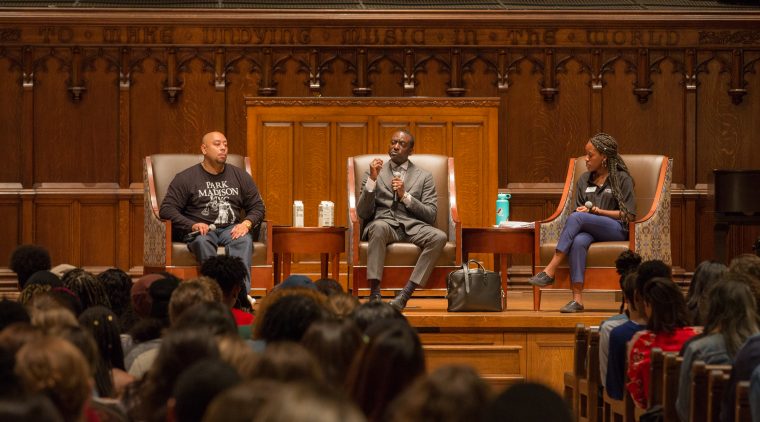
Aasif Mandvi, an Indian-American comedian known for appearances on “The Daily Show” and HBO’s comedy series “The Brink,” discussed his new book “No Land’s Man” and the representation of minorities in Hollywood at the annual Congress of the South 40-sponsored lecture on Oct. 29.
Mandvi read selections from his book focusing on his experience as an immigrant and being a minority in Hollywood.
 Marvin Lee | Student Life
Author and actor Aasif Mandvi speaks in Graham Chapel as part of the Congress of the South 40 Fall Speaker Series. Mandvi spoke about his new book, “No Land’s Man,” which explores his identity and how it relates to college students.
The first selection, “International House of Patel,” discussed his immigration and his father’s idealization of America’s plentiful resources. In the second section, Mandvi described the single moment when he heard about his parents displaying affection for each other, which he explained as an uncommon action among non-Western parents.
Despite his success as an actor and producer today, Mandvi said when he was younger, he initially had trouble imagining himself in Hollywood. He recounted times when he was only able to see white actors. However, seeing Omar Sharif, the Egyptian actor who played Yuri Zhivago in “Doctor Zhivago” in movies convinced Mandvi that people who were not white could also become successful actors. Mandvi added that meeting Sharif coincidentally was one of the most special times in his life.
“Especially as a minority, when you see someone who looks like you [on television], it allows you to have a sense of possibility,” Mandvi said.
CS40 speaker and sophomore Gabby Bloom said the organization chose Mandvi as the lecturer for CS40 week because he addressed his identity and how it influenced his experiences as an actor.
“I hope that those who attended have a greater understanding of the multidimensional nature of identity,” she said.
After the talk, Mandvi held a question and answer session to interact with students. Mandvi acknowledged that, even today, he feels like television shows have to be geared toward white audiences.
Freshman Katie Balfany enjoyed the lecture and felt it helped emphasize why having minorities play roles in media is important.
“I loved seeing Aasif in person. I’ve seen a lot of his work, so it was really cool to see the guy behind the character on ‘The Daily Show’ and some of the other things I’ve seen,” she said. “I also think Aasif is a prime example of why we need to worry about representation in media and pop culture of all different kinds of groups.”
Stay in Touch!
Get the latest and top news from StudentLife delivered to your inbox