Campus Events | News | Politics
Salaam and Santana speak about mass incarceration, systemic racism
Yusef Salaam and Raymond Santana, two members of the Central Park Five—renamed the Exonerated Five—spoke in Graham Chapel last night as the Congress of the South 40’s fall speakers.
Salaam and Santana, along with Korey Wise, Kevin Richardson and Antron McCray—Black and Latinx teenagers between 14 and 16 years old at the time—were wrongfully convicted of raping a white woman in 1989 in New York City. Salaam and Santana served nearly seven years and five years, respectively, in prison before being released in 2002 after the rapist came forward.
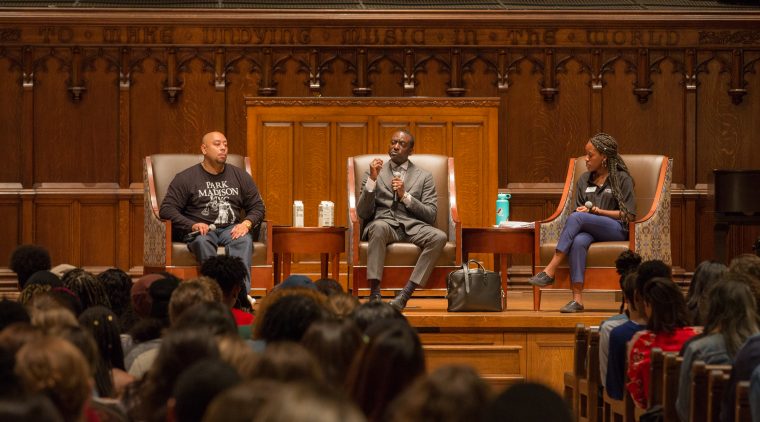 Photo by Curran Neenan
Congress of the South 40 Speaker sophomore Ola Adebayo led a discussion with the two men. They spoke about their personal experiences through the case while also focusing on larger issues of systemic racism and the prison-industrial complex, as well as telling attendees what they can do to enact social change.
“The man that I am today and the platform that we’ve been given and the duty that we’ve accepted, the responsibility that we’ve accepted, is powerful,” Santana said. “It puts us in the position to change the playing field, to finally plant those seeds, to change the system.”
The case has been the focus of a 2012 documentary by Ken Burns and, more recently, an Ava DuVernay-helmed Netflix series called “When They See Us,” which came out in May. Salaam said the series shows not only the experiences of the five wrongly convicted boys, but also what it means to be a person of color in the United States.
“The problem is that they looked at the color of our skin, and we were guilty and we had to prove ourselves innocent,” Salaam said. “As opposed to what the system states: you’re innocent until proven guilty. That’s where the challenge lies.”
The two speakers addressed the difficulty of overcoming stories or judgments that people make about people of color who are implicated in crimes, despite evidence that exonerates them.
“Once you believe a narrative, you can stay stuck on the narrative and you won’t let it go, for whatever your reason is internally,” Santana said. “At the end of the day, five lives have to pay for that, and nobody cared.”
A major focus for Santana and Salaam was the mass incarceration of people of color. According to the two, it’s driven by governments’ need for revenue.
“The criminal system of injustice has had a long history of locking our people up and using them based on budgets and numbers,” Santana said. “What we do now is we use our story as a tool to talk to you guys, because you guys are the cream of the crop. You are what the system wants to keep moving forward. You are the commodity.”
Though both men received college degrees, their difficulties didn’t end when they were released from prison. Because he spent much of his formative teenage years behind bars, Santana had difficulty negotiating life outside prison, where he eventually turned to dealing drugs and fell into the cycle of mass incarceration.
“For me, it’s the wrong decision, but at that moment I feel like I have another outlet,” Santana said. “I have nobody to turn to, so I succumbed to the pressure of just trying to be alive. From there, in my mind, I could understand that I’m going back to prison. I know it. It’s only a matter of time.”
After they spoke, Salaam and Santana took questions from the crowd, such as how students can get involved in social activism, where they see the state of racism in the U.S. today and what they think about the accuracy of the Netflix series.
“I really loved their candor, and I appreciated them being here and taking the time, not just at this very moment at Wash. U., but in essence of just stepping back into the spotlight in a moment they could have really decided, rightfully so, to live their lives for themselves,” senior Anaya Johnson said. “Their story for me is an encouragement that we can’t turn a blind eye and that we have to continue to hold people accountable and do everything in our power that allows for the system to be reconfigured.”
Twenty students—including Johnson and senior Jasmine Trotter—were chosen in a raffle to meet Salaam and Santana, get their autographs and ask them a question.
“It was amazing,” Trotter said. “All of the things they had to say were so insightful and the fact that they are using their voice and their platform to talk to students like us after all that they’ve been through—it was just an honor and I was honored to be in the room with them.”
Salaam and Santana ended the night by urging attendees and young people in general to vote and stay active on social issues.
“Most folks want to live in harmony and in peace,” Salaam said. “Most people want to realize that, even though I’m a child of a former slave owner or a child of a former slave, that moving into the future, we can do better.”
Stay in Touch!
Get the latest and top news from StudentLife delivered to your inbox