News
Jefferson’s books found in Olin
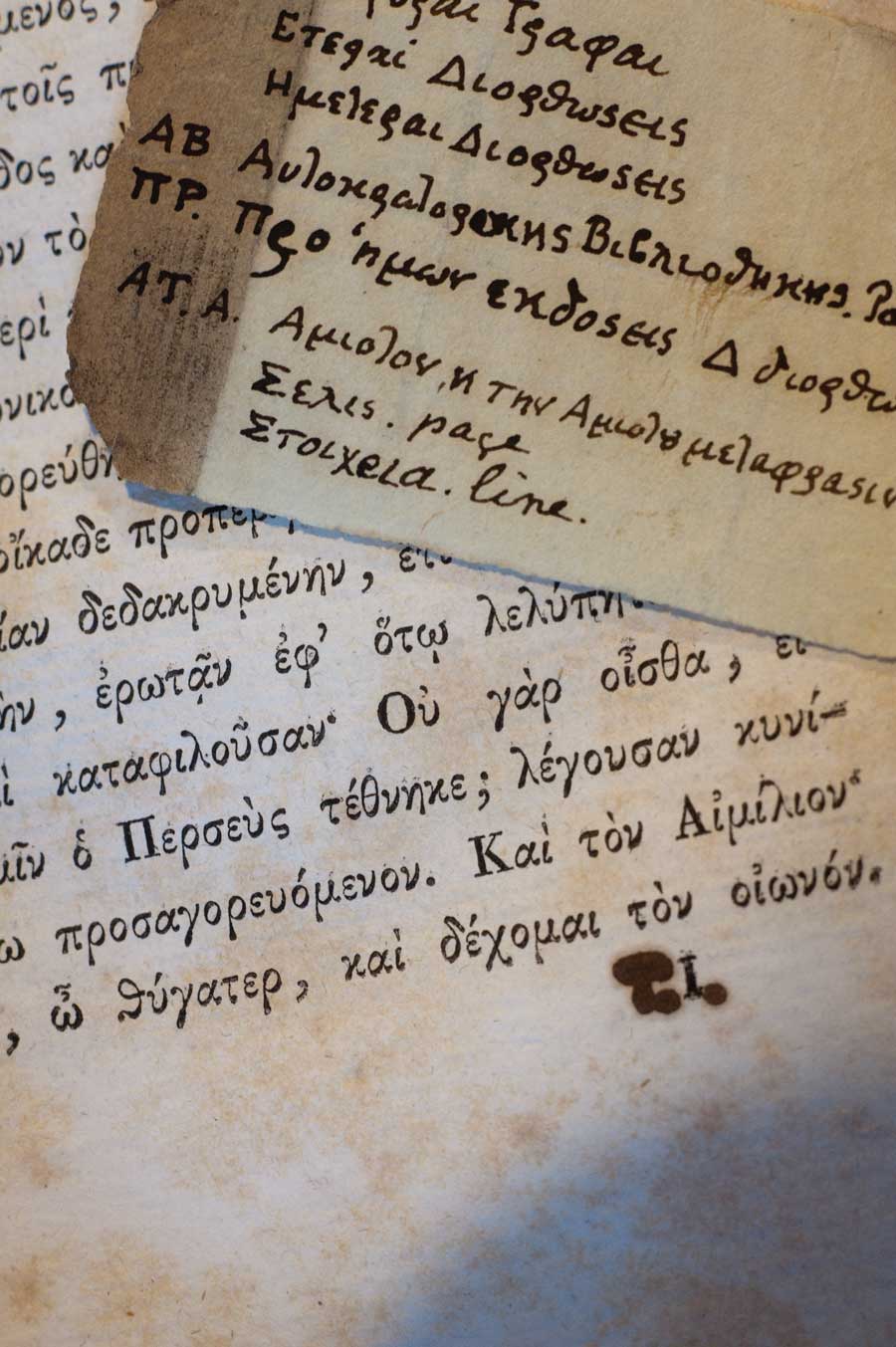
A piece of paper believed to have been written in Greek by Thomas Jefferson was recovered from inside of a copy of Plutarch’s “Lives.” The copy of “Lives” is also believed to have been owned by Jefferson, as indicated by the addition of a “T” before the books’ signature. On pages with a “T” in the signature, Jefferson would add the letter “I” since the I and J are believed to be alternative forms of the same latter in the Latin alphabet.
The discovery, consisting of 28 titles in 74 volumes, was made by Monticello scholars and announced Monday by the Thomas Jefferson Foundation and the University.
These books will be available in the Department of Special Collections in Olin Library. Students are welcome to come in to look at, or even pick up, the books.
“It’s a great opportunity for students and faculty here to come in and look at these books,” said Anne Posega, the head of Special Collections. “It will certainly pull in scholars from around the world who are interested in Jefferson.”
The books have resided in the library for 131 years and were tracked down by two Monticello scholars who were tracing the posthumous whereabouts of Jefferson’s book collection.
After Jefferson died, his family sold many of his possessions to pay for debts, but his granddaughter, Ellen Wayles Coolidge, asked to keep the books that eventually became part of the Washington University collection.
Coolidge’s son-in-law, Edmund Dwight, donated the books to the University in 1880, several years after her death.
“We don’t really know his connection [to the University]” Posega said. “The scholars are still trying to pin [it] down.”
Dwight was from Boston, and the scholars suspect that he had connections to William Greenleaf Eliot, a co-founder of the University. Both Dwight and Eliot graduated from Harvard University.
According history professor David Konig, who studies Jefferson’s legal works, the donation shows a commitment to education.
“What it shows is that his commitment to education was so strong that even his granddaughter and great-granddaughter were aware of it, and that they made sure they kept following this Jeffersonian legacy of support for education and gave this huge collection of books to a university rather than selling them,” Konig said.
The books in Olin are mostly classics, including ones written by Plato and Plutarch as well as some about history and architecture. They are written in English, French, Italian, Greek and Latin.
“These books were meant to be used in a college,” Konig said.
Jefferson marked each of his books with a small letter at the bottom of a few pages. When the books were printed, the publisher would put a letter at the bottom of a group of pages to indicate what order the group should be bound in. The letters used were “T” and “I.”
Jefferson would write his own T’s before the printed I’s and I’s after the printed T’s. He used I’s instead of J’s because that was the Latin form of the letter. He was effectively marking the books with his initials.
A small piece of paper was found in Jefferson’s copy of Plutarch’s “Lives” with notes that, scholars say, were written in Greek by Jefferson.
The Library of Congress and the University of Virginia are the only libraries with a larger portion of Jefferson’s collection.
Scholars are excited about the discovery, if only because it will allow them to learn more about Jefferson’s life and work.
“I certainly think it’s a big deal,” said Nick Miller, a graduate student in the English department. “Jefferson’s at the heart of conversations we have about politics, race and slavery. We’re getting a better sense of what he’s read and where those ideas came from.”
With additional reporting by Michael Tabb.
Stay in Touch!
Get the latest and top news from StudentLife delivered to your inbox