Campus Events | News | Politics
Student panel discusses Egypt conflict
 Paul Goedeke | Student Life
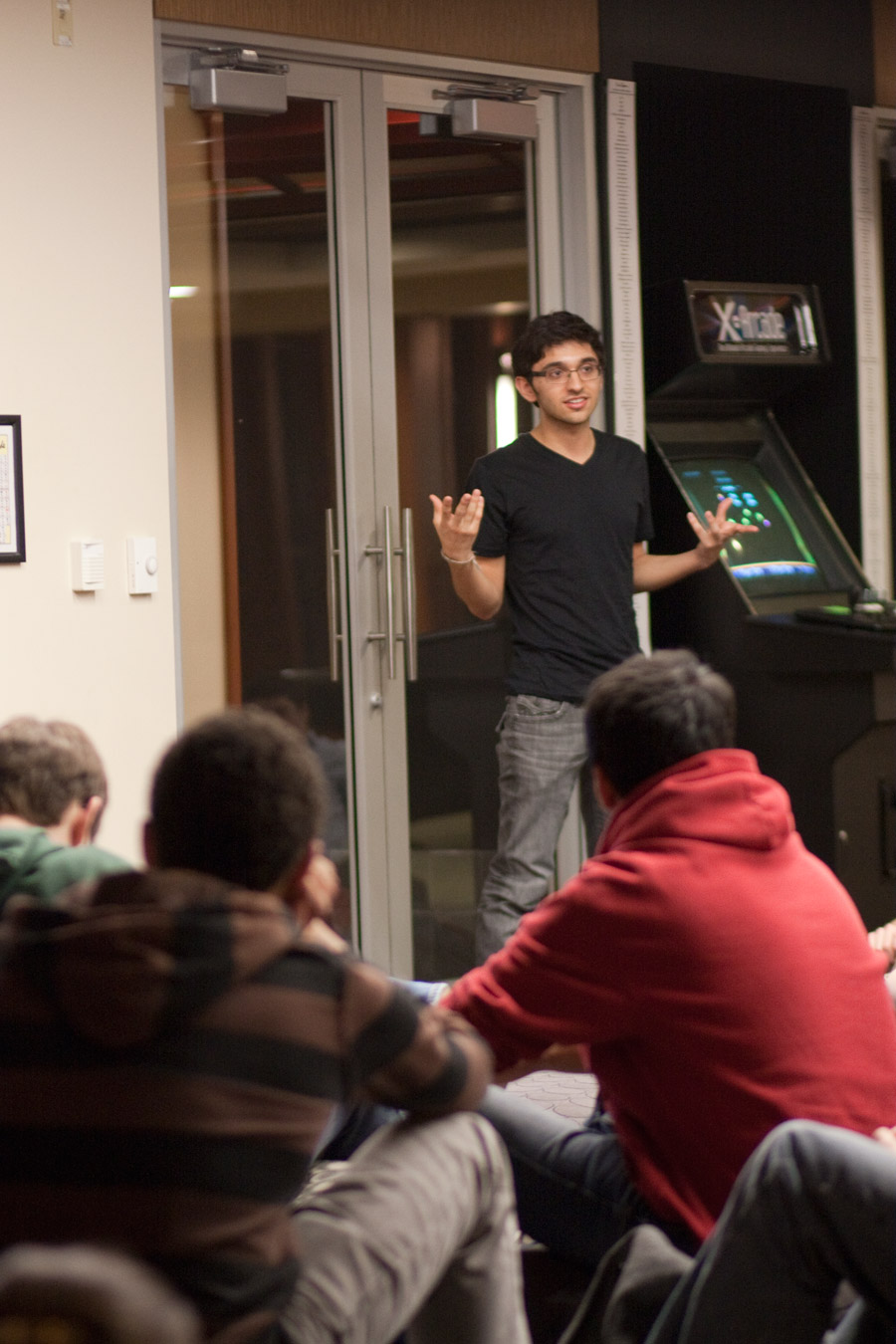
Junior Parsa Bastani tells students about his experiences in Alexandria as part of a panel on the current political climate in Egypt on Wednesday night.
On Wednesday night, around 80 students gathered in the Danforth University Center Fun Room to hear 20-year-old Amin Abu-Hashen participate in a panel about Egypt’s current political climate from Cairo.
The panel came less than 24 hours before Egyptian President Hosni Mubarak announced that he would not relinquish power.
Senior Nick Wilbar, co-editor-in-chief of the Washington University Political Review (WUPR), met Abu-Hashen, an Egyptian citizen, while studying at the American University in Cairo (AUC) last spring. Abu-Hashen was called from Cairo using Skype.
Wilbar joined Abu-Hashen and juniors Sarah Rangwala and Parsa Bastani as members of the panel, co-hosted by both WUPR and Controversy N’ Coffee (CNC). Rangwala spent last semester at AUC, and Bastani returned early from a semester abroad in Alexandria at the Middlebury School in the Middle East last week after the U.S. Department of State issued an order for all American citizens to leave the country.
Bastani offered the perspective of an American spectator before Abu-Hashen shared his experiences as a participant in the recent protests, which began Jan. 25.
The protesters’ grievances include various legal and political issues related to the government of President Hosni Mubarak, including police brutality, state-of-emergency laws, lack of free elections and free speech, food price inflation and low minimum wages.
Abu-Hashen said that most Egyptians he knows genuinely despise Mubarak, and that the protests have been inspirational for many citizens; however, he said that the violence has been difficult to stomach.
“It’s very tough to hear of people’s homes being forcibly broken into,” Abu-Hashen said. “It was very unsafe for a couple of days.”
Abu-Hashen said that he had also personally witnessed police using Molotov cocktails, a type of gasoline bomb, and civilians beating up the police in droves.
On Wednesday night, Abu-Hashen predicted that Mubarak would relinquish power. However, Mubarak announced in a speech Thursday afternoon that he would not leave office, enraging hundreds of thousands who had gathered in Tahrir Sqaure in Cairo to celebrate his resignation.
Mubarak also announced in the speech that he will delegate some authority to Vice President Omar Suleiman.
For the panel’s organizers, Abu-Hashen’s perspective—and the format of the event—allowed for a different kind of conversation about Egypt and the Middle East.
“It allowed us to talk with people who were there, Egyptian kids who participated in it,” Wilbar said. “Parsa stood to shed a lot of light on it because he saw it happen, but these Egyptian kids actually participated, they saw how meaningful it was to watch it unfold.”
Students who attended the panel found Abu-Hashen’s testimony meaningful.
“I’m a political science major, and especially after coming back from abroad, I try to stay more aggressive about international issues,” junior Michael Fletcher said. “Egypt is obviously a big deal. I didn’t realize how unsafe it had gotten…I knew protests were going on, but I naively thought they were more peaceful than this.”
Senior Nicole Lopez, who spent her junior year in Jordan, agreed.
“I’ve been dying to talk to people about this because I love the Middle East,” Lopez said. “You’re watching Tunisia, then you see these
massive protests in Egypt. I don’t have much contact with people inside of Egypt, so it was really exciting to hear what’s actually going on on a ground level.”
The uprising has generated conversation about Egypt among pundits and academics alike, including Ahmet Karamustafa, a professor of history at the University.
“The spectacular popular uprising is the clearest evidence that the autocratic rule of Mubarak and his associates is doomed,” Karamustafa wrote in an e-mail to Student Life on Thursday afternoon. “The cosmopolitan people of Egypt have shown that they are way ahead of their moribund regime. No matter what the outcome, it won’t be business as usual again in Egypt.
Stay in Touch!
Get the latest and top news from StudentLife delivered to your inbox