News
Washington University students attend the 2022 UN Climate Change Conference in a week-long trip to Egypt
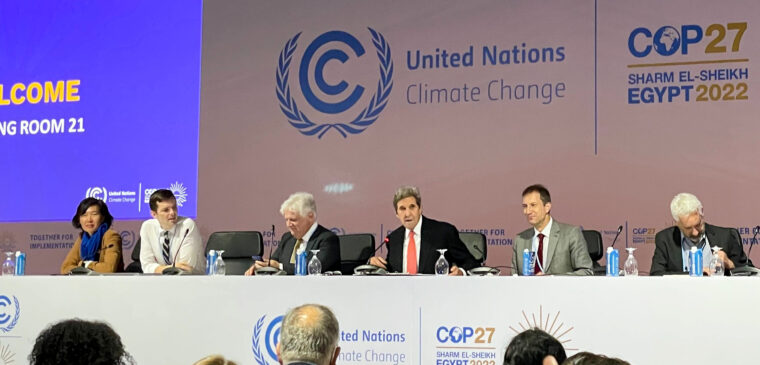
The 2022 Conference of the Parties summit of the United Nations Framework Convention on Climate Change (Courtesy of Shira Lyss-Loren).
Twelve Washington University students attended the 2022 Conference of the Parties summit (COP27) of the United Nations Framework Convention on Climate Change (UNFCCC) in Sharm el-Sheikh, Egypt, Nov. 6-18.
The International Climate Negotiation Seminar, a class held every Fall semester since 2016, prepared enrolled students to attend and observe the UNFCCC as a delegate of the University.
There are nine groups of NGOs or constituencies that have been granted observer status to the UNFCCC. University students attended COP as a part of the Research and Independent Non-Governmental Organizations (RINGO) constituency, the only non-advocacy group and the second largest constituency recognized by the UNFCCC.
RINGO serves to use “research and analysis to develop strategies addressing both the causes and consequences of global climate change,” hosting daily meetings while COP is occurring to discuss negotiation developments and any relevant information.
Senior Shira Lyss-Loren, a member of the University delegation to COP, described the opportunity to travel to COP as “one of WashU’s best kept secrets,” as she and other student delegates heard about the International Climate Negotiation Seminar by word-of-mouth.
“[COP] just felt like a very cool opportunity to get an international perspective on climate and also see how these solutions that I learn about in class are being implemented on a global scale,” Senior Dylan Fernholz-Hartman, who also attended COP as a delegate, said.
The International Climate Negotiation Seminar is a 3-credit course led by Teaching Professor in Environmental Studies and Interim Director of Washington University Climate Change Program Beth Martin, who also serves as a RINGO co-focal point.
Senior Ranen Miao, University COP delegate, described Martin as a “fantastic professor” and “incredible resource” given her extensive experience as a leader of the RINGO delegation.
“Because she’s gone to COP so many years in a row now she knows all these different people. She will be talking to us and an ambassador or a negotiator from another country will walk by and be like, ‘Hello Beth, good to see you,’” Miao said. “It’s so rare to have that incredible opportunity.”
While universities from all over the world attend COP, the seminar provides a unique experience for University students to learn UN climate history, politics, and jargon to better prepare to observe the development of international climate diplomacy through interdisciplinary discussions.
“You end up being a lot more informed than a lot of the other people there by knowing things like the acronyms, knowing the different agreements that are being referenced, knowing the different conferences that led up to the current point and the ongoing global tensions that may be contributing to different types of negotiating and diplomatic outcomes,” said Miao.
Lyss-Loren felt she was as prepared for the conference as possible.
“I think some of the things that I didn’t feel prepared for are inevitable, like the scale of the UN conference shocked me,” Lyss-Loren said. “I don’t think that any one semester can adequately prepare you for the UN jargon.”
To attend the conference, students were split into two groups of six, with each group attending a different week. Students were then broken into pairs to focus on specific climate-related topics such as agriculture.
On a typical day at COP, students rode an 8:30 am bus for a 9 am briefing, after which there was a long day of observing negotiations, writing reflections, and attending pavilion and side events. Observers spent 10 to 12 hours a day at the conference venue with the task of publicizing notes to make climate negotiations more accessible to the public.
Miao described the trip as “phenomenal,” and felt it was an “incredible journey” that provided an international space in which to learn about climate diplomacy and negotiation.
“Because you’re walking around, you’re seeing so much and you’re so overstimulated being in the space where so much is happening at one time,” Miao said. “I feel like there really wasn’t that much time during the day especially to really get to do anything recreational outside of just really immersing yourself in this incredible global negotiation and meeting all these amazing people.”
At COP, students had the opportunity to meet with influential global diplomats, presidents, secretaries, and UN student representatives from around the world.
“The people who you meet there are so interesting and so cool,” Miao said. “I was walking and standing in a lunch line and the person in front of me was a member of Parliament from Belgium, and the person behind me was the lead negotiator for the United States Department of Transportation.”
Lyss-Loren described that her “holy shit moment” was watching the UN document being edited live.
“I watched the UN decision get passed,” Lyss-Loren said. “The clapping was insane. It was very much a surreal moment.”
Fernholz-Hartman found the international community at COP to be valuable to his understanding of the climate challenges being faced by the rest of the world.
“People from every single country are represented in this conference, and you’re just in the halls with people from Africa and people from South America and all types of European countries, and to be in that international space as an American I think is so interesting and puts in perspective a lot the amount of work that has to be done,” Fernholz-Hartman said. “I just thought it was so valuable to speak to people from around the world, and listen to them.”
While Lyss-Loren took the LSAT last year with the hopes of becoming a lawyer, she said that the UN conference changed what she wanted for her future as she has a deeper understanding of the value of the private sector in the fight against climate change.
“I don’t think I saw the career that wasn’t law, and now I see where I can bring my passion and my skills in,” Lyss-Loren said. “I think the coolest part of the whole conference and my class was seeing that if we’re going to beat climate change, it is a hugely interdisciplinary thing…from the very local level all the way to the international governments, it really involves everyone from every sphere of the world.”
Similarly, Fernholz-Hartman described his future being shaped by his COP experiences. Shifting from an engineering background, he was persuaded to put more time into targeted outreach in education for youth, as well as furthering his studies of data science.
“This is an interconnected problem, and so if you only look at the problems by themselves, fixing one thing actually is a problem somewhere else, and so you need this more holistic look,” Fernholz-Hartman said. “[COP] made me want to go into politics actually: to potentially campaign, or be someone’s environmental advisor to help them talk about the environment and the scientific aspect and how it interacts with the equity aspect in a more coherent way.”
Fernholz-Hartman noted the low number of youthful attendees at COP.
“At COP there’s not a lot of young people, which I think is one of my biggest critiques would be that the youth perspective has no access to closed door negotiations, and over half of the negotiations are closed door,” Fernholz-Hartman said.
Lyss-Loren felt the conference provided a broader picture of how to best implement solutions to climate change.
“I think in the way that [COP] changed my perspective is I realize it’s less about individual actions, it’s not really about recycling and trashing yard waste, although it’s important,” Lyss-Loren said. “It’s about putting pressure on big hedge funds to divest from fossil fuels, divest from dirty energy. That’s what’s actually going to matter.”
Conversing on a personal level with important figures from around the world, Lyss-Loren described her “wow” moment as realizing just how “human” everyone was.
“There’s a barrier to accessing COP but once you’re in that space, there’s a networking and understanding of just how human everyone is that doesn’t exist outside of it,” Lyss-Loren said.
Lyss-Loren saw hope in the people she met, however acknowledges the institutional inefficiency she witnessed.
“After attending COP, the people that I met and the passion that I saw, and the number of things that are being done to deal with climate change in the private sector sphere and even in the government sector sphere, fills me with hope,” Lyss-Loren said. “But watching the UN negotiation process itself filled me with fear, because it’s so slow and it’s so political and I think we have all the right people doing the things but in the wrong way.”
Ultimately, the conference compelled her curiosity for the political systems of countries outside of the US.
“[COP] impacts what news sources I’m following…for me, that means for the first time ever when I’m reading things about climate I’m not reading it in CNN, I’m reading the local Botswana newspaper,” Lyss-Loren said. “We need to be listening to local communities about their issues and the problems that they’re facing, because the United States just saying ‘we think these are your problems, here’s fixes’ isn’t helping.”
Lyss-Loren believes the University should fund COP entirely for attending students to assure the program is “equally accessible” to everyone. Currently, the cost of attendance is partially covered by the Climate Change Program and need based support is accessible.
“The ability to just be there and all be humans that are waiting in line for the bathroom or waiting in line for food or just chilling outside of an event waiting gives you a level of access that I think requires more intentional diversity in the group that’s going,” she said.
Lyss-Loren described the trip as an “overwhelming experience” as it was constantly busy.
“I wish I had done a little bit more introspection around what I’m bringing to that space, my role in that space, and what I wanted to get out of it and for what reasons,” Lyss-Loren said. “I think there’s reflexivity that needs to happen before you even apply, and then before you go.”
Miao encouraged future applicants to understand in what way they want to engage in climate negotiations.
“It’s so much more than getting this trip to go travel somewhere,” he said. “It’s very much this incredible, life-changing opportunity to engage in this amazing international fabric of negotiation and collaboration.”
Stay in Touch!
Get the latest and top news from StudentLife delivered to your inbox