Campus Events | News | Uncategorized
Pushkar Sharma speaks on U.N. career, U.S. hegemony
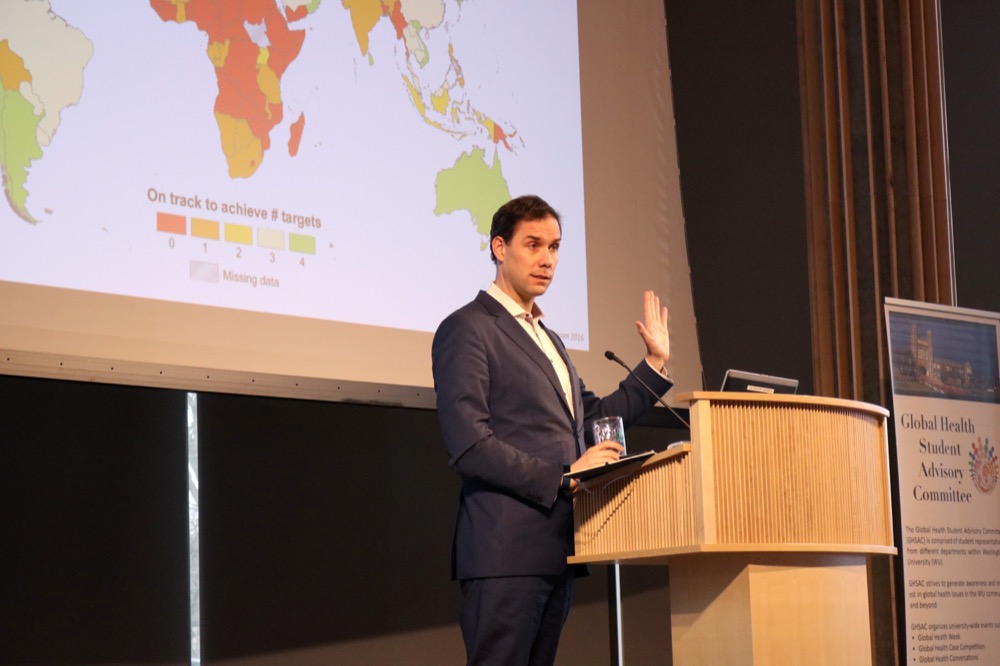
Writer and policy strategist Pushkar Sharma discussed his career in the United Nations and his views on the United States’ place as a global leader during the Gephardt Institute’s Meet the Leader series, Oct. 25.
Sharma, a Washington University alumnus, opened with a brief summary of his career path before fielding queries from a crowd of roughly twenty-five in Stix International House. The intimate setting in Stix’s sitting room allowed almost every student attendee to ask Sharma a question.
After graduating from the University in 2006 with a degree in International Studies and Drama, Sharma went to work doing statistical analysis for Pratham, an Indian educational NGO that was compiling a national database of educational outcomes. He worked with data gathered from going door-to-door to test children’s reading comprehension and arithmetic skills in the Indian countryside and urban centers.
“Within 30 seconds you could determine whether a student had reading comprehension or couldn’t read a letter at all,” Sharma said.
In 2008, Sharma accepted a job at the University in the International and Area Studies program, which was based in Stix International House at the time. Sharma then had a brief stint at the Bridgespan Group, a social sector consulting firm in Boston, before moving on to earn his Masters in Public Administration (MPA) from Columbia, focusing on international conflict resolution and human rights.
Sharma parlayed those skills into internships for the U.N. in Colombia and Myanmar while still in graduate school before embarking on a weeklong research trip to North Korea shortly after Kim Jong Un rose to power in order to see things from a North Korean perspective.
After finishing his master’s degree, Sharma moved to Jordan to study Arabic and began consulting for UNESCO to study the efficacy of the adult education classes it offered to refugees. Sharma then took a U.N. job in the Gaza Strip, facilitating humanitarian access for those on both sides of the Israel-Palestine conflict, an experience which he said was “indescribable.”
In 2014, while Sharma was stationed in Gaza, a war broke out between Israel and Hamas in the midst of Ramadan. Sharma remembers receiving a frantic call from his boss asking him to evacuate around 200 people from the heavily shelled areas they were staying in. Over the course of the day, Sharma and his colleagues wrangled together buses and cars to evacuate the fasting observers from the Strip. Sharma called the evacuation “the most important thing” that he has worked on.
After his stint in the Gaza Strip, Sharma joined the U.N.’s peacekeeping mission in Kosovo as the Special Assistant to the Special Representative of the Secretary-General. The mission consisted of “opening a political dialogue” between Kosovo and Serbia, who are involved in a “mainly rhetorical” conflict. His duties consisted of note-taking at meetings with high-level officials such as the Russian foreign minister and the UN Secretary General, as well as some more menial tasks.
“If his pillow wasn’t fluffy enough, or he wasn’t happy with his seat on the plane, I’m the guy he would call and say ‘Fix this right now,’” Sharma said.
After summing up his job experiences, Sharma fielded questions from the crowd, such as how his diplomatic experience informs his playwriting and poetry and how best to find jobs abroad after graduation. One student asked about the United States’ role in upholding a peaceful, and increasingly democratic, world order which Sharma called our “greatest post-war achievement.”
“It goes back to this idea of rules-based order and what rules matter and who has to abide by those rules,” Sharma said. “And more and more, you have powerful people, leaders in many countries saying ‘Those rules don’t apply to me.’”
Sharma pointed to the recent removal of U.S. troops from Syria as an example of the United States abdicating its role as an international peacemaker.
However, the hardest question, according to Sharma, was saved for last when Brett Hyde, the director of the Washington University Linguistics Department, asked Sharma what universities should be doing to help mold better people.
“With media as it is today, it becomes easier to get your blinders on and to say, ‘I’m doing my job, I’m working hard, my life is good, I deserve it,’” Sharma said. “Pat myself on the back and be comfortable and not ask questions. The much harder life is to ask those questions and to take those risks and put yourself in places that are uncomfortable or that are different to you, that are foreign to you. ”
Junior Candace Hayes, a Civic Scholar at the Gephardt Institute, originally came to the event to make up for missing one of her scholarship programs, but said the talk ended up being a “truly rewarding and eye-opening experience.” Hayes, a Sociology major on the pre-law track, said the talk sparked a new interest in international relations and assuaged some of her fears about going straight to law school.
“There’s a lot of legitimacy in going and working for a while and just figuring yourself out, figuring out your place in the world and how you can make the best impact,” Hayes said.
Gabriela Hall, a senior majoring in Systems Engineering, was already interested in foreign relations headed into the talk, and said it reinforced pre-existing beliefs they had about their career trajectory. Hall is looking to enter the foreign job market and said Sharma reaffirmed their “desire to look into less conventional next steps.”
“I think I’m okay with not doing the comfortable engineering job that is expected of me,” Hall said. “And that’s okay.”
Stay in Touch!
Get the latest and top news from StudentLife delivered to your inbox