Staff Columnists
A call for more collaboration in the humanities
Icome from a large extended family with a lot of engineers, and when I go home for holidays—aside from the usual queries about boyfriends and jobs—I’m generally asked a lot of questions about why I chose the majors I ended up with. When asked why I’m studying English, I generally respond by saying that I love literature, I like people and I’m interested in a career that involves a fair amount of written and oral communication.
This is a practical answer that attempts to justify the choice of an impractical major, but I think there are things within it that make sense. I am an adamant believer in the notion that the study of words helps us to relate to others, to understand our own positions, goals and desires—in short, to make sense of the world around us. But I also think that at Washington University, and no doubt at other elite institutions of higher education, that the model by which the humanities are taught has largely abandoned that higher purpose.
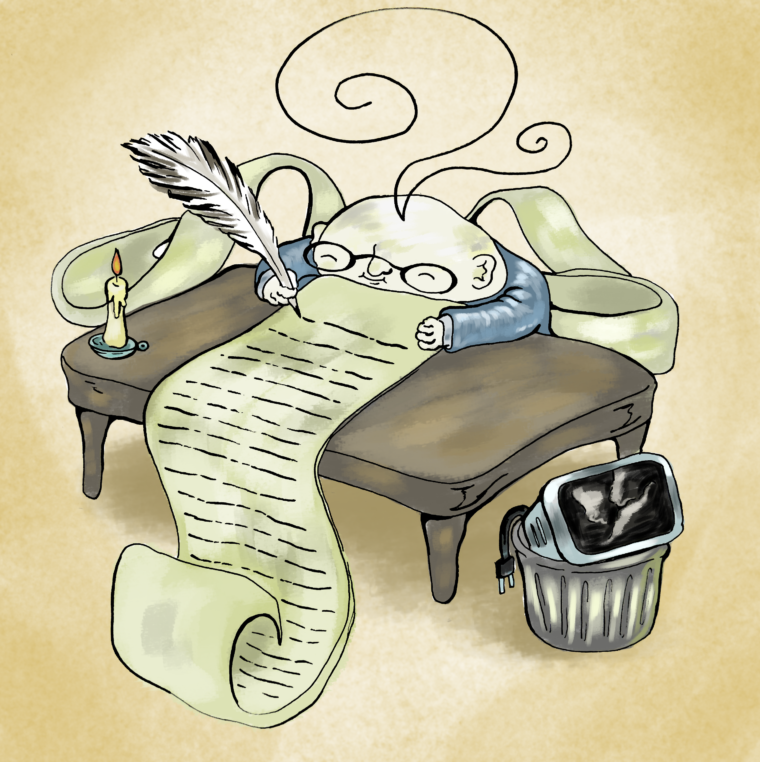
In any given literature class at Wash. U., student performance is evaluated primarily by papers—typically, five-to-12 page beasts that require a fair amount of thought and observation and ask for a coherent argument about the texts in question. Students here generally put a significant amount of work into these papers, often taking several nights in the library to write them. And oftentimes when I hear the theses of papers my friends have written, I’m blown away by their creativity, piqued with enough curiosity to want to read their papers and alter my own argument on the basis of what they’ve said.
But sharing our papers is not a model that we’re taught to abide by—in fact, I would imagine that the American university system pegs sharing your thesis with a friend who’s writing the same paper as some latent variety of plagiarism. We are taught, instead, to print our papers out and turn them in silently after expending hours of time and energy on literary analysis. Generally, the only person exposed to our work is a professor, and generally, we get it back with a few check marks, a letter grade and some fairly succinct comments.
And even if these comments weren’t succinct, we wouldn’t be able to do much with them: As soon as we get one paper back, we’re already thinking about how to write the next one. Despite the amount of thought and energy we’ve put into our analyses, we are rarely given room for revision or expansion—requirements that could broaden our understandings significantly.
The scope of what we discuss in class and write about, too, often means that we are not learning from what we read the way we could. As human beings, we’re inclined to read not because we want to look for an author’s technique or find obscure allusions in his work, but because we want to better understand our lives and the lives of those around us. We ought to be reading not for canonical or historical significance, but for meaning. We ought to be looking both inward at ourselves and outward at the world, not sideways at what a host of literary critics have already said.
I understand that at some level of higher education, solo research papers in the humanities may be necessary. For graduate students, it may make sense to perform a careful analysis of criticism. But at the undergraduate level, I would ask humanities departments at the University to consider changing their model of instruction by allowing students to write papers in groups or pairs, by focusing class discussions on the moral and ethical debates or on the emotional meaning contained within the texts and by shifting focus to expansion and revision of already-generated papers.
Perhaps that sounds easy, or perhaps it sounds soft. The humanities have tried for a long time to avoid being seen as soft by the hard sciences with whom they share a university. Let’s face it: Done well, the humanities aren’t easy to study, but they are, unavoidably, soft. The study of human meaning and purpose isn’t rigid, and I don’t see a problem with allowing it its softness.
Stay in Touch!
Get the latest and top news from StudentLife delivered to your inbox